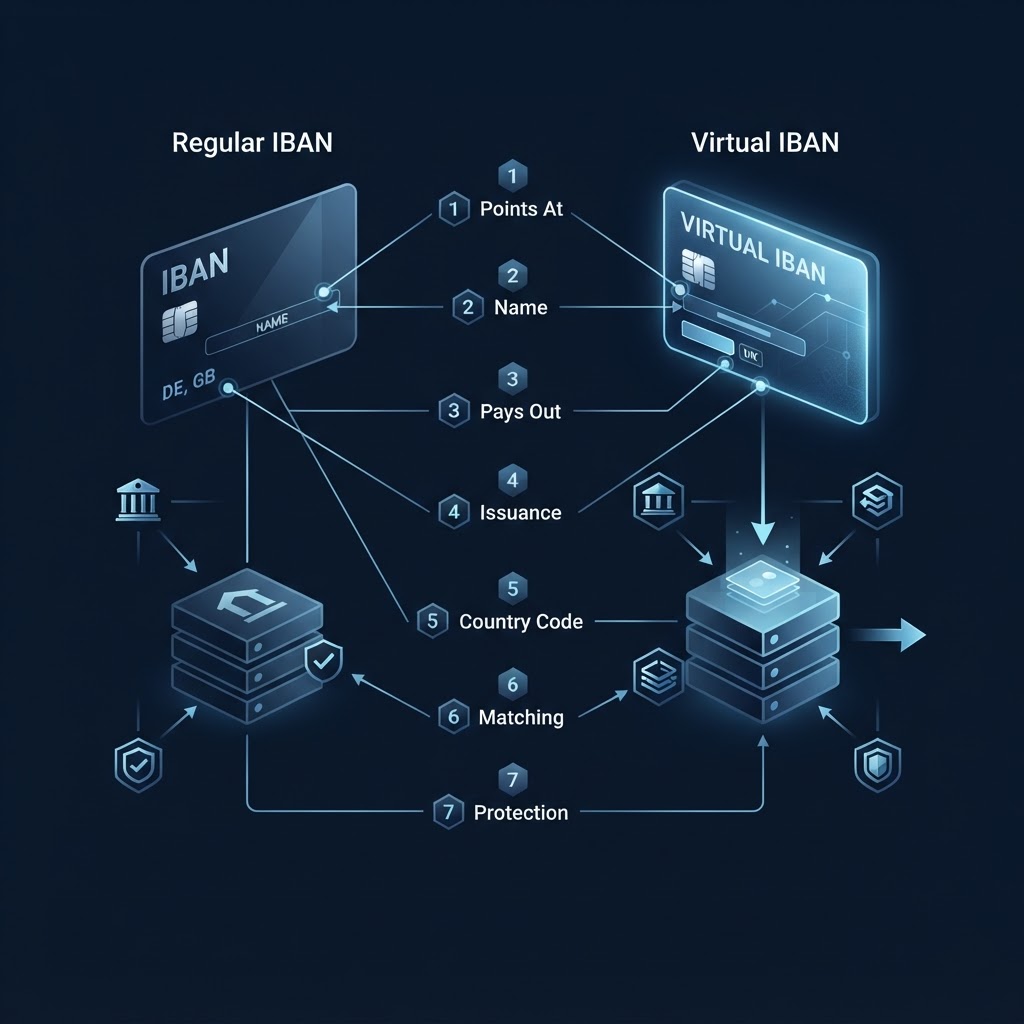
Ask a provider for the difference between an IBAN and a virtual IBAN and you will usually get one sentence: a virtual IBAN routes to a master account. True, and not enough. That one design choice changes seven separate things about how your business gets paid, what the payer's bank sees, whether the number can pay anyone, and what stands behind the balance if the provider fails. This page lists all seven, with the source for each. It starts with the part most explainers blur: what does not change at all. ## What does not change: the number itself A virtual IBAN is a real IBAN in every technical sense. Compliance firm Nasara Connect sets out the anatomy in its practical guide for UK businesses: the format is defined by ISO 13616, a two letter country code, two check digits, then a country specific Basic Bank Account Number of up to 30 characters, for a maximum of 34 in total. The check digits are computed with the MOD 97-10 method, so a mistyped or transposed character is caught before the payment leaves. A virtual IBAN keeps exactly that anatomy and passes exactly that validation. The European Banking Authority confirmed the same thing from the regulator's side. Its report on virtual IBANs describes a vIBAN as an identifier with the same format and functionality as a regular IBAN, and notes that to third parties it is typically indistinguishable from one. When your client pays you, their bank cannot discern that the identifier is virtual and will not know which master account the funds end up in. So every difference below sits on the receiving side, in what the provider does once the payment arrives. The payer never sees any of it. That is precisely why you have to ask. ## The seven differences between an IBAN and a virtual IBAN ### 1. What the number points at A regular IBAN has a one to one relationship with a physical account that sits in a clearing bank's core ledger with its own balance, in the words of infrastructure provider Newrails' comparison of virtual and traditional IBANs. A virtual IBAN is a programmatic proxy that points at an underlying pooled account. The EBA's version is more precise. The vIBAN is linked to a payment account it calls the master account, that master account has its own IBAN which is different from the vIBAN, and every incoming payment addressed to the vIBAN is credited directly to the master account. The money never rests in the virtual number. It lands in the master account and your share is recorded in the provider's ledger. If you want that journey followed step by step, read how a virtual IBAN works. ### 2. Whose name is on the account behind it With a regular IBAN, the account is in your company's name. With a virtual IBAN, the EBA found the master account can be opened in two ways: in the name of the vIBAN's end user, or in the name of another entity that allocates vIBANs to its customers. In the second case the master account is often held at a credit institution in the name of a payment or e-money institution, and doubles as that institution's safeguarding account. That distinction decides what a payer sees. Cross border provider BlindPay's comparison of real accounts, virtual accounts and virtual IBANs separates named virtual accounts, titled to the end customer, from pooled ones that sit under the provider's name, often an omnibus or "for benefit of" account. On a pooled structure the beneficiary the payer sees is the provider, name checks may show a mismatch, and outgoing payments go out under the provider's name. We cover how to test which one you have in our guide to the named virtual IBAN. ### 3. Whether it can pay money out This is the difference almost nobody mentions. A regular IBAN sends and receives. A virtual IBAN might only receive. The EBA report is careful here. In some cases vIBANs can also be used to make payments from the master account to third parties, with outgoing payments initiated by the end user debited from the master account. In other use cases, credit institutions and e-money institutions issue vIBANs that customers can use only to top up their own e-money account, or to receive a redemption back, and no other incoming or outgoing payment is possible. Stripe's guide to virtual IBANs in Germany describes its own model the same way: the vIBANs act only as receiving accounts connected to a main account and cannot be used to make outgoing payments or transfers. Receive only is not a flaw. For collections it is a feature, because a misused identifier cannot drain anything. It is a problem if you assumed the number on your invoice could also pay your suppliers. Ask before you assume. ### 4. How fast it is issued and how many you can hold A regular account is opened by a bank for one holder after its own KYC or KYB, one at a time, and holds its own balance on the bank's books, as BlindPay puts it. Opening thousands is not realistic. Virtual IBANs are generated. Newrails reports string generation in under 500 milliseconds, with compliance gating adding seconds for automated KYC or minutes to hours for manual review, and notes that because the BBAN runs to 10 to 30 characters depending on the country, a single master account can support billions of permutations. That is the whole reason platforms, marketplaces and multi-entity groups use them: one number per customer, invoice or entity, issued by API. ### 5. Which country code it carries The ISO standard, as quoted in the EBA report, says the first two letters of an IBAN are the country code of the country in which the financial institution servicing the account resides. For a regular IBAN that is simply where your bank is. For a virtual IBAN it gets interesting. Nasara Connect points out that a vIBAN and its master account do not have to share a country code: a firm can issue identifiers with one country's prefix while the master account sits in another. The EBA observed exactly this, with providers using a branch in a host member state mainly to obtain local scheme access and issue vIBANs carrying that country's code, while the master account is held and serviced from home. The EBA also records that this is used deliberately to get around IBAN discrimination, where a payer refuses to pay a foreign IBAN. BlindPay notes that inside the euro area Regulation 260/2012 prohibits refusing an account because of the country it is held in, and that some companies still do it anyway. The catch, which the EBA lists as a supervisory problem, is that national authorities disagree on whether issuing a vIBAN with another country's code requires a branch there at all. For you, the practical question is where the master account actually sits and under whose authorisation, because that is where your money is. ### 6. How an incoming payment gets matched, and when that fails Core banking vendor Baseella describes the mechanical difference in its guide to virtual IBAN issuance. When a payment is sent to a standard IBAN, the credit posts directly to the named account. When a payment is sent to a virtual IBAN, it arrives at the provider's pooled settlement account carrying the vIBAN in the payment message, and the platform must match that reference to the right customer position in its ledger before you see the money. Within SEPA and UK Faster Payments the reference survives and the match is automatic, which is the reconciliation benefit everyone sells. Baseella's warning is about everything else: when a payment originates over SWIFT, intermediary correspondent banks regularly omit or truncate the virtual IBAN in the beneficiary field, so the credit arrives at the settlement account without a usable routing key and has to be traced manually by payer name, amount and expected schedule. Newrails adds that even inside SEPA, vIBANs do not remove exceptions from sanctions matches, incorrect currency routing or duplicate submissions. If a meaningful share of your receipts arrive by SWIFT from outside Europe, the reconciliation gain is smaller than the brochure says. ### 7. What protects the balance With a regular IBAN at a bank, the account is yours and the applicable deposit protection attaches to it. With a virtual IBAN, the EBA report identifies a risk for end users who are not the holder of the master account: they may not have a payment account within the meaning of PSD2, and so may not benefit from all the safeguards and rights that PSD2 attaches to one. In the UK the position is set by two documents. The FCA's page on using payment service providers states that money held with an authorised payment institution, an e-money institution or a small payment institution is not covered by the Financial Services Compensation Scheme. What applies instead is safeguarding under regulation 23 of the Payment Services Regulations 2017, which requires relevant funds to be segregated and held in a separate account with an authorised credit institution. Newrails draws the line that matters: a pooled account is just a master account where many users' funds are physically aggregated, and it lacks protection unless it is formally designated as a safeguarding account. Same money, different legal label, very different outcome in an insolvency. We compare the two regimes in safeguarding versus FSCS. ## The UK twist: sort codes, virtual account numbers and Confirmation of Payee Most of the virtual IBAN literature is written for the euro area. The UK runs the same structure under a different name. Baseella notes that UK banks issue dedicated sort codes with virtual account numbers to their payment clients, which act in exactly the same way as virtual IBANs do for SEPA. So if you are offered "a UK account number" by a non-bank, the seven differences above apply to it too. There is one more UK specific difference, and it is historical. When the Payment Systems Regulator first mandated Confirmation of Payee in Specific Direction 10 in 2020, the obligation to send a name check did not apply where the receiving account was a Head Office Collection Account, defined as an account a provider uses to collect funds in aggregation before transferring them to the individual accounts of its customers. That is a pooled master account by another name. The scheme has since widened: Pay.UK's Confirmation of Payee eligibility now includes organisations that do not own a sort code but offer accounts addressable by Secondary Reference Data. The point for a business is that a name check on a virtual UK account number is only as good as the provider's registration behind it, which is a question to put in writing. ## Germany: every virtual IBAN is on file with BaFin For the German market the difference is one of record keeping. Stripe's guide explains that in December 2020 BaFin issued a general ruling under section 24c of the German Banking Act requiring credit institutions to record every IBAN issued to payment service providers, including virtual IBANs, together with the names of the persons assigned to them. A German IBAN runs to 22 characters whether it is virtual or not; what the ruling adds is that the identity behind each virtual one must be retrievable by the supervisor. A provider offering DE virtual IBANs should be able to tell you which credit institution holds that record. ## The seven differences at a glance | | Regular IBAN | Virtual IBAN | | --- | --- | --- | | Points at | Its own account with its own balance | A master account with a different IBAN | | Name on the account | Yours | Yours, or the provider's, depending on structure | | Pays out | Yes | Sometimes; some are receive or top-up only | | Issuance | One at a time, after KYB | Generated in seconds, by API, in bulk | | Country code | Where your bank is | Can differ from where the master account sits | | Matching | Credit posts to the named account | Matched in a ledger; SWIFT can strip the key | | Protection | Deposit cover at a bank | Depends on whether the master account is a safeguarding account | ## How EX FI handles IBANs EX FI accounts give each currency balance its own dedicated IBAN where applicable, across GBP, EUR, USD, CAD, CHF, DKK, NOK, SEK, PLN, HKD, SGD, ZAR, CNY and more, with payments over SWIFT, SEPA, Faster Payments, BACS and CHAPS. SEPA and UK Faster Payments cost 0.99 GBP per transfer, international SWIFT 26.40 GBP, internal transfers between EX FI accounts are free, and FX is 0.70 percent on major pairs and 0.90 percent on minors. UK-incorporated entities pay no monthly fee, no opening fee and keep no minimum balance. The regulatory position, stated exactly, because section seven above is the reason to state it. EXFI is a trading name of EX Financial Solutions Ltd, which is not itself authorised or regulated by the FCA and acts as a distributor of payment services provided by Gemba Finance Limited, FCA FRN 804853. Regulated payment services are available to UK customers only. EXFI accounts are payment accounts, not bank accounts. They are not covered by the FSCS, and funds are safeguarded in segregated accounts in accordance with the Payment Services Regulations 2017. If you now want to decide which structure fits a given flow, our IBAN vs virtual IBAN decision guide does that in five rows. If you have decided on a virtual one, how to get a virtual IBAN covers the application sequence, and the EBA's full list of concerns is in our summary of the EBA virtual IBAN report. ## FAQ ### Can you tell if an IBAN is virtual just by looking at it? No. It has the same format, passes the same check digit validation, and the EBA notes that a payer's provider cannot discern that an identifier is virtual or which master account receives the funds. Only the issuing provider's mapping knows, which is why the questions have to go to the provider rather than to the number. ### Can a virtual IBAN have a different country code from the master account? Yes. The EBA observed providers issuing identifiers with a host country's code while the master account is held in the home country, and recorded that national authorities disagree on whether that requires a branch. Ask where the master account is held and which authority supervises it. ### Is a virtual IBAN the same thing as a virtual account? A virtual IBAN is a virtual account in IBAN format, used mainly for SEPA and other IBAN based rails. The UK equivalent is a sort code with a virtual account number, and the US equivalent is a routing and account number pair. Same structure, different identifier. ### Does a virtual IBAN mean fewer compliance checks? No. Baseella's point is that the word virtual describes the technical architecture, not the compliance weight: payments received through a vIBAN must be screened, attributed, reconciled, safeguarded and reported exactly like payments to any other account. Expect the same onboarding questions. ### Why does the EBA say there is no definition of a virtual IBAN? Because there is none in EU payments law. The EBA's press release of 24 May 2024 records that the industry issues vIBANs in different ways and national authorities diverge in applying the rules. The Anti-Money Laundering Regulation defines one as an identifier causing payments to be redirected to a payment account with a different IBAN, but only for anti money laundering purposes.
Back to News
Insights 13 min read13 October 2026
Difference Between IBAN and Virtual IBAN: 7 Changes
The difference between an IBAN and a virtual IBAN is not the number but what sits behind it. Seven changes: ownership, payouts, matching and protection.
E
EX FI