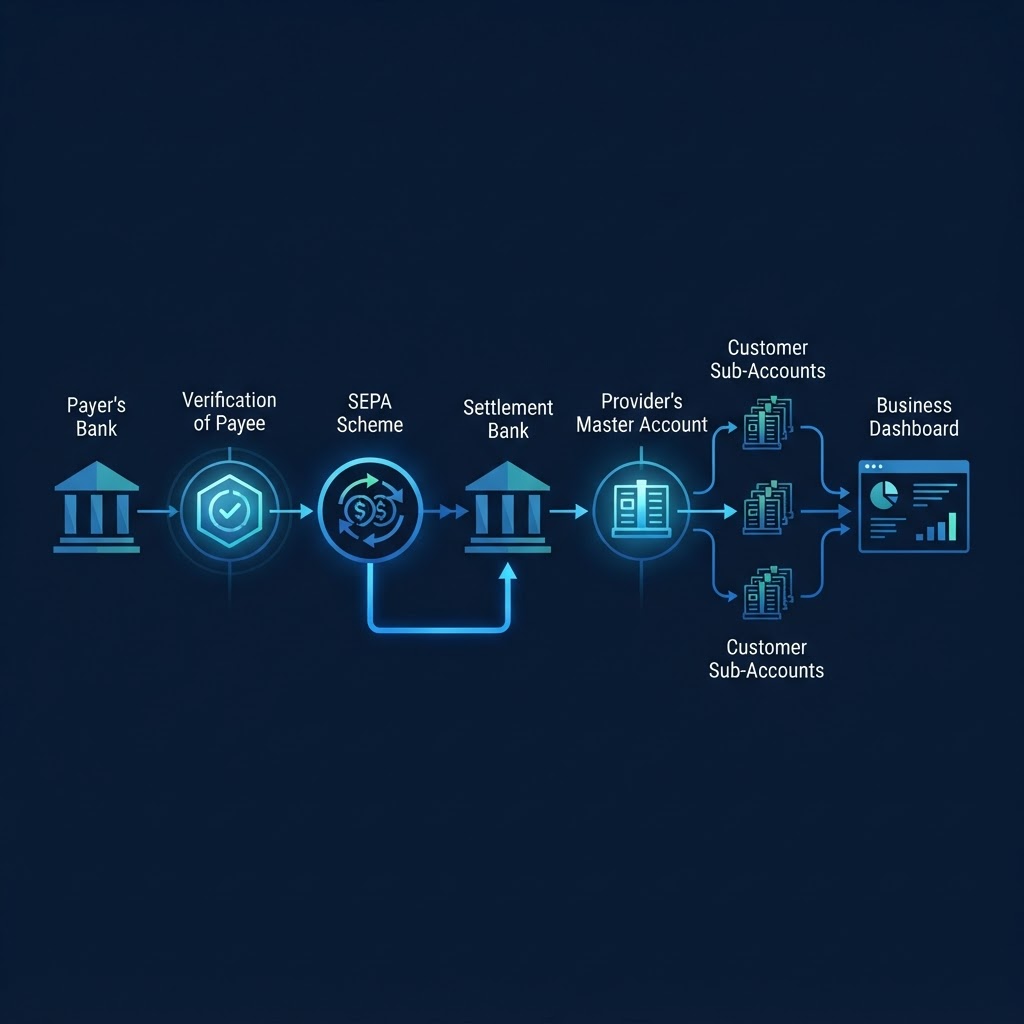
If you are asking how does a virtual IBAN work, the short answer is this: a virtual IBAN is an account number that redirects money. A payer sends funds to it exactly as they would to any IBAN, the payment lands in a different account called the master account, and the provider's ledger records that the money belongs to you. Everything that matters, from reconciliation to what protects the balance, follows from that one redirection. This guide walks a single payment through the whole chain, explains why businesses want the structure, names the two very different set-ups that share the label, and then answers the question most explainers avoid: who actually holds your money. ## What a virtual IBAN is, in one sentence The European Banking Authority looked at how providers across the EU issue virtual IBANs and found that most share the same characteristics. In its report on virtual IBANs, a vIBAN has the same format and functionality as a regular IBAN, is linked to a master account that has its own different IBAN, and has all incoming payments credited directly to that master account. To a third party it is typically indistinguishable from a normal IBAN. The payer's bank cannot see that it is virtual or which master account the money ends up in. That is also why the thing has no tidy legal home. Law firm A&O Shearman describes vIBANs as identifiers formally linked to a master bank account and informally associated with other accounts or relationships, used to streamline reconciliation and to let firms take part in payment systems indirectly. They exist because the industry built them, not because a regulation defined them. The EBA's press release goes further: there is no common definition across member states, and national authorities apply the anti money laundering, payment services and SEPA rules to them inconsistently. So treat "virtual IBAN" as a description of a routing trick, not of a product with fixed rights attached. The rights depend on what sits underneath. ## How a virtual IBAN works, step by step Infrastructure bank ClearBank lays out the mechanics from the issuer's side in four moves: the business generates a vIBAN and assigns it to a customer, the payer pays it like a standard IBAN, the bank recognises the vIBAN and routes the payment to the underlying real account, and the transaction is assigned to the correct virtual account in the ledger. To the sender, nothing is different. Below is the same flow from your side as the receiving business. ### Step 1: the provider allocates a vIBAN to you You do not open a virtual IBAN. You open a business or payment account with a provider, pass its identity and business checks, and the provider then allocates one or more identifiers to your profile. The identifier is often in a different format or country code from the master account behind it. We cover the application sequence in our guide on how to get a virtual IBAN, so this article stays on the mechanics. ### Step 2: a payer sends money to it like any IBAN Your client's finance team enters the vIBAN in their banking app and presses send. Since 9 October 2025, if that client's bank is in the euro area, it must first run Verification of Payee. The ECB's deadline table shows the check is mandatory for euro area providers from that date, free to the payer, and returns match, close match, no match or other before the payment is initiated. Non euro area member states follow from 9 July 2027. Mechanically, the payer's bank asks the bank behind the IBAN whether the payee name matches. The European Payments Council scheme has the requesting provider send the IBAN and name to the responding provider, which answers before the SCT or SCT Inst goes out. The name that comes back is whatever is registered against the receiving IBAN. If that is your provider's name rather than yours, your client sees something other than a clean match. That outcome, and how to test for it, is the subject of our article on what a named virtual IBAN changes for the payer's name check. ### Step 3: the scheme delivers the funds to the master account Here is the redirection. Stable Mint, an EU e-money institution, describes the receiving side plainly: the payment routes through SEPA to the sponsor institution's master account at its settlement bank, the sponsor identifies which vIBAN the payment was addressed to, and only then credits the matching sub-account in its own ledger. The money does not pass through an account in your name at a bank. It arrives in the intermediary's account and becomes, in Stable Mint's words, an accounting entry in the books of that intermediary. ### Step 4: the ledger credits your sub-account The provider's ledger now shows a balance against your vIBAN. ClearBank's description is useful here because it names what the underlying real account can be: a customer safeguarded account, an operating account or a client money account, each a regulated account type. Funds stay centralised in one or a small number of real accounts while the ledger does the work of telling customers apart. ### Step 5: you see and use the balance through the provider You access the balance through the provider's dashboard or API. In Stable Mint's framing, the vIBAN holder has no direct relationship with the payment scheme or with the credit institution that holds the master account. The provider supplies both the connectivity and the account layer. Whether you can also pay out from the vIBAN depends on the structure, which the next two sections explain. ## Why businesses use one: reconciliation at the point of receipt The reason this structure exists is the shared account problem. A platform or payments business typically runs one safeguarding or settlement account, as Clear Junction describes, and that one account can receive payments from hundreds or thousands of payers in a day. With a single IBAN, the only way to tell them apart is the reference field, the payer name or a familiar amount, and every mistyped reference becomes a manual investigation. Virtual IBANs move attribution upstream. Each identifier is set aside for one customer, merchant or ledger line, so the payment arrives already matched. Clear Junction's phrase for it is attribution at the point of receipt rather than after investigation. The EBA report gives a concrete example: a payment institution issues one vIBAN per customer to a merchant, so refunds and payouts go back to the same account the customer paid from. The same Clear Junction piece is honest about the conditions. The automation only holds if the business has clear processes for creating and closing identifiers, because orphaned ones accumulate when customer relationships end; if internal systems agree on what each identifier represents; if limits and review triggers are defined; and if balances line up across the internal ledger, the bank statement and the safeguarding report. A vIBAN improves the data; it does not remove the oversight. One distinction saves confusion. A virtual account, in ClearBank's definition, is a ledger sub-account that cannot receive SEPA or SWIFT payments from outside. A virtual IBAN is a virtual account that has been made externally addressable through the IBAN infrastructure. Every vIBAN is a virtual account; not every virtual account is a vIBAN. ## The two structures behind the same label Two providers can both say "virtual IBAN" and mean legally different things. A paper on virtual IBAN as a service in EU and Polish law separates them clearly. ### Model A: technical sub-accounts under one business account In the first model, which the paper calls Mass Payment Accounts, a licensed institution gives one business client a settlement account with technical sub-accounts. The sub-accounts exist to reflect and distinguish incoming payments. They are not payment accounts, and the end user can only fund them. This is the reconciliation tool described above: a utility, a marketplace or a platform collecting many payments into its own account. ### Model B: vIBANs that are payment accounts in their own right In the second model, the sub-accounts are payment accounts themselves. The end user can hold a balance, send transfers and sometimes use cards. The consequence the paper draws is that the master account holder providing those services must itself be authorised as a payment institution, an e-money institution or a credit institution. The paper also explains why this model exists: some providers can obtain an IBAN but cannot join the designated local payment systems directly, so they reach them through a licensed master account holder. The EBA report maps onto the same fork. It identifies two ways the master account can be held: in the name of the vIBAN's end user, or in the name of another entity that allocates vIBANs to its customers. In the second case the master account may sit at a bank in the name of a payment or e-money institution and double as that institution's safeguarding account. The report's finding that should matter most to a business follows directly: where you are not the master account holder, you may not have a payment account within the meaning of PSD2, and so may not benefit from all the rights that attach to one. The full set of findings, including the anti money laundering concerns, is in our guide to the EBA virtual IBAN report. ## Who holds your money, and what protects it Step 3 is where the protection question is decided. The funds arrive in the intermediary's master account. Stable Mint states the EU consequence without softening it: deposit guarantee scheme protection typically does not apply to a vIBAN balance, because the money is in the intermediary's account rather than in the customer's own bank account, and providers are required to disclose that. The UK equivalent runs the same way. The FCA's consumer guidance lists three kinds of non-bank provider, authorised payment institutions, e-money institutions and small payment institutions, and states that money held with them is not covered by the Financial Services Compensation Scheme. What protects it instead is safeguarding: under regulation 23 of the Payment Services Regulations 2017, relevant funds must be segregated and placed in a separate designated account with an authorised credit institution. A ring-fence, not a compensation scheme. The difference is the subject of our article on safeguarding versus FSCS, and the licence behind it is explained in what an authorised payment institution is. Here is our own position, stated exactly. EXFI is a trading name of EX Financial Solutions Ltd, which is not itself authorised or regulated by the FCA and acts as a distributor of payment services provided by Gemba Finance Limited, FCA FRN 804853. Regulated payment services are for UK customers only. EXFI accounts are payment accounts, not bank accounts. They are not covered by the FSCS, and funds are safeguarded in segregated accounts in accordance with the Payment Services Regulations 2017. If a provider cannot give you an equivalent paragraph, with the regulated entity and its reference number named, you do not yet know which structure you are in. ## How EX FI structures it An IBAN is only as useful as the account and rails behind it. EX FI accounts hold balances in GBP, EUR, USD, CAD, CHF and more than a dozen further currencies, each with its own dedicated IBAN where applicable, and move money over SWIFT, SEPA, Faster Payments, BACS and CHAPS. SEPA and UK Faster Payments cost 0.99 GBP per transfer, international SWIFT 26.40 GBP, and transfers between EX FI accounts are free. FX is 0.70 percent on major pairs and 0.90 percent on minors. UK-incorporated entities pay no monthly fee, no opening fee and hold no minimum balance. The question of whether to prefer a dedicated or virtual identifier for a given currency gets its own treatment in our piece on a dedicated or virtual business IBAN account. ## Six questions that tell you which kind you have Everything above reduces to six questions a provider should answer in one email. 1. Whose name is on the master account, mine or yours? 2. Is my vIBAN a payment account in its own right, or a ledger entry that only reflects incoming payments? 3. Which legal entity holds the payment services authorisation for this arrangement, and what is its register number? 4. Where are safeguarded funds held, and at which credit institution? 5. What name will a Verification of Payee or Confirmation of Payee check return when a client pays this IBAN? 6. What happens to the identifier, and to any payments still addressed to it, when I close the account? A provider that answers all six without hesitation has nothing to hide about its structure. The one that answers with a badge is the one to keep asking. ## FAQ ### Can a payer tell that an IBAN is virtual? Usually not. The EBA found that a vIBAN has the same format and functionality as a regular IBAN and is typically indistinguishable to third parties, so the payer's provider cannot see that it is virtual or which master account receives the funds. ### Is a virtual IBAN the same as a virtual account? No. A virtual account is an internal ledger sub-account that cannot receive SEPA or SWIFT payments directly from outside. A virtual IBAN is externally addressable through the IBAN infrastructure and maps incoming payments to a virtual account behind it. ### Can I send money out from a virtual IBAN, or only receive? It depends on the structure. The EBA report notes that in some set-ups the vIBAN can be used to pay third parties, with the money debited from the master account. In the technical sub-account model the identifier only reflects incoming payments. ### Does my virtual IBAN have to be in the same country as the master account? Not necessarily. The EBA found that supervisors disagree on whether issuing a vIBAN carrying another member state's country code requires a presence in that state. Ask the provider where the master account actually sits. ### Is money received through a virtual IBAN protected if the provider fails? In the UK, funds held with a payment institution or e-money institution are not FSCS covered and must instead be safeguarded in a segregated account under the Payment Services Regulations 2017. In the EU, deposit guarantee cover typically does not apply to a vIBAN balance held in an intermediary's ledger.
Back to News
Insights 12 min read12 October 2026
How Does a Virtual IBAN Work? Routing and Reconciliation
How does a virtual IBAN work? Payments route to a master account and are matched in a ledger. Who holds that account decides your protection.
E
EX FI