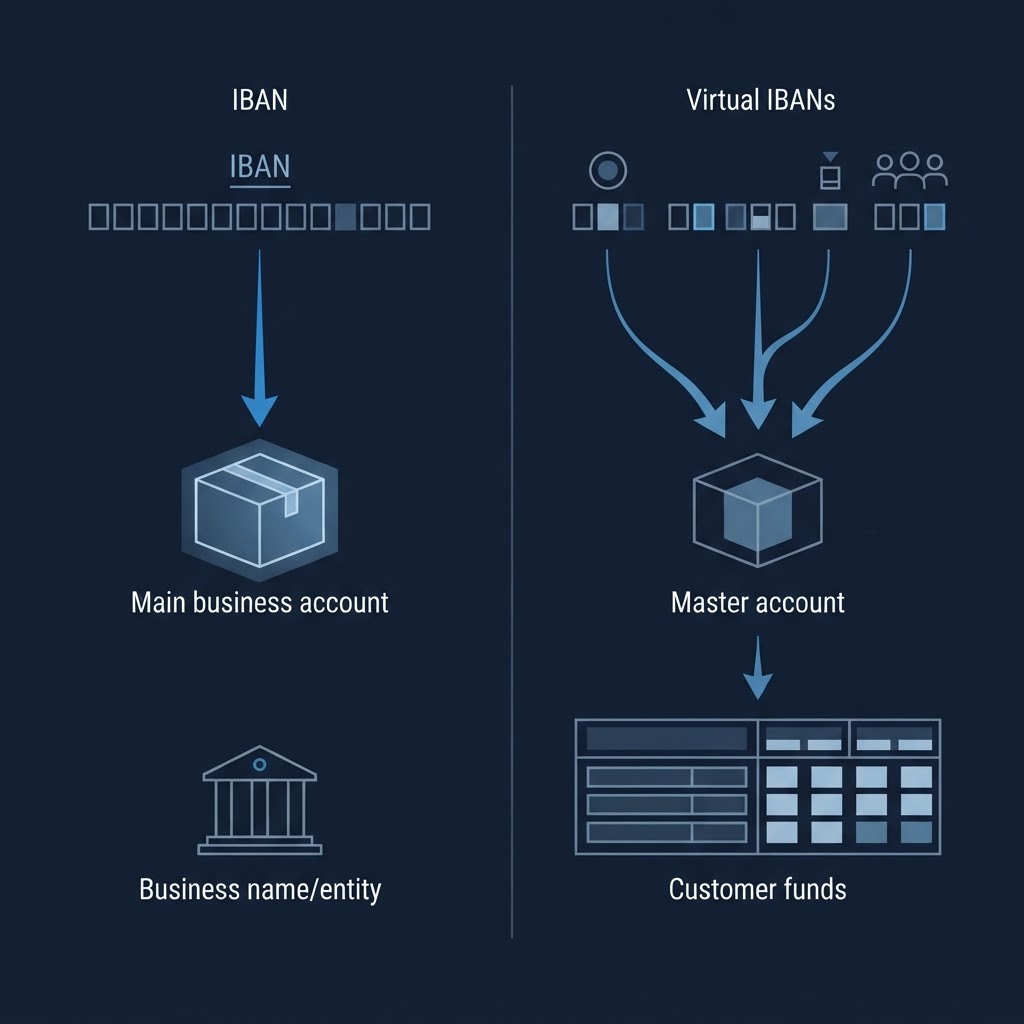
The IBAN vs virtual IBAN question sounds like a formatting detail. It is not. A regular IBAN points at an account that holds your money in your name. A virtual IBAN points at somebody else's account and relies on a ledger to remember that the money is yours. Everything that differs between the two, from how fast you reconcile to what protects the balance if the provider fails, follows from that one fact. This guide puts the two side by side across the five things a finance lead actually has to decide on, then gives a plain rule for when each one fits. ## The one-sentence difference between an IBAN and a virtual IBAN A regular IBAN has a direct one-to-one relationship with a physical account sitting in a bank's core ledger, with its own balance, as infrastructure provider Newrails puts it in its comparison of virtual and traditional IBANs. UK FX firm Privalgo says the same in fewer words: one IBAN to one bank account. A virtual IBAN keeps the format and drops the account. The European Banking Authority's report on virtual IBANs found that a vIBAN has the same format and functionality as a regular IBAN, is linked to a master account that carries a different IBAN, and has every incoming payment credited to that master account. To the payer it is indistinguishable from a normal IBAN. E-money institution Stable Mint calls it a routing label: payments addressed to it arrive in a master account held by a payment or e-money institution, which then credits your balance in its own internal ledger. One caveat before the comparison. The EBA's press release records that there is no common definition of a virtual IBAN across EU member states, and national supervisors apply anti money laundering, payment services and SEPA rules to them inconsistently. "Virtual IBAN" describes a structure, not a regulated product. Two providers can use the label for legally different things. ## IBAN vs virtual IBAN: side-by-side | What you are comparing | Regular IBAN | Virtual IBAN | | --- | --- | --- | | What it identifies | An account with its own balance, in your name | An identifier that routes to a master account with a different IBAN | | Who holds the balance | You, at the account-holding institution | The master account holder; your share is a ledger entry | | Adding more identifiers | A new account each time, with its own reconciliation logic | Issued programmatically, often many per customer or invoice | | How payments get matched | By payment reference, payer name or amount | By the identifier the payment landed on | | What a payee name check returns | The account holder's name | Depends: your name if registered, otherwise the master account holder's | | What protects the money | Depends on the institution; deposit cover at a bank | The master account's status: safeguarded if designated, otherwise not | | When you leave | Close the account | Identifier is retired; payments still addressed to it need a plan | The rows are expanded below, each with its source. The middle rows are where businesses are usually surprised. ## What changes for reconciliation This is the reason virtual IBANs exist. With one regular IBAN receiving payments from hundreds of counterparties, the only way to tell them apart is the reference field. A Finextra piece on platform payments puts a number on the cost: reconciliation can account for 30 to 40 percent of back-office labour, and the primary failure point is reference-based matching, with truncated references, inconsistent formats across banks and payers who forget them. A virtual IBAN moves the matching upstream. Each identifier is set aside for one customer, invoice or entity, so the payment arrives already attributed by the account it landed on, not by the message attached to it. Privalgo's framing is that payees no longer need to add anything when they transfer money to you. The alternative, one regular account per counterparty, does not scale. Clearing bank ClearBank notes that because a traditional IBAN maps one-to-one to a real account, each new customer means opening a new account and handling its reconciliation logic, so operational cost grows faster than revenue. Virtual accounts let a provider run millions of identifiers over a small number of real accounts. If you want the payment followed end to end, from the payer's bank to your dashboard, our guide on how a virtual IBAN works step by step does exactly that. ## What changes for who holds your money Here the two part company in a way that matters more than reconciliation. With a regular IBAN, the account is yours. With a virtual IBAN, the EBA report identifies two ways the master account can be held: in the name of the vIBAN's end user, or in the name of another entity that allocates vIBANs to its own customers. In the second case the master account may sit at a bank in the name of a payment or e-money institution and double as that institution's safeguarding account. The report's consequence is the line every business should read twice: where you are not the master account holder, you may not have a payment account within the meaning of PSD2, and so may not benefit from all the rights that attach to one. Stable Mint states the practical result without softening it. The balance is an accounting entry in the intermediary's books, and deposit guarantee cover typically does not apply, because the money is in the intermediary's account rather than in a bank account of your own. Newrails adds the distinction that decides whether that is a problem. A pooled account is just a master account where many users' funds are physically aggregated. A safeguarding account is the same thing legally designated under payment services rules so that the funds are ring-fenced from the provider's creditors if it fails. A pooled account lacks that protection unless it is formally designated as a safeguarding account. So the question is never "is my IBAN virtual?" It is "what is the master account, legally?" In the UK the answer runs through two documents. The FCA's guidance on payment service providers states that money held with an authorised payment institution, an e-money institution or a small payment institution is not covered by the Financial Services Compensation Scheme. What applies instead is safeguarding: regulation 23 of the Payment Services Regulations 2017 requires relevant funds to be segregated and placed in a separate designated account with an authorised credit institution. A ring-fence rather than a compensation scheme. We compare the two mechanisms in detail in safeguarding versus FSCS, and the EBA's full list of findings, including its money laundering concerns, is in our guide to the EBA virtual IBAN report. ## What changes for the payer's name check A regular IBAN returns the account holder's name when a payer's bank runs Confirmation of Payee in the UK or Verification of Payee in the euro area. A virtual IBAN returns whatever name is registered against it, which in a pooled structure can be the master account holder rather than you. Your client then sees a mismatch warning before paying an invoice that carries your name. Whether a provider registers your name against each identifier is the subject of our article on the named virtual IBAN, including a ten-minute test you can run yourself. ## When a regular IBAN is the right answer, and when a virtual one is Newrails' rule is the most honest one in the SERP: choose virtual IBANs for multi-tenant scale and automated reconciliation, choose traditional IBANs for simple, low-volume or capital-heavy treasury set-ups, and expect to end up using both. UK formation agent Incorpuk's table reaches the same place from the buyer's side: a virtual IBAN often sits under a master account and usually carries no standalone banking relationship, and the term describes the account structure rather than guaranteeing a particular type of regulated service. Translated into a decision: - Treasury balances, payroll, tax, anything that sits for weeks: a real account in your name, with the protection regime stated in writing.
- •Collections from many payers, marketplace or client-money flows, per-market payment details: virtual IBANs over a safeguarded master account, so the reconciliation happens on arrival.
- •Both at once: the normal outcome for a trading business with international customers. Whichever way you lean, three questions settle which structure a provider is actually offering. Whose name is on the master account? Is my identifier a payment account in its own right, or a ledger line that only reflects incoming payments? Which legal entity holds the authorisation for the arrangement, and what is its register number? A provider that answers all three in one email has nothing to hide. One that answers with a badge has not answered. ## How EX FI handles IBANs EX FI accounts hold balances in GBP, EUR, USD, CAD, CHF, DKK, NOK, SEK, PLN, HKD, SGD, ZAR, CNY and more, each with its own dedicated IBAN where applicable, and move money over SWIFT, SEPA, Faster Payments, BACS and CHAPS. SEPA and UK Faster Payments cost 0.99 GBP per transfer, international SWIFT 26.40 GBP, and transfers between EX FI accounts are free. FX is 0.70 percent on major pairs and 0.90 percent on minors. UK-incorporated entities pay no monthly fee, no opening fee and hold no minimum balance. Our regulatory position, stated exactly. EXFI is a trading name of EX Financial Solutions Ltd, which is not itself authorised or regulated by the FCA and acts as a distributor of payment services provided by Gemba Finance Limited, FCA FRN 804853. Regulated payment services are for UK customers only. EXFI accounts are payment accounts, not bank accounts. They are not covered by the FSCS, and funds are safeguarded in segregated accounts in accordance with the Payment Services Regulations 2017. That paragraph is the answer to the three questions above, and it is the paragraph to demand from any provider you compare us with. If you are weighing a dedicated identifier against a virtual one for a specific currency, start with our piece on the dedicated or virtual business IBAN account. If you have decided and want the application sequence, read how to get a virtual IBAN. ## FAQ ### Is a virtual IBAN a real IBAN? In format and routing, yes. It is a valid identifier that SEPA and other schemes accept, and the payer's bank cannot tell it apart from a regular one. What it lacks is an account of its own at a credit institution; the funds land in a master account and your share is recorded in the provider's ledger. ### Can a virtual IBAN receive direct debits? Often. Stable Mint notes that a vIBAN can receive SEPA Credit Transfers and, in many implementations, SEPA Direct Debit payments, but support depends on the provider and the structure behind the identifier, so confirm it before moving collections. ### Does a virtual IBAN mean my money is pooled with other customers' money? Usually the funds sit in one master account alongside other customers' funds, separated only by the provider's ledger. Whether that master account is a formally designated safeguarding account, rather than an ordinary pooled account, is the question that decides whether the funds are ring-fenced from the provider's creditors. ### Can a business have both a regular IBAN and virtual IBANs? Yes, and most do. A real account in the company's name for treasury and reserves, with virtual IBANs issued over a safeguarded master account for collections, is the structure Newrails describes as the usual end state for platforms.