If you are working out how to get a virtual IBAN, here is the part most sign-up pages leave out: you almost never apply for the IBAN itself. You apply for a business or payment account, pass the provider's identity and business checks, and then request one or more virtual IBANs on top of it, as Statrys lays out in its own walkthrough. The IBAN is the easy bit. The account underneath it, and who holds it, is what decides whether it works for you.
That matters more than it sounds, because there is no single thing called a virtual IBAN. The European Banking Authority found no common definition across the EU and divergent national interpretation of the rules that govern them. Two providers can use the same label for two quite different structures.
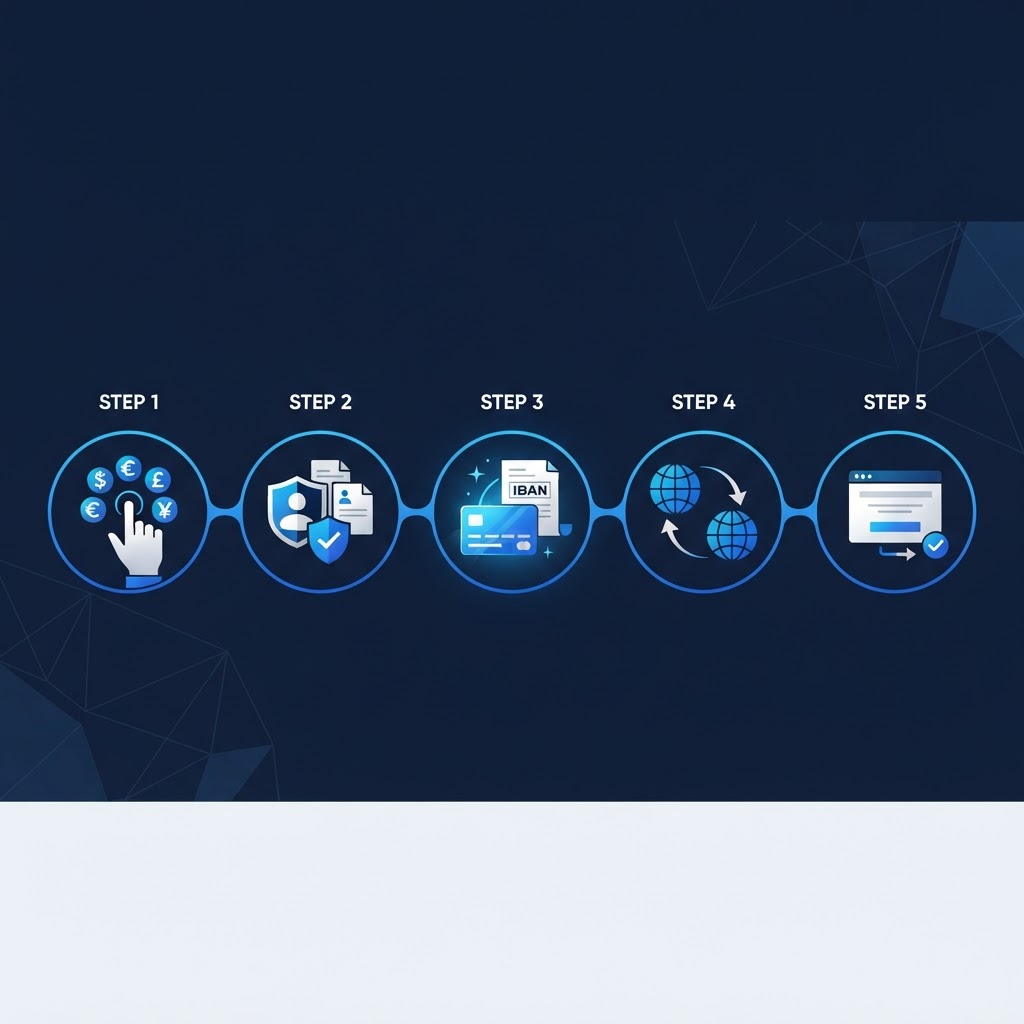
This guide gives you the sequence in five steps, then the structure checks that most guides skip.
Step 1: Decide what the IBAN has to do
Start from the payments you need to receive, not from the product page.
Currencies you need to receive, not just hold
Holding a currency and receiving it are not the same feature. The IncorpUK guide for UK companies puts it well: check that the currencies you need are supported for receiving, and that UK clients can pay you through local GBP details rather than an international SWIFT route. If your clients are in the euro area, you want an IBAN that accepts SEPA. If they are in the UK, you want a sort code and account number that accepts Faster Payments.
Write down three things before you compare anyone:
- •which currencies arrive, and from which countries
- •rough monthly volume and average payment size
- •whether you need one IBAN or one per client, entity or market
Named or pooled
This is the decision that decides everything else. Some providers issue an IBAN in your business name; others route incoming payments through a pooled collection account and rely on a reference to find you. According to Eqwire, "named IBAN" is a commercial term rather than a regulatory category, and no name data is encoded inside the IBAN string itself. So you have to ask. We cover the naming question in depth in our guide to the named virtual IBAN, and the wider comparison in IBAN vs virtual IBAN.
Step 2: Check eligibility before you fill in a form
Eligibility filters out more applicants than documents do. Providers look at your country of incorporation, your business type, and where your directors and owners live.
A UK company is not a free pass. IncorpUK notes that incorporation does not automatically guarantee approval, and that providers assess the business model, ownership, geography and expected transactions on their own terms. The same guide points out that directors living outside the UK are not necessarily excluded, which matters for founders who run a UK company from abroad.
Check the fine print for three blockers:
- •Entity type. Virtual IBANs are usually sold through business accounts. Sole traders and individuals may get a different product or nothing.
- •Jurisdiction. Some providers take only UK or EU entities; others onboard offshore companies with extra due diligence, according to virtual-ibans.com.
- •Industry. Higher risk sectors need specialist providers. Mainstream platforms often decline them.
Step 3: Prepare the KYB pack
Know Your Business checks are where applications stall. Arrive with everything in one folder.
Company documents
- •Certificate of incorporation (for a UK company, the Companies House record)
- •Articles of association
- •Shareholder register tracing ownership to the real people behind it
- •Board resolution authorising the application and naming signatories
- •Proof of company address
People documents
Every person who owns or controls 25% or more of the company counts as an ultimate beneficial owner, and each one needs to be verified, per this virtual IBAN KYC checklist. For each owner and director, expect:
- •a valid passport or national ID card
- •proof of residential address dated within the last three months
- •a live selfie or short video check, the remote onboarding method set out in EBA guidelines
The business description
Write a clear two to four page summary: what you sell, who pays you, from where, in which currencies, at what volume. The same checklist warns that compliance teams read your website, so make sure it matches what you wrote. A mismatch between the two is one of the most common reasons for extra questions.
Step 4: Apply and get through review
The form itself is quick. Transferra quotes about 15 minutes to apply and 1 to 2 days of compliance review. Behind the scenes the provider runs sanctions screening on the company, directors and owners, politically exposed person checks, adverse media searches and a review of your source of funds.
What slows this stage down is almost never the provider's queue. It is a missing board resolution, an expired passport, or a business description that does not explain where the money comes from. Answer follow-up questions in full on the first reply.
Once you are approved, extra virtual IBANs are usually issued from the dashboard without a fresh compliance check. That does not mean KYC is finished. Providers run periodic reviews, and material changes such as new shareholders, new markets or a new business line should be reported proactively.
Step 5: Verify the IBAN before it goes on an invoice
Do not paste the new IBAN into your invoice template on day one. Test it.
- •Send a small test payment from an account you control, on the rail your clients will use.
- •Check the name on the receiving side. Confirm exactly whose name appears on the account and whether your company is the named beneficiary.
- •Run it through a payee check. In the euro area, Verification of Payee became mandatory from 9 October 2025, and the payer's bank now sees a match, close match or no match result before sending, according to the ECB's Instant Payments Regulation timeline. Non euro area EU states follow from 9 July 2027.
That third step is why the named versus pooled question stops being academic. Under the EPC Verification of Payee scheme, the payer's provider checks the IBAN and the payee name before a SEPA credit transfer goes out. If your client sees a mismatch warning against your company name, expect the payment to pause while they check with you. For the mechanics end to end, read how a virtual IBAN routes a payment.
The structure checks most guides skip
Speed and price are easy to compare. These five questions are not, and they matter more.
1. Who is actually regulated? The brand on the website is not always the licensed firm. Many providers distribute services from a regulated partner. That is a legitimate model, but you should know the partner's name and look it up on the FCA register. Our explainer on the authorised payment institution shows what the licence covers.
2. Is it a bank account or a payment account? Money held with a payment institution or e-money institution is not covered by the FSCS, as the FCA spells out for customers. It is protected differently: under regulation 23 of the Payment Services Regulations 2017, relevant funds must be segregated and held in a separate designated account. We compare the two regimes in safeguarding versus FSCS.
3. Where does the money sit? The EBA's full report found that virtual IBANs can obscure the location of the master account and of the customer's funds. The country code on your IBAN does not prove where the account is held. Ask.
4. Is the IBAN yours alone? Dedicated or shared makes a real difference for reconciliation and payee checks. Our comparison of a dedicated or virtual business IBAN goes through both.
5. What happens at the exit? Find out how long you keep the IBAN if you close the account, and how you will redirect clients who still have the old details saved.
How this works at EXFI
We would rather show you our own structure than ask you to take a badge on trust.
EXFI is a trading name of EX Financial Solutions Ltd, which is not itself authorised by the FCA and acts as a distributor. Regulated payment services are provided by Gemba Finance Limited (FCA FRN 804853), and the service is for UK customers only, as stated on exfi.app. EXFI accounts are payment accounts, not bank accounts: funds are not covered by the FSCS and are safeguarded in segregated accounts under the Payment Services Regulations 2017, per the EXFI Impressum.
In practice, getting an IBAN with us follows the steps above:
- •Eligibility: business entities only, incorporated in the UK or EU. No consumer accounts.
- •Review: standard applications are reviewed within 24 to 48 hours with full online KYC.
- •Currencies: balances in GBP, EUR, USD, CAD, CHF, DKK, NOK, SEK, PLN, HKD, SGD, ZAR, CNY and more, each with its own dedicated IBAN where applicable, on SWIFT, SEPA, FPS, BACS and CHAPS.
- •Pricing: no monthly fee for UK incorporated entities, no opening fee, no minimum balance. SEPA and UK FPS transfers cost 0.99 GBP, international SWIFT 26.40 GBP, internal transfers are free, and FX is 0.70% on major pairs and 0.90% on minors.
If you need several currencies rather than one IBAN, our guide to opening a multi-currency account covers that path. None of this is financial advice; compare the structure against your own payment flows.
FAQ
Can I get a virtual IBAN without a UK or EU company?
Sometimes. Some providers onboard companies incorporated elsewhere, with additional due diligence, while others accept UK and EU entities only. EXFI currently accepts UK and EU incorporated businesses, and its regulated service is for UK customers only.
Can a sole trader or individual get a virtual IBAN?
It depends on the provider. Virtual IBANs are mostly offered through business accounts, so a personal applicant may find the feature is not available at all. EXFI does not offer consumer accounts.
Do I need to redo KYC for every extra virtual IBAN?
Usually not. One onboarding covers the underlying account, and additional IBANs are issued from the dashboard. You will still face periodic reviews and must report material changes to ownership or business activity.
Why was my virtual IBAN application rejected?
The common causes are outside the provider's risk appetite (industry or jurisdiction), missing or expired documents, unclear source of funds, or a website that does not match the business description. Providers often decline without a detailed reason, so fix the pack before reapplying elsewhere.