Most writing on agentic commerce banking is addressed to bank executives: how to stay "top of wallet" when AI agents choose how to pay. That is a real problem for banks. This article starts from the other side of the account. If your business lets an AI agent buy, subscribe or pay suppliers, the money still leaves an account at a bank or a payment institution, and that provider has to decide whether to let the payment through. So the useful questions are practical ones. What have UK and European banks actually switched on? What does your provider check before an agent's payment goes out? Where does UK law stand today? And what should you ask before you connect an agent to a business account? ## What agentic commerce banking means HSBC Innovation Banking defines agentic commerce as software that acts on a customer's behalf to complete commercial tasks within a defined mandate. An assistant finds the cheapest flight. An agent books it and pays, within a spending limit you set in advance. The banking part is what happens at the moment of payment. HSBC puts it precisely: the institution needs to establish not only who owns the account, but what authority has been delegated to the agent and whether this specific transaction falls inside that authority. Payment systems were built on the assumption that a person decides and clicks. Agentic commerce removes the click. Demand is moving faster than the rules. Bain's September 2026 research found that 59% of US consumers now use AI for product research, up from 36% in March 2025, and cites a Forrester estimate that agentic commerce may reach a fifth of US e-commerce by 2030. ## What banks have switched on in 2026 ### Card networks went first The first live agent payments in Europe ran over cards, because the networks already had the tokens and the identity layer. - March 2026. Santander and Mastercard completed Europe's first live end-to-end payment executed by an AI agent, using Mastercard Agent Pay over Santander's live payments infrastructure. Santander was explicit that this was a controlled pilot, not a commercial rollout.
- •March 2026. Visa started issuer trials under its Agentic Ready programme, reported by Finextra, with early partners including Barclays, HSBC UK, Nationwide, Revolut and Santander. The first phase was about issuer readiness: letting banks validate agent-initiated transactions in production.
- •July 2026. Visa announced live agentic transactions with over 30 European issuers, with agents buying from independent merchants such as lastminute.com and Frasers. The UK issuers listed include Barclays, HSBC UK, Lloyds Banking Group, Nationwide, NatWest and Revolut. Every transaction was authenticated with Visa Payment Passkeys to support compliance with Strong Customer Authentication, and Visa says the model is being extended to commercial and B2B payments. The pattern matters for a business. Today, an agent paying from your company almost always means an agent using a tokenised card credential, and the bank's role is that of card issuer. ### Account-to-account and VRP are next The UK has a second route that most of the consultancy coverage skips: open banking. The government's Payments Forward Plan scheduled the first live commercial Variable Recurring Payments under an industry-led scheme for Q1 2026. A VRP is a standing mandate that lets an authorised third party initiate a series of payments from your account within agreed limits, which is close to what an agent needs. HM Treasury's July 2026 Modernising Payment Services Regulation consultation proposes a new statutory right of access for VRPs: at a payment initiation provider's request, the account provider would have to let it lodge a payment mandate for a series of transactions. The same consultation says the UK has "a genuine opportunity to lead the world" in agentic payments. If that right of access becomes law, agent payments straight from a business account, without a card in the middle, become far more realistic. ## What your bank has to check before an agent pays Strip away the protocols and an agent payment asks the account provider to answer three questions at once. ### Who owns the account This part does not change. Your business is still the customer, KYC still applies, and the account holder remains the legal payer. An agent is a tool you deploy, not a customer in its own right. ### What authority was delegated This is new. The provider needs evidence of the mandate: spending limits, permitted merchants or payees, time windows, and how the mandate can be revoked. HSBC's example is a corporate treasury team allowing an agent to buy foreign currency up to a limit. If the agent goes outside those parameters, or is manipulated, someone has to show what was authorised. If you want the mechanics, see our explainers on how an AI agent gets permission to spend and on AP2 mandates. ### Which agent acted The Paypers sets out the gap clearly: 3D Secure and Strong Customer Authentication confirm who the human is, but not which agent acted on their behalf. Institutions need to register and authenticate agents and keep audit trails that stand up to legal scrutiny. "Know your customer" gets a companion, "know your agent", and fraud and dispute handling must take account of how the agent was configured at the time of the payment. ## Where UK rules stand ### Consent under regulation 67 The Payment Services Regulations 2017 do not require every payment to be keyed in by a person. Rob Bratby's analysis of regulation 67 explains that a payment is authorised only where the payer consented to it, or to a series it belongs to, in the form and procedure agreed with the provider. The limits you give an agent are not automatically the same thing as legal consent; that depends on your contract with the provider. The consequence is uncomfortable. If you set the agent's limits too loosely, a bad purchase will usually fall inside your consent, because the agent did what you allowed. If an outsider subverts the agent through prompt injection, the payment may be unauthorised, which brings in the refund duty under regulation 76. A model that misreads its own instructions sits somewhere in between. We go through the dispute side in detail in who pays when an agent purchase goes wrong. ### Strong customer authentication SCA does not say a human must approve every transaction. But it was designed to confirm the person, which is why the live card pilots relied on passkeys bound to a verified cardholder and their explicit instruction. For fully autonomous, asynchronous payments, how SCA applies is still an open question. ### What the government and the FCA are asking HM Treasury's Question 15 asks directly whether provisions on authentication, consent and liability for unauthorised transactions need updating for agentic payments. The FCA's payments priorities commit it to considering whether regulation needs to change to support agentic AI payments, alongside its open banking and VRP work. A UK Finance blog by Ashurst Perkins Coie ties the threads together. The government's AI Adoption Plan calls for a trust framework built on three pillars: legal and liability frameworks, Know Your Agent protocols, and authentication and governance standards. And the UK Jurisdiction Taskforce concluded in July 2026 that liability must rest with legal persons, since AI has no separate legal personality. In plain terms: the agent's mistakes are yours or your provider's, never the agent's. For EU rules on the same questions, see our planned guide to agentic commerce rules in the EU. ## Why banks are worried, and why it matters to you Banks are not only gatekeepers here; they have money at stake. Bain lists the threats to issuers: agents may default to lower-margin methods such as debit and account-to-account, AI platforms may demand a bigger share of the payments profit pool, and agents could compress credit card economics by optimising rewards. Roland Berger's October 2026 study puts European agent-mediated volume at EUR 1.5 to 2.7 trillion by 2030, more than 90% of it B2B, and estimates a bank revenue pool of EUR 2.0 to 3.7 billion a year in B2B alone, across financing, trade finance automation, machine-to-machine payments and verified data. Its advice to banks: negotiate liability rules and checkout placement, and build the evidence trail regulators will require. Fraud is the shared worry. Accenture reports that 78% of payments leaders expect fraud to increase significantly with agentic payments and 87% see trust as the key barrier, yet 60% still rely on standard workflows to investigate agent-driven fraud. For a business, this has two effects. Expect providers to impose controls, such as velocity caps and re-authentication for out-of-pattern payments, that McKinsey expects regulators to demand when agents move money quickly across accounts. And expect them to compete for agent traffic, because the provider an agent chooses keeps the transaction. ## Payment account or bank account: does it change anything? Many businesses that will use agents run their cross-border money through payment institutions or e-money firms rather than banks. The type of account matters, and it is worth being exact about it. EX FI is a useful worked example. Per its Impressum, EXFI is a trading name of EX Financial Solutions Ltd (company number 17105188), which is not itself authorised by the FCA and acts as a distributor of payment services provided by Gemba Finance Ltd, authorised and regulated by the FCA as a payment institution (FRN 804853). EXFI accounts are payment accounts, not bank accounts: funds are not covered by the FSCS, but are held in segregated accounts under the Payment Services Regulations 2017 (see our guide to safeguarding). For agentic commerce, the PSRs rules on consent, authentication and refunds apply to payment accounts as they do to bank current accounts. What differs is deposit protection, and which providers get covered by any new VRP right of access, which the Treasury says could be limited to providers of current accounts or firms above a certain size. On the EX FI site, the regulated payment services are provided by Gemba Finance Limited (FCA FRN 804853), for UK customers only. Agent-native (MCP) banking features are on the roadmap and not yet live. ## Questions to ask your bank or payment account provider Before you connect any agent to a business account, get written answers to these: 1. Which rail will the agent use? A tokenised card, open banking or VRP, or an API payment from the account? Each has different refund and dispute rules.
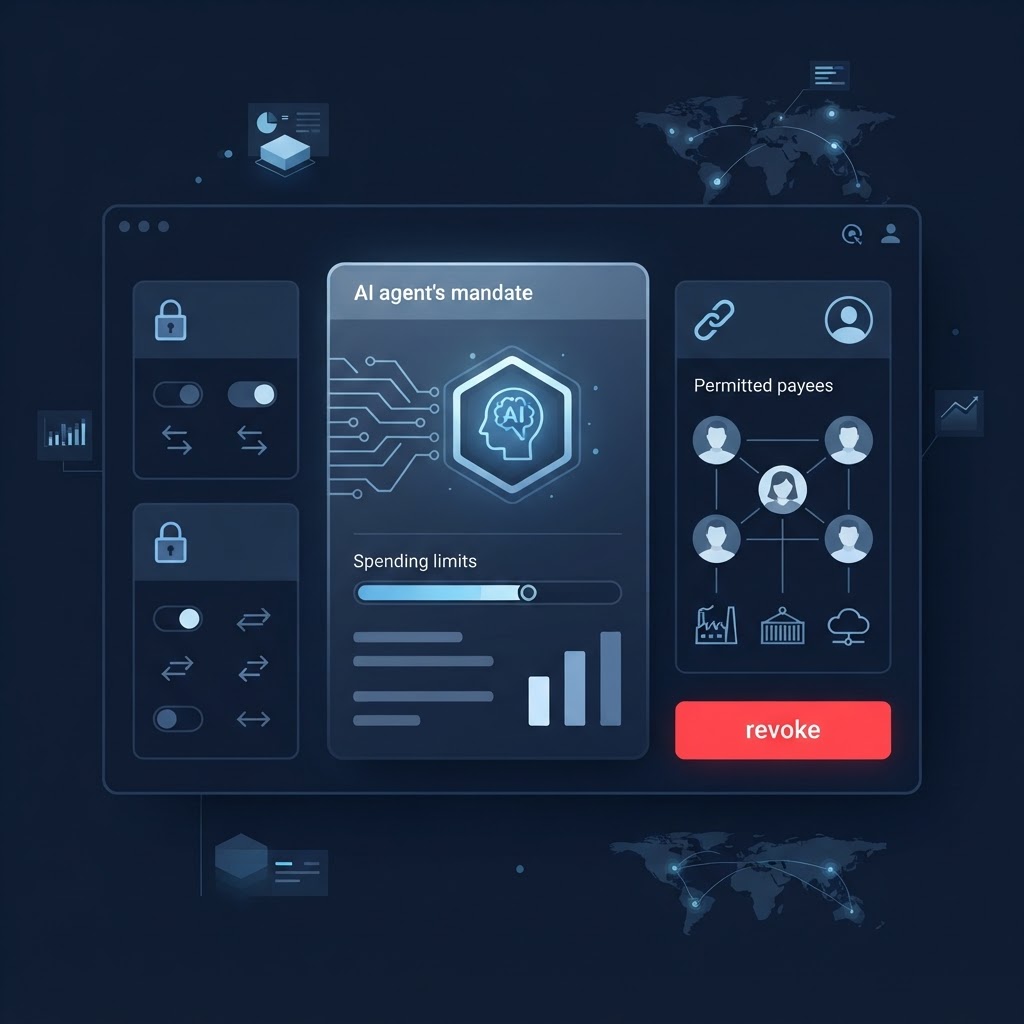
- •How is the mandate recorded? Can you set limits per agent, per payee and per period, and revoke them instantly?
- •How does the provider identify the agent? Is there agent registration or a dedicated token, or does the agent simply use your credentials?
- •What counts as your consent? Ask how the framework contract treats agent-initiated payments under regulation 67.
- •Who carries the loss if the agent is manipulated? Ask for the provider's position on prompt injection and model error.
- •What audit trail do you get? You need the instruction, the parameters and the payment, linked, for your own controls. Our guide to agentic commerce in B2B procurement covers the approval side.
- •Is the account protected by the FSCS or safeguarded? Know which before balances grow. None of this is advice on which provider to choose. It is the minimum due diligence for letting software spend company money. ## FAQ ### Can an AI agent hold or use a business account on its own? No. An agent has no legal personality, so it cannot be the account holder. It acts for the business that holds the account, and liability for its payments rests with legal persons: your company, your provider, or another party in the chain. ### Are UK banks already letting AI agents pay? Yes, in limited form. Barclays, HSBC UK, Lloyds, Nationwide, NatWest and Revolut are among the issuers Visa named for live agent card transactions in July 2026. These are card payments at participating merchants, not general agent access to bank accounts. ### Will open banking be used for agent payments? It is the most likely route for paying straight from an account. The first commercial VRPs under an industry scheme were scheduled for Q1 2026, and the Treasury has proposed a statutory VRP right of access that would let payment initiation providers lodge mandates for a series of payments. ### Who refunds a wrong agent payment? It depends on whether the payment fell inside the consent you gave under your framework contract. A payment within loose limits is usually authorised and yours to bear. A payment caused by an outsider subverting the agent may be unauthorised, which can trigger the provider's refund duty.