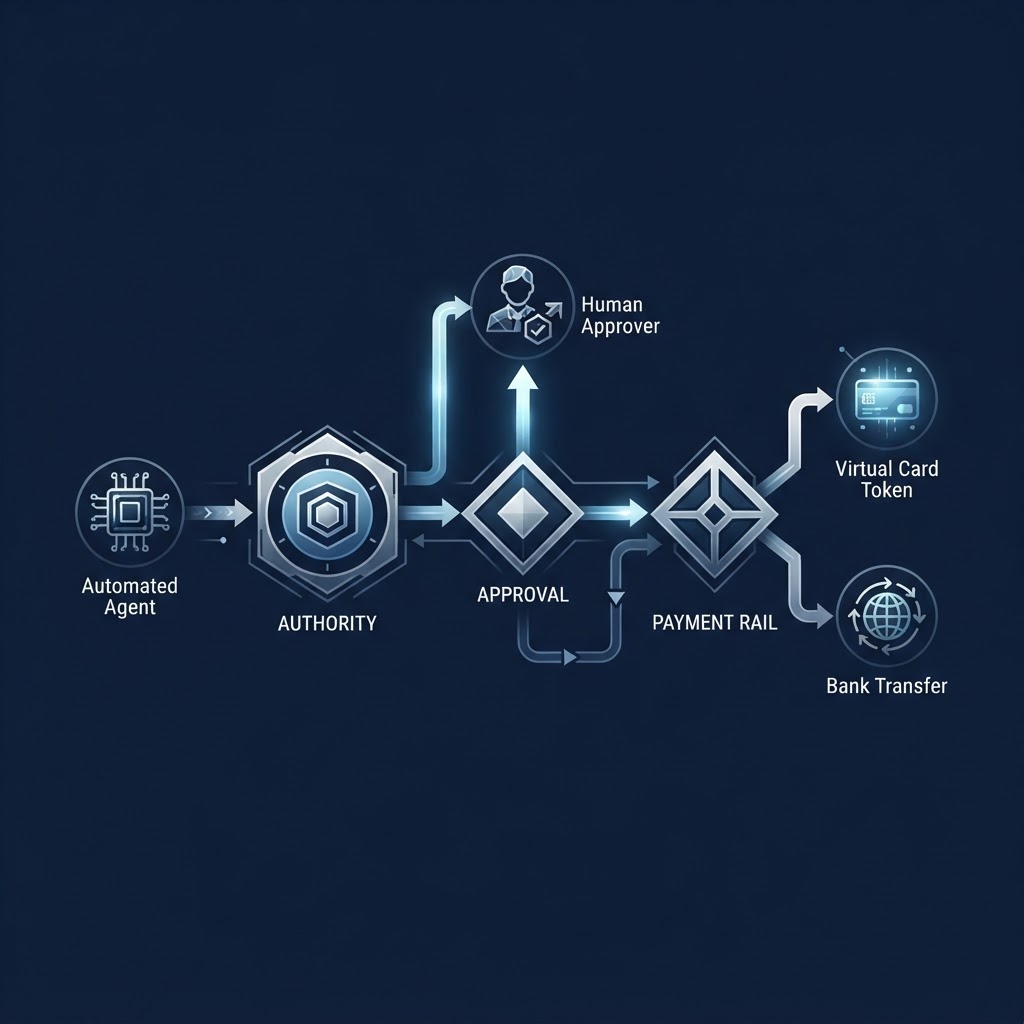
Most of what has been written about agentic commerce in B2B is advice for sellers: structure your catalogue, expose your prices through an API, or procurement agents will skip you. That advice is sound, but it leaves out the other side of the table. When an AI agent buys on behalf of your company, someone in finance still has to answer three questions. Who gave the agent authority to commit funds? Where does a human approve? And which payment rail actually moves the money to the supplier? This article answers those questions for UK and EU businesses. It is written for the buyer's finance team, not the seller's marketing team. ## What agentic commerce means in B2B Deloitte defines B2B agentic commerce as the use of AI agents to conduct business on behalf of enterprises on both the buyer and the seller side. In its fullest form, a buyer's procurement agent negotiates directly with a supplier's sales agent, and the transaction completes in seconds. Adoption is uneven. Deloitte reports that nearly 40% of B2B buyers already use agentic AI in purchasing, for evaluating products, configuring orders, reviewing contracts and benchmarking prices, while only 24% of suppliers use agents in the sales process and 67% plan to. Buyers are moving first. The forecasts are larger still. Gartner predicted at its IT Symposium/Xpo 2025 that 90% of B2B purchases will be handled by AI agents within three years, pushing more than 15 trillion USD of spend through automated exchanges by 2028, as reported by Digital Commerce 360. Treat that as a forecast, not a measurement. The direction is still clear. ## Why B2B is harder than consumer agent shopping A consumer agent buying running shoes has one budget holder and one card. A procurement agent faces a different set of constraints, which McKenna Consultants sets out in detail: - Contract pricing. The buyer has negotiated rates with specific suppliers. Buying outside contracted terms has financial and compliance consequences.
- •Approval thresholds. Purchases above a set amount need sign-off from a budget holder, and the agent has to route orders correctly or flag when a threshold will be crossed.
- •Audit trail. When a person submits a purchase order, the login and the click are the record. When an agent does it, the reasoning, the tool calls and the data it used have to be captured explicitly for finance and compliance. There is a fourth difference the seller-side guides rarely mention. Consumer agent payments run almost entirely on cards. B2B purchasing also runs on invoices, payment terms and bank transfers, and those rails were never designed for a non-human initiator. ## The four levels of autonomy, and where your controls change Deloitte describes a maturity path in four stages. The short labels below are ours; the point is that each stage moves a different control from a person to a policy. 1. Assisted. Agents handle discrete tasks such as supplier discovery and summaries. People still run the workflow. Existing approval rules apply unchanged.
- •Orchestrated. Agents run RFQs, score responses, draft contracts and prepare purchase orders. People set criteria and handle exceptions. You now need rules for what the agent may prepare versus what it may submit.
- •Negotiating. Agents negotiate within guardrails and escalate exceptions. The guardrails themselves become the control, so they need to be written down and versioned.
- •Agent to agent. Buyer and supplier agents transact directly. People set policy and intervene only where judgement is needed. At this stage the payment authority itself has been delegated. Most businesses sit at stage one or two today, according to Deloitte. The jump that matters for finance is between two and three, because that is where the agent stops preparing payments and starts committing to them. ## Control 1: authority, or how an agent gets permission to commit funds ### Scoped permissions An agent that can browse a catalogue should not automatically be able to place an order. McKenna's example is a useful template: "can browse catalogue" and "can submit orders up to 5,000 GBP" are two different authorisation scopes, and a commerce platform built for agents has to support both. In practice the scope should also name the suppliers, categories and cost centres the agent may use. ### Mandates signed in advance The commerce protocols now make this distinction formal. A guide to the Universal Commerce Protocol in B2B explains that UCP's Checkout capability, in its 2026-08-25 version, requires a person to finalise the order through a trusted interface unless the AP2 Mandates extension is supported. Without mandates, the agent assembles the cart and a human signs off. With them, the buyer pre-signs limits such as a price ceiling and a time window, and the agent executes once the conditions are met, with nobody in the loop. For a procurement function that is the line between a decision-support tool and a delegation of authority to spend company money. If you want the mechanics of how a mandate is structured, see our explainers on how an agent gets permission to spend and the AP2 protocol and agent mandates. The card networks are building the same idea into the credential. Visa's page on agentic AI for businesses says agentic tokens are issued only after an agent is authorised to act for a verified business or funding source, and are bound to context: who the agent represents, what it may do and under what conditions. ## Control 2: approvals, where the human stays in the loop Approval chains have long been the main obstacle to automating procurement. UCP gives them a defined place. A checkout session moves through named states, and one of them,
requires_escalation, is the standard hand-off to a human: a signature threshold exceeded, a manager's approval needed, a pricing exception. The specification also grades errors by severity, so an agent can tell a stock-out from a compliance refusal and respond differently to each. Visa describes the same principle from the payment side: compliance is enforced before execution, not after. A payment can only be initiated if the conditions the business set are met, such as approved suppliers, limits, timing and usage rules. Perficient's analysis of agent-driven buying adds the governance list every finance team should copy: delegated authentication so agents cannot reach data they should not, defined boundaries so agents cannot commit to terms outside guardrails, and audit trails so every transaction is logged and traceable. Skip it, Perficient warns, and you automate your mistakes. ## Control 3: which rail actually pays the supplier ### Card tokens and virtual corporate cards Cards are where agentic B2B payments are furthest along. The Mastercard Agent Pay announcement of 29 April 2025 introduced Agentic Tokens, required agents to be registered and verified, named IBM's watsonx Orchestrate as a partner for B2B use cases, and gave a B2B example: a small textile business whose agent handles sourcing and completes a cross-border purchase with a virtual corporate card token. That example has since been run for real. HSBC and Mastercard piloted end-to-end B2B agentic commerce transactions for two Singapore clients on 29 May 2026, connecting a multinational buyer, the procurement platform SourceSage and the supplier FortyTwo on Mastercard Agent Pay with tokenised payments. HSBC paired it with virtual corporate cards that carry pre-set limits and usage rules and can be assigned to specific teams, suppliers or projects. On the acceptance side, Visa's Intelligent Commerce Connect offers a single integration with spend controls and accepts payments initiated through the Trusted Agent Protocol, Machine Payments Protocol, Agentic Commerce Protocol and Universal Commerce Protocol. ### Bank transfers against invoices Much B2B spend never touches a card. Suppliers invoice, and buyers pay by bank transfer on terms. Here the agentic tooling is far less mature, and the controls sit with the business and its payment account provider rather than a card scheme. That makes the account itself part of the control system: which payees are allowed, what limits apply, and who must confirm before money leaves. For a comparison of how each rail behaves when an agent is the initiator, see our guide to cards, bank transfers or stablecoins. Multi-entity groups add one more layer. If an agent is buying for several subsidiaries, the purchase and the internal recharge are two different flows, and the second is often where the cost hides. Our piece on intercompany payments covers that settlement layer. ### What UK law counts as consent In the UK, regulation 67 of the Payment Services Regulations 2017 says a payment transaction is authorised only if the payer has consented to that transaction, or to a series of transactions of which it forms part. Consent must be given in the form and by the procedure agreed between the payer and its payment service provider, and it may be given via the payee or a payment initiation service provider. The payer can withdraw consent until the payment order becomes irrevocable. Two points matter for B2B agents. First, consent to a series of transactions is the closest existing legal concept to a standing mandate, which is exactly what a procurement agent needs. Second, the form of consent is whatever you agree with your provider, so the mandate record is not a nice-to-have: it is the evidence that consent was given. When it goes wrong, that record decides the outcome, as our article on who pays when an agent buys the wrong thing explains. This is not legal advice. ## Where EXFI fits EXFI is built for the businesses this article describes: UK and EU companies paying suppliers across currencies. The EXFI site lists multi-currency accounts with dedicated IBANs and rails including SWIFT, SEPA, FPS, BACS and CHAPS. Regulated payment services are provided by Gemba Finance Limited (FCA FRN 804853), UK customers only. As the EXFI Impressum states, these are payment accounts, not bank accounts; funds are not covered by the FSCS and are safeguarded in segregated accounts under the Payment Services Regulations 2017. EXFI has also announced MCP-native banking primitives for AI agents: agent wallets, signed spending limits and programmable compliance. These are announced for selected partners and are not live products today. The design goal is the one this article keeps returning to: a spending limit signed by the account holder before the agent acts, so the mandate exists at the moment it is needed. For the account-provider view of this shift, see what agentic commerce means for banking and payment accounts. ## A readiness checklist for finance teams This is not financial or legal advice. It is the list the sources above point to. 1. Map your autonomy stage. Write down which of Deloitte's four stages each procurement workflow is at, and which control changes at the next stage. - •Write scopes, not trust. For every agent: allowed suppliers, categories, cost centres, a per-order cap, a period cap and an expiry.
- •Keep a human gate for anything above threshold. Map your existing approval matrix onto the escalation step, rather than letting the agent decide when to ask.
- •Choose the rail per spend type. Tokenised virtual cards suit catalogue buying with tight limits. Invoice payments need payee allowlists and confirmation rules at the account level.
- •Record the mandate before the money moves. Keep the instruction, the approved cart and the limit in a form you can produce later.
- •Log agent decisions into your ERP. The audit trail has to show why the agent chose this supplier at this price, not just that it did.
- •Read your providers' agent terms. As the disputes article above shows, card schemes and platforms are already writing clauses that attribute agent actions to their users. Know what you have signed. ## FAQ ### Can a procurement agent place an order without human approval? Not by default. Under the Universal Commerce Protocol, checkout must be finalised by a person through a trusted interface unless the AP2 Mandates extension is supported, in which case the buyer pre-signs limits such as a price ceiling and a time window. ### How do AI agents pay suppliers in B2B today? Mostly with tokenised corporate cards. Mastercard Agent Pay and Visa's agentic tokens bind a card credential to a verified agent and its permitted actions. Bank transfers against invoices are less mature for agents and rely on controls set at the payment account. ### Is B2B agentic commerce live yet? In pilots. HSBC and Mastercard completed end-to-end B2B agentic transactions for two Singapore clients on 29 May 2026. Deloitte places most enterprises at the assisted stage, where agents support people inside existing workflows. ### Does an agent's purchase count as authorised under UK payment rules? Under PSR 2017 regulation 67, a payment is authorised only if the payer consented to it or to a series of payments it belongs to, in the form agreed with its payment service provider. How that applies to an agent acting outside the payer's intent has not been tested.