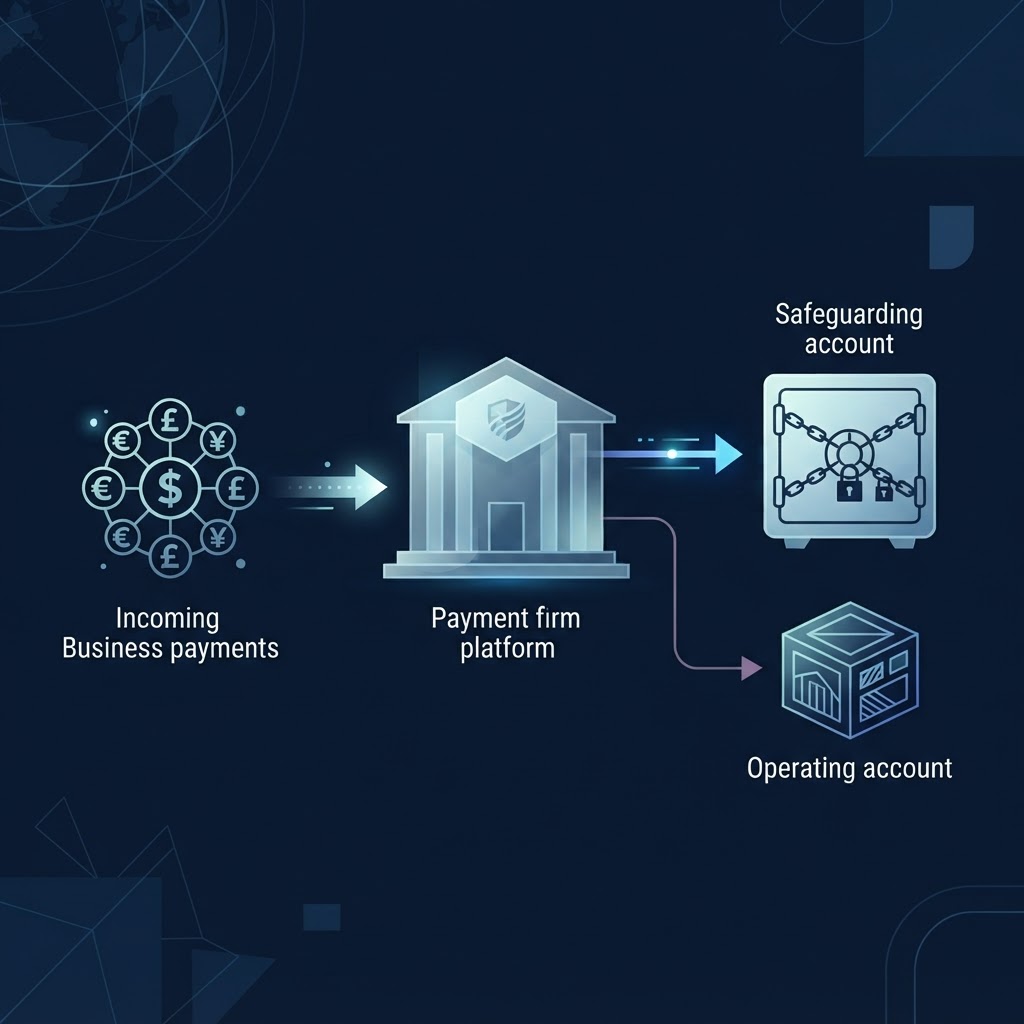
If your company holds a balance with a payment app, a multi-currency account provider or an e-money wallet, that money is not sitting in a bank account in your name. It sits in a safeguarding account: a separate account at a bank, opened by the payment firm, which exists for one reason only. If the firm fails, the money in it belongs to its customers, not to its creditors. That one sentence carries most of the protection a business has outside the banking system, so it is worth knowing exactly how it works and where it stops. ## What a safeguarding account is A safeguarding account is a segregated bank account that an e-money institution or payment institution uses to hold customer funds apart from its own money. If the firm fails, properly safeguarded funds form a protected pool, and customers' claims are paid from that pool ahead of the firm's other creditors. Three features define it: - It is the firm's account, not yours. It is opened by the payment firm at a bank and titled so that nobody can mistake it for the firm's operating account.
- •It holds many customers at once. One pooled balance stands behind thousands of individual customer balances.
- •The bank cannot touch it for the firm's debts. The bank confirms in writing that it has no right of set-off over the money. We walk through that letter clause by clause in our guide to the EMI safeguarding account. The money that must go into it has a legal name: relevant funds. Broadly, that is anything a firm receives from or for customers to execute a payment or in exchange for e-money. ## Who has to have one In the UK, safeguarding comes from two pieces of law: the Payment Services Regulations 2017 and the Electronic Money Regulations 2011. The FCA's guidance for firms sets out who is caught: | Firm type | Safeguarding | |---|---| | Authorised payment institution (API) | Mandatory, a condition of authorisation | | Authorised e-money institution (AEMI) | Mandatory | | Small e-money institution (SEMI) | Mandatory for e-money | | Small payment institution (SPI) | Optional, but if chosen, the same standard as an API | | Firms offering only account information or payment initiation | Not caught for those services, because they never hold the money | Banks are not on the list. A bank takes deposits, and deposits are covered by a different scheme. Safeguarding exists precisely because payment and e-money firms are not banks. ## How money moves through a safeguarding account ClearBank, which provides safeguarding accounts to fintechs, describes the flow in five steps: 1. The firm receives money from a customer, for a payment or in exchange for e-money.
- •It identifies how much belongs to each customer, including money received but not yet allocated.
- •It keeps that money apart from its own, in the safeguarding account or under another permitted method.
- •It reconciles its records against what is actually held.
- •The money stays protected until it stops being relevant funds, for example once a payment has reached the payee's provider. ### The next business day deadline Under the segregation method, any relevant funds the firm still holds at the end of the business day after receipt must be in the safeguarding account (or in approved secure assets). The money is protected before that point too: the duty starts when the firm receives it, not when it lands in the account. ### One pooled account, many customers Because one account backs many balances, the firm's own records do the work of telling customers apart. Since the FCA's strengthened regime took effect on 7 May 2026, firms must reconcile their internal records and the bank's figures at least once every reconciliation day, and many use virtual account numbers beneath the real safeguarding account to match each incoming payment to the right customer. Firms must also assess whether to spread safeguarded money across more than one bank, so concentration at a single institution is now a question the regulator expects them to have answered. ## Segregation or insurance: the two ways to safeguard A safeguarding account is the most common way to meet the rules, but not the only one. As Griffin, a UK bank, puts it, firms have two options: a ring fenced safeguarding account, or an insurance policy or comparable guarantee that covers all relevant funds and pays into a separate account if the firm becomes insolvent. The two are not equally popular. Segregation is the traditional route and is favoured by regulators; insurance is simpler to set up but harder to evidence to a supervisor and can become more expensive than segregation as balances grow. For the exact wording of both methods in the law, see our walk through of the PSR 2017 safeguarding requirements. From the customer's side the practical question is simple: which method does your provider use, and with whom? ## What a safeguarding account does not do This is where most marketing copy goes quiet, so here it is plainly. It is not deposit insurance. There is no scheme that pays you a fixed amount within days. When Guavapay Limited, a UK e-money institution, entered compulsory liquidation on 21 January 2026, the FCA told customers directly that the FSCS does not apply to payment services. The liquidators would assess which funds were safeguarded for customers and which belonged to the firm, then return identified money where possible, subject to the deduction of costs. It is not a guarantee of 100 percent back. A safeguarding account protects the money that was actually put into it. If a firm safeguarded badly, the pool is smaller than what customers are owed, and the costs of distributing the pool come out first. It does not cover what is not relevant funds. Only money received for payments or in exchange for e-money is in scope; anything else a provider holds for you needs its own answer. What it does do is keep customer money out of the firm's general estate, so customers are not left queuing alongside every other unsecured creditor. Whether that beats a bank deposit depends on your balance size and how fast you would need the money; we compare the two side by side in safeguarding vs FSCS. ## Safeguarding accounts outside the UK The same idea runs through EU law, under the second Payment Services Directive and the second E-Money Directive, but the account itself can look different country by country. In the Netherlands, firms have historically used a foundation trust account: a separate foundation opens the bank account, so the money is not even held in the payment firm's name. Since 2022 a second route exists, a segregated bank account the firm can hold directly, though Dutch law limits it to banks with their registered office in the Netherlands. The deposit gap is the same on both sides of the Channel. EU deposit guarantee schemes cover eligible bank deposits up to 100,000 euros per depositor per institution and do not cover e-money; safeguarding has no statutory cap, but recovery runs through an insolvency process rather than a fast payout. ## Safeguarding account vs client money account People often use "client account" and "safeguarding account" interchangeably. They are different regimes. A client money account sits under chapter 7 of the FCA's Client Assets Sourcebook and is used by investment firms and wealth managers. There, money is held on a statutory trust from the moment it arrives. A safeguarding account relies instead on segregation plus the bank's written acknowledgement. The FCA has proposed moving payments safeguarding to a statutory trust in a future end-state regime, but that is a proposal, not today's law. ## What to check if your business balance sits with a payment firm A safeguarding account is invisible to you, so the checks are questions, not documents you can open: 1. What is the firm? API, EMI, small institution, or a distributor of someone else's licence? Look for the FCA firm reference number, then check it on the FCA register.
- •Does it safeguard, and by which method? Segregation or insurance, and at which bank or banks.
- •How often does it reconcile? The answer should be daily.
- •Who holds your money if the front-end brand disappears? With distributors, the regulated entity behind the brand is the one that safeguards. Our own position, stated exactly: EXFI is a trading name of EX Financial Solutions Ltd, which is not itself authorised by the FCA and distributes payment services provided by Gemba Finance Ltd, a payment institution authorised and regulated by the FCA under FRN 804853. EXFI accounts are payment accounts, not bank accounts. They are not covered by the FSCS; funds are safeguarded in segregated accounts under the Payment Services Regulations 2017. As the exfi.app footer says: UK customers only. The four questions above are fair to ask us too. If what you actually need is the bank side of this, which UK banks offer these accounts to regulated firms, that is the subject of our guide to the safeguarding bank account in the UK. ## FAQ ### Can a normal business open a safeguarding account? No. A safeguarding account is something a regulated payment or e-money firm opens with a banking partner to hold its customers' money. An ordinary trading company holding its own cash needs a business bank account or a payment account instead. ### Is the safeguarding account in my name? No. It is held in the payment firm's name and pooled across customers. Your claim is against the firm for your balance; you have no interest in the firm's safeguarding accounts themselves, which is also why a lender cannot take security over them. ### Can a payment firm use more than one bank for safeguarding? Yes. Under the FCA rules in force since 7 May 2026, firms must periodically assess whether to diversify across safeguarding providers. That does not oblige every firm to use several banks, but it must be able to justify its choice. ### How long does it take to get safeguarded money back if a firm fails? There is no fixed timeline. An administrator or liquidator first identifies which money belongs to customers, then distributes it, and the costs of that process can be deducted from the pool before anything is returned.