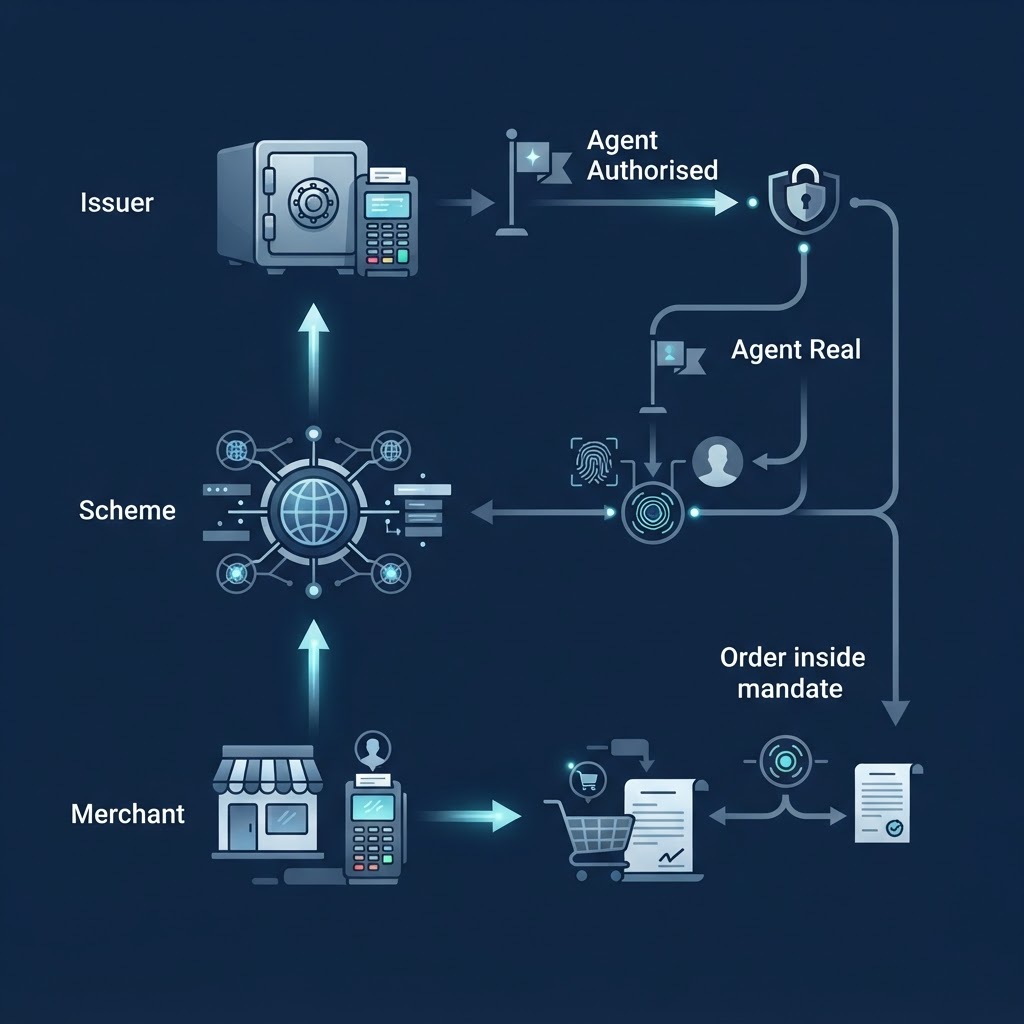
An AI agent picks a supplier, submits the payment and completes the order while nobody on your team is watching. The transaction settles normally. Three weeks later someone opens the statement and asks why the company paid for the wrong item, from the wrong merchant, at the wrong price. Agentic commerce disputes are the category of chargeback and refund claims that follow, and right now the rules for who absorbs the loss are only half written. This article walks the dispute through the three layers that decide it: card scheme rules, payment statute in the EU and UK, and the contracts of the platforms in between. It then shows why every layer ends up asking for the same piece of evidence. ## What an agentic commerce dispute actually is An agent-authorised purchase is a payment an AI agent completes inside permissions the payer granted in advance, such as a spend cap, a product category or a standing reorder. A dispute follows when the cardholder, the issuer and the merchant disagree on whether those permissions covered this specific order, as Chargeflow's chargeback analysis puts it. The ways an agent can go wrong are more varied than simple fraud. A Mondaq law-firm note lists them: the agent chose the wrong merchant, accepted a bad substitute, bought at the wrong time, exceeded its instructions, bound the principal to a subscription it never agreed to, or acted inside a technical permission envelope that was wider than the principal's real understanding. Payment processor NMI frames the resulting evidence problem in four statements that are all true at once: the agent clicked, the agent accepted the terms, the cardholder authorised the agent, and the cardholder did not authorise this purchase. Chargeback representment was built to prove the third statement. The dispute turns on the fourth. ## Fraud is handled. Everything short of fraud is not Acquirer Worldpay draws the line clearly in its piece on how agentic commerce liability is still being written. When an agent authenticates properly and a token is issued correctly, liability follows existing authenticated tokenised-transaction rules: the issuer carries fraud risk and the cardholder's chargeback rights stay intact. No liability shift exists yet, and EMVCo has stood up a dedicated task force to work out how the EMV specifications could support agentic payments. Where it gets murky is everything short of outright fraud. A payer who says the agent misunderstood an instruction or bought outside what it was authorised to buy is making a dispute claim, not a fraud claim, and today's frameworks do not have a clean answer for who absorbs it. Regulators have not filled the gap either. Chargeflow's regulatory overview notes that no US, EU or UK rule directly answers whether the consumer authorised a specific purchase or only the act of shopping, and quotes Federal Reserve Governor Christopher Waller's September 2026 speech naming authentication, liability and fraud prevention as the open challenges to scaling agent-delegated purchases. ## What the card schemes have published The schemes have moved fast on agent identity and permission, and slowly on disputes. ### Visa Visa published its Trusted Agent Protocol on 14 October 2025 with Cloudflare, using cryptographic HTTP Message Signatures so merchants can distinguish shopping agents from scrapers. Visa Intelligent Commerce launched in April 2025 and was extended by Intelligent Commerce Connect on 8 April 2026, giving agent platforms a single integration point for onboarding, verification and token issuance. The Coincub framework table records those dates and the same conclusion for each: existing card dispute rules apply, with no agent-specific dispute rule published. The most important sentence Visa has published is not in a press release. Payments analyst Matt Berryman found it in the public rules and reports it in Authorised to do what?: rule 4.1.24.10, last updated October 2025, makes a cardholder responsible for what an agentic payment provider does as part of an agentic transaction "as if the Cardholder initiated the Transaction". Rule 1.1.1.3 gives applicable law precedence wherever the two collide. ### Mastercard Mastercard announced Agentic Tokens in April 2025 as an extension of its Digital Enablement Service. The token binds a credential to a specific agent, a specific merchant scope and a specific consent policy, so the agent completes checkout without ever holding a card number. Agent Pay followed on 29 April 2025 and its Acceptance Framework lets merchants take agent-initiated payments through existing card agreements. ### American Express American Express released its ACE developer kit and Agent Purchase Protection on 14 April 2026, a commitment to back card member purchases made by registered agents. It is the only scheme-level protection statement so far that speaks directly to the cardholder's downside. ### Reason codes There is no agent-specific chargeback reason code. Agent disputes file under existing codes according to what the cardholder claims: Visa 10.4 and 13.3, Mastercard 4837 and 4853, covering unauthorised transaction, not as described, cancelled recurring and not received. The claim, not the fact that an agent was involved, decides the evidence needed. ## Where the merchant of record sits The platform layer has answered the question contractually, and the answer is consistent. The Agentic Commerce Protocol co-developed by OpenAI and Stripe states in its Delegated Payment Spec that OpenAI is not the merchant of record and that settlement, refunds, chargebacks and compliance remain with the merchant and its payment service provider. OpenAI's production guidance repeats the point. Google's Universal Commerce Protocol takes the same approach. Stripe went further on the merchant side. A new clause 1.7 in its legal terms, binding on any account kept open past 6 January 2027, makes a merchant "solely responsible for each action initiated by or through the AI Agent" and declares those actions legally binding on it. Read against Visa's cardholder rule, both ends of the transaction now carry a contractual attribution clause pointing responsibility away from the intermediary. Retailers are doing the same thing to shoppers. Bloomberg Law reports that Target updated its terms of service in March so that once a customer authorises an agentic commerce agent, any selection the agent makes is treated as authorised by the customer, even where the agent buys the wrong item or acts on a wrong price. One operational detail matters for any business that also accepts payments: your dispute ratio under Visa and Mastercard monitoring programmes counts every dispute, whatever initiated the order. An agent-driven spike in disputes is still your spike. ## What PSD2 and the UK PSR 2017 say about consent Scheme rules allocate responsibility inside the scheme. Statute asks a different question: did the payer consent? ### EU: PSD2 articles 64 to 92 Berryman's reading of the EU text is the clearest available. Article 64 says a payment is authorised only if the payer consented to it. Article 72(2) adds that a recorded use of the card is not by itself sufficient to prove consent. Article 73 puts the first refund of an unauthorised payment on the issuer, immediately and at the latest by the end of the following business day, unless it has reasonable grounds to suspect fraud and reports them. Article 74 can push some of the loss back onto a payer who acted fraudulently or with gross negligence, and Article 92 lets the issuer pursue another payment service provider to whom the liability is attributable. Responsibility and consent are not the same test, and the evidence that satisfies one may not satisfy the other. Nothing in Visa's rule contradicts PSD2, because rule 1.1.1.3 defers to applicable law, but a UK or EU payer whose agent overspent has a statutory route that a US cardholder does not. ### UK: PSR 2017 regulations 76 and 77 The UK regulations track PSD2 closely. Under regulation 76 of the Payment Services Regulations 2017, the payer's payment service provider must refund an unauthorised payment transaction as soon as practicable and in any event no later than the end of the business day following the day it becomes aware of it. Under regulation 77, the payer can be made liable for up to 35 GBP of losses from a lost, stolen or misappropriated payment instrument, and for all losses where the payer acted fraudulently or failed with intent or gross negligence to keep the instrument's security credentials safe. The unanswered question is whether an agent that acted inside a valid credential but outside the payer's intent counts as an "unauthorised" transaction under these regulations. The rules were written for a binary: the payer either consented to a specific transaction or did not. That binary is exactly what delegation to an agent breaks. ## The US contrast: Regulation E and Regulation Z The US position is worth knowing because most of the agent platforms are American and their documentation assumes it. Chargeflow's table summarises the caps: under Regulation E, which covers debit, prepaid and ACH, consumer liability for unauthorised transfers is 50 USD if reported within two business days, up to 500 USD after that, and unlimited for later transfers if the 60-day statement window is missed. Under Regulation Z, which covers credit cards, it is the lesser of 50 USD or the amount obtained before notice to the issuer. The CFPB's official interpretation of Regulation E cuts against the agent user: when a consumer furnishes an access device and grants authority to a person who then exceeds it, the consumer is fully liable for those transfers. Whether an AI agent is such a "person" has not been tested, which is why the Mondaq authors describe the Reg E requirement of actual authority as the hinge of the whole problem. The rail matters too. Bloomberg Law quotes fintech counsel noting that debit cards carry less protection than credit, and that stablecoins, often described as a natural match for agent payments, allow no refunds or chargebacks at all. An agent that settles in stablecoins has no dispute path to speak of. ## The evidence that decides it: the mandate record Strip away the jurisdiction and every layer above converges on three questions, in the order Chargeflow lists them. Was the agent authorised, and with what scope: spend cap, categories, merchants, expiry? Was the agent real, meaning can the network, issuer or merchant verify its identity and that it acts for this payer? Was this order inside the mandate: do item, price, quantity, merchant and shipping address match what was approved? A yes on the first two with an unknown on the third is the gap. Device data, IP address and session logs all describe the agent, not the buyer, so the only artefact that answers the third question is a record of the instruction and the approved cart, produced before the payment moved. That is the design problem EX FI is working on. The live EX FI site positions the company as building regulated, MCP-native banking primitives for AI agents: agent wallets, signed spending limits and programmable compliance. Those agent primitives are announced for selected partners and are not live products today. The regulated payment services behind EXFI accounts are provided by Gemba Finance Limited (FCA FRN 804853), UK customers only. As the EXFI Impressum states, these are payment accounts, not bank accounts; funds are not covered by the FSCS and are safeguarded in segregated accounts under the Payment Services Regulations 2017. The logic is simple. If a spending limit is signed by the account holder before the agent acts, the mandate record exists at the moment the dispute needs it, rather than being reconstructed from session logs afterwards. For background on how the mandate concept is standardised across protocols, see our explainer on the AP2 protocol and agent mandates, and for the broader risk picture, are AI agent payments safe. ## A checklist for businesses delegating payments to agents This is not legal or financial advice. It is the list of things the sources above show a dispute will ask for. 1. Write the mandate in a form you can produce. Spend cap, merchant scope, category scope and expiry, dated before the agent's first transaction. 2. Keep the agent's identity and the approved cart. The session log proves the agent acted. Only the cart and instruction prove what it was told. 3. Know which rail the agent used. Card payments carry statutory and scheme dispute rights. Stablecoin settlement carries none. 4. Read your provider's agent clauses. Stripe's clause 1.7 and Visa's rule 4.1.24.10 both attribute the agent's actions to you. Expect similar terms from other platforms. 5. Count agent orders in your dispute ratio. If you also accept payments, agent-initiated disputes land in the same monitoring programmes as human ones. 6. Prefer a human confirmation step for anything irreversible. Consumer lawyers quoted by Bloomberg Law point out that a human final decision sidesteps most of the open liability questions. For how the EU is approaching the regulatory side of this, including PSD3 and the Payment Services Regulation, see our piece on agentic commerce in the EU. ## FAQ ### Is a purchase made by my AI agent an unauthorised transaction? Not automatically. Visa's rules attribute an agent's purchase to the cardholder as if they initiated it, while PSD2 and the UK PSR 2017 ask whether the payer consented to that specific payment. No published rule yet says how a transaction inside a valid credential but outside the payer's intent is classified. ### Is there a chargeback reason code for AI agent purchases? No. Visa and Mastercard have published no agent-specific code. Agent disputes file under existing codes such as Visa 10.4 and 13.3 or Mastercard 4837 and 4853, depending on what the cardholder claims. ### Who is the merchant of record when ChatGPT or another agent completes checkout? The merchant that sells the goods and takes payment. The Agentic Commerce Protocol's Delegated Payment Spec states that OpenAI is not the merchant of record and that refunds and chargebacks remain with the merchant and its payment service provider. ### Can I dispute an agent payment made in stablecoins? There is no equivalent dispute path. Stablecoin payments do not carry refund or chargeback mechanisms, so a wrong purchase settled in stablecoins can only be recovered by agreement with the recipient.
Back to News
Insights 12 min read12 October 2026
Agentic Commerce Disputes: Who Pays When an Agent Buys Wrong
Who pays when an AI agent buys the wrong thing? How card scheme rules, PSD2 and the UK PSR 2017 handle agentic commerce disputes and chargebacks today.
E
EX FI