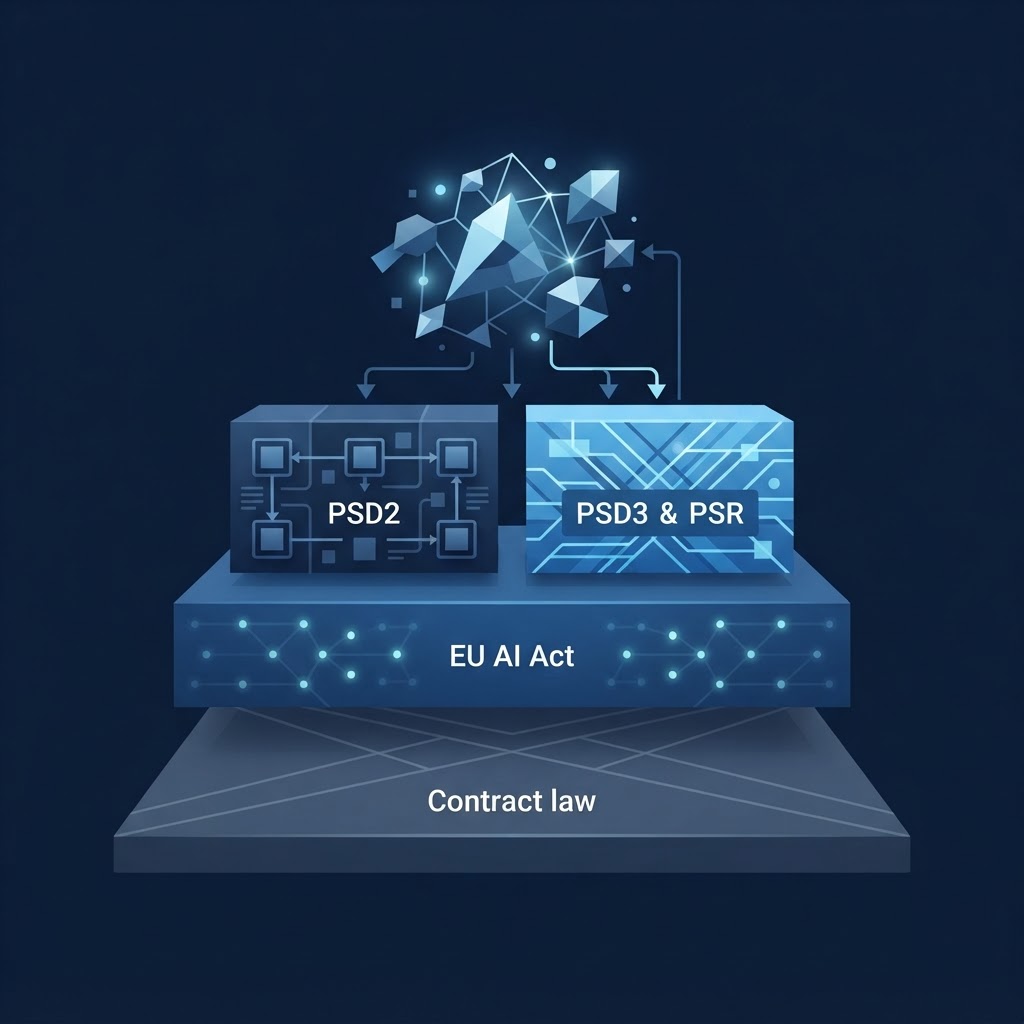
Agentic commerce in the EU is no longer a slide in a strategy deck. In June 2026, according to Worldline's agentic commerce white paper, Europe's first end-to-end agentic payments were completed in production across several countries, with Worldline, Mastercard, Visa, Credit Agricole and ING involved. The technology works. The open question is the legal one: which EU rules decide whether an AI agent's payment is authorised, who must authenticate it, and who refunds it when it goes wrong. The short answer is that there is no special EU regime for agent payments, and the new payments package does not create one. Agents are fitted into four existing frameworks: PSD2 today, PSD3 and the Payment Services Regulation (PSR) next, the AI Act alongside them, and contract law underneath. This guide takes them in that order and ends with what a business should have in place now. ## There is no EU agentic payments law, by design Law firm Osborne Clarke states it plainly: within the EU, agent-based payment models remain subject to PSD2 and the regulatory technical standards on strong customer authentication (SCA), and there is no special "extra-regulatory" regime. The questions are functional. Who is actually providing a payment service? Who holds or controls the funds? What counts as valid authorisation when an agent acts? The industry is lobbying to keep it that way. In its October 2026 paper on agentic AI in finance, DIGITALEUROPE argues that the EU should not reopen the AI Act or introduce new agentic-AI-specific financial services legislation, and should instead clarify how PSD2, PSD3, the PSR, DORA, the GDPR and eIDAS apply to agentic use cases. The European Payment Institutions Federation takes a similar line in its 7 October 2026 position paper: with the right technical framework, the current regulatory foundation can accommodate agentic experiences, and it does not expect AI-assisted commerce in itself to require significant changes to how dispute costs are allocated. So the useful work is not waiting for a new law. It is mapping an agent's payment onto the rules that already exist. ## PSD2 today: consent, SCA and the licence question ### Consent can cover a series of payments Under PSD2, a payment is authorised only if the payer consented to it. Taylor Wessing's analysis notes that PSD2 is technology neutral and generally applies to AI agents making payments on a customer's behalf. Consent can be given before or after execution, can cover a series of transactions, and its form is left to the contract between the payer and their payment service provider (PSP). In principle, the framework contract can be drafted so that consent covers a series of agent-initiated payments limited to criteria the customer specified. The hard part is the boundary. PayTechLaw sets out the questions German and EU lawyers are now asking: is a mandate given to an agent in advance enough to count as authorisation under Article 64 PSD2 (Section 675j of the German Civil Code), how specific must the instructions be, how much discretion may the agent have, and how can anyone show in a dispute that a specific payment stayed inside the mandate? ### SCA was built around a person SCA requires two of three elements: something the payer knows, has or is. Taylor Wessing points out that all three are tied to a person, which makes SCA particularly hard to satisfy when an agent pays at the final step. The live debate is whether each agent payment needs fresh authentication, whether a granular mandate authenticated once is enough, and whether existing exemptions such as low value, trusted beneficiaries, transaction risk analysis or merchant-initiated transactions can carry the load. That last exemption is narrower than it looks. An EU-law study of payment agents by Grabowski and Costea concludes that agentic payments are not equivalent to merchant-initiated transactions, because in an MIT the payee initiates the payment within scheme processing. An agent acting for the payer is a different thing. ### Who needs a licence Enabling others to initiate or execute payments is, as a rule, a regulated payment service in the EU. Taylor Wessing explains that a company supplying only technical infrastructure may fall under the technical service provider exclusion, as long as it never holds client funds and a licensed PSP handles initiation or execution. A non-regulated firm can hardly bring a complete agent payment product to the EU market alone. Grabowski and Costea go a step further. An agent that initiates payments directly from a payment account under a protocol-only model may amount to a payment initiation service, which implies licensing and SCA, and the authors compare that setup to screen scraping. Where an agent provider and a separate credentials provider split the roles by contract, the arrangement may resemble a payment scheme and can bring in EBA outsourcing rules and, for ICT services, DORA. ## What PSD3 and the PSR change ### Where the package stands The European Parliament announced that negotiators reached a deal on PSD3 and the PSR in November 2025. Parliament's Legislative Train records the provisional political agreement on 27 November 2025 and approval of the agreed text by the ECON committee on 5 May 2026; the deal still needs formal adoption by Parliament and Council before it can enter into force. Arthur Cox summarises the timing once it does. Member States get 21 months from PSD3's entry into force to transpose it, and the PSR, as a regulation, applies directly across the EU from that same date. The verification of payee articles apply 27 months after entry into force. PSD3 repeals both PSD2 and the E-Money Directive, and moves conduct rules into the directly applicable PSR so that national implementations diverge less. ### The changes that matter for agents None of these provisions mentions AI agents. PayTechLaw is explicit that the new framework contains no specific provisions for agentic payments. But several of them land squarely on agent flows: - Spending limits. Parliament's summary says PSPs must offer spending limits and blocking measures. For an agent, a limit set at the account is a second line of defence behind whatever the agent's own mandate says.
- •Fraudster-initiated payments. If a fraudster initiates or changes a transaction, it is treated as unauthorised and the PSP is liable for the full fraudulent amount. A hijacked or manipulated agent is an obvious test case.
- •Fraud prevention liability. A PSP that fails to implement appropriate fraud prevention mechanisms will be liable for customers' losses.
- •Name and IBAN matching. PSPs must check that the payee's name matches its unique identifier and refuse the payment if it does not, which catches an agent paying a lookalike supplier.
- •Clearer SCA. Arthur Cox notes the rules clarify precisely when SCA applies, with clearer treatment of merchant-initiated transactions, and require SCA methods that are free and do not depend solely on a smartphone. DIGITALEUROPE suggests the regulatory technical standards on SCA under Article 89 of the PSR are where the agent question should be settled, including whether SCA performed when a mandate is set up could cover later transactions inside its limits. ## The AI Act: an AI system, usually not high risk ### Is a payment agent high risk? Grabowski and Costea conclude that payment agents will as a rule qualify as "AI systems" under the AI Act, while payment protocols are transactional infrastructure rather than general-purpose AI models. Typical agentic payment use cases are not currently listed as high risk in Annex III. Taylor Wessing adds that an agent's risk category depends on its tasks and data: one that assesses creditworthiness would fall into the high-risk regime. ### The dates after the Omnibus The European Commission's AI Act page confirms the Act became applicable on 2 August 2026, with exceptions. After the AI Omnibus, which entered into force on 27 July 2026, rules for high-risk use cases in Annex III apply from 2 December 2027 and those for high-risk systems embedded in regulated products from 2 August 2028. For the wider picture beyond payments, EX AI Summit tracks which AI regulatory compliance rules are actually in force. What does apply now is transparency. Under Article 50, in force from 2 August 2026, providers must design AI systems so people know they are interacting with one, with fines of up to 15 million EUR or 3% of worldwide annual turnover. A shopping agent talking to a customer is squarely in scope. ### Who is the deployer? A European Journal of Risk Regulation article flags a gap that matters more than the risk label: it is unclear whether the consumer configuring an agent, the platform providing it or the bank executing the payment is the "deployer" under Article 26. The same authors note that the human oversight required by Article 14 for high-risk systems may be impractical when transactions run in milliseconds. ## The UK is moving on its own track Since Brexit, PSD3 and the PSR do not apply in the UK, where the Payment Services Regulations 2017 remain the reference. UK regulators are signalling their own approach. Pinsent Masons reports that FCA chief executive Nikhil Rathi said accountability for regulated outcomes "must remain clear" where agentic systems are deployed, and Bank of England deputy governor Sarah Breeden named consent for multiple transactions, dispute liability and protocol fragmentation as the biggest issues. The firm expects new UK rules on consent and authorisation, possibly splitting authorisation into the initial mandate and a check that each payment sits inside it. A group trading in both markets should expect two answers to the same question. ## What to have in place now Every source above converges on the same evidence: a mandate you can prove. Osborne Clarke calls it bounded delegation and lists what the audit trail must show: who granted consent, what the mandate included, which limits applied, whether step-up or SCA was triggered, and exactly what the agent did. DIGITALEUROPE wants delegated authority that is explicit, limited, revocable and auditable, with no credential sharing or impersonation. EPIF points to tamper-proof, cryptographically signed payment mandates as one way to prove the consumer's intent. This is not legal or financial advice, but the checklist follows directly: 1. Define the mandate in writing before the first payment. Amount caps, frequency, merchant or payee allow-lists, categories and an expiry date.
- •Keep the agent off your credentials. Use tokens or delegated access, never a shared login, which is the setup the EU-law study compares to screen scraping.
- •Set account-level limits too. Use the spending limits and blocking tools your PSP offers, and expect them to be mandatory under the PSR.
- •Log the instruction and the approved basket, not just the payment. That is the evidence a dispute will ask for. Our guide to agentic commerce disputes walks through how card schemes and PSD2 consent rules decide them.
- •Check who is licensed in your chain. If your agent provider is not a PSP, find out which PSP initiates and executes the payment.
- •Disclose the AI. If an agent interacts with your customers, Article 50 transparency already applies. This is the problem EX FI is building for. The EX FI site positions the company as building regulated, MCP-native banking primitives for AI agents: agent wallets, signed spending limits and programmable compliance. Those agent primitives are announced and not live products today. The regulated payment services behind EXFI accounts are provided by Gemba Finance Limited (FCA FRN 804853), UK customers only. As the EXFI Impressum states, EXFI accounts are payment accounts, not bank accounts; funds are not covered by the FSCS and are safeguarded in segregated accounts under the Payment Services Regulations 2017. For the protocol side of mandates, see our explainer on the AP2 protocol and agent mandates, and for how this works between companies, agentic commerce B2B. If you are still deciding whether to let an agent pay at all, start with are AI agent payments safe. ## FAQ ### Is agentic commerce legal in the EU? Yes. No EU rule prohibits AI agents from shopping or paying. Agent payments must meet the same PSD2 requirements as any other payment: valid consent, SCA where required, and a licensed payment service provider somewhere in the chain. ### Will PSD3 and the PSR regulate AI agents directly? No. The agreed texts contain no agent-specific provisions. Their new rules on spending limits, fraud liability, payee name checks and SCA will still apply to agent-initiated payments, and the SCA technical standards under Article 89 of the PSR are the likeliest place for agent guidance. ### Does an AI shopping agent need a payment licence in the EU? It depends on what it does. An agent that initiates payments from a customer's payment account may be providing a payment initiation service, which requires authorisation. A provider that only supplies technical infrastructure, never holds funds and works with a licensed PSP may fall under the technical service provider exclusion. ### When do AI Act rules apply to payment agents? The transparency duties in Article 50 have applied since 2 August 2026. High-risk obligations for Annex III use cases apply from 2 December 2027, but typical agentic payment use cases are not currently listed there; an agent that scores creditworthiness would be.