Agentic commerce is buying and selling where an AI agent does the shopping. You state a goal and a budget. The agent searches, compares, chooses and, increasingly, pays. IBM defines it as AI agents that research, negotiate and complete purchases on behalf of consumers or businesses, often without direct human intervention.
The term is everywhere and most explainers lead to someone's platform. This one separates what is live from what is announced, puts the protocol alphabet in one table, and says what changes for a UK or EU business on both sides of the till. Where a topic needs more depth, it links to a dedicated EX FI guide.
What is agentic commerce?
IDC gives the sharpest definition: the buyer delegates discovery and purchase to an agent that uses preapproved payment methods, and the human never sees the store. Consent is given when the task is assigned, not at a checkout page.
Three things follow from that:
- •The customer is software. The agent arrives as a nonhuman actor with its own credentials, delegated authority and spending limits.
- •Control moves to the buyer. The agent works for the person who set the rules, not for the brand or marketplace it is browsing.
- •It is not only retail. IBM lists travel, ticketing, subscriptions and digital services alongside online shopping.
How agentic commerce differs from ecommerce
In ecommerce a person searches, opens tabs, reads reviews and types card details. In agentic commerce the person delegates and, at most, approves. The work between those two moments belongs to the agent.
SAP adds a useful split. Consumer-side agents help a buyer find and evaluate products, often routing intent back to a merchant's storefront. Merchant-side agents work inside the business on merchandising, fulfilment, inventory and service. "Agentic commerce" covers both, which is why two people using the term can mean different things.
There is also an awkward detail for sellers. IDC notes that an agent entering through a browser is indistinguishable from human traffic, and that card-not-present rules were designed for humans. A merchant often cannot tell who, or what, is buying.
The five levels of delegation
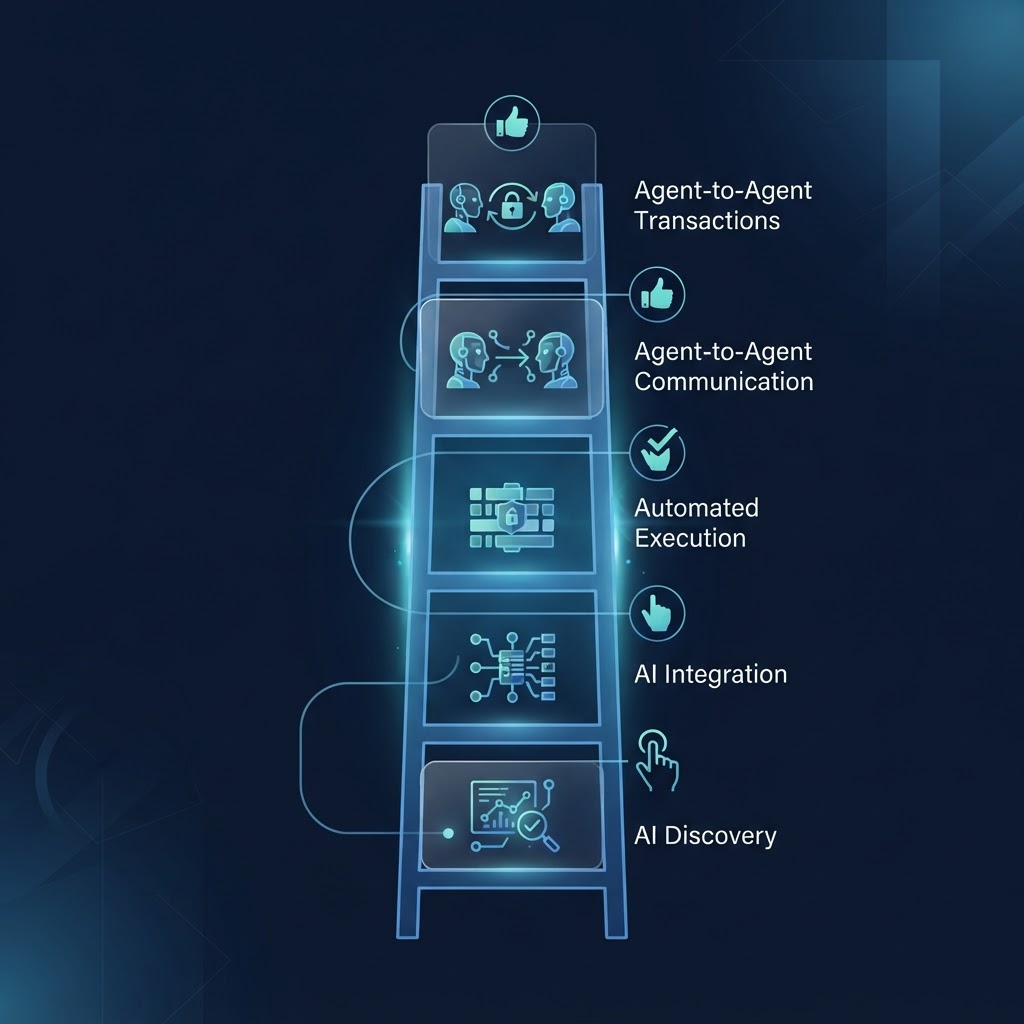
Agentic commerce is a spectrum, not a switch. AWS describes five levels of delegation:
| Level | What the agent does | Who confirms the purchase |
|---|---|---|
| AI-powered discovery | Recommends products against your constraints | You, on the merchant site |
| Conversational checkout | Pre-fills shipping and payment details | You, inside the chat |
| Autonomous purchasing | Buys within limits you set in advance | Nobody at the moment of purchase |
| Automated replenishment | Reorders when a rule fires, such as low stock | The rule |
| Agent-to-agent | Negotiates and transacts with a merchant's agent | Neither human, in real time |
Most of what consumers can use today sits in the first two rows. The lower rows are where the consent, liability and payment questions get hard. For the step-by-step walk from prompt to settled money, see our guide to agentic commerce and payments.
Who is building it: the protocol map
The second reason the topic feels confusing is the alphabet. These are the standards that keep appearing, and the job each one does.
| Protocol | Backed by | Job |
|---|---|---|
| MCP (Model Context Protocol) | Created by Anthropic, now at the Linux Foundation | Connects an agent to tools, data and services |
| A2A (Agent2Agent) | Google, Linux Foundation | Lets agents discover and delegate to other agents |
| ACP (Agentic Commerce Protocol) | Stripe and OpenAI | Checkout between an agent and a merchant |
| UCP (Universal Commerce Protocol) | Listed by AWS among the open protocols | Agent access to merchant systems |
| AP2 (Agent Payments Protocol) | Google, with PayPal and others | Signed mandates proving what the user authorised |
| Visa TAP, Mastercard Agent Pay | Card networks | Anchor agent identity to card authorisation |
| x402, MPP | Coinbase and Cloudflare; Stripe and Tempo | Pay per request for APIs, data and compute |
MIT's Initiative on the Digital Economy records that MCP was donated to the Linux Foundation's Agentic AI Foundation in December 2025 and that A2A launched in April 2025. AWS lists MCP, A2A, ACP and UCP as the interoperability layer. AP2's Cart Mandate covers a human-present purchase and its Intent Mandate a human-not-present one, and PayPal stresses that accountability stays with real-world entities, not the agent. Our explainer on AP2 mandates goes deeper, and the guide to AI agent payment rails compares cards, bank transfers and stablecoins.
The practical point: no single protocol does everything. AWS flags protocol fragmentation as a live risk, and any real deployment stacks several of these.
What is live today, and the numbers
Some of agentic commerce is already in production. IBM cites Google's AP2, Visa's AI-ready tokenised credentials and Stripe's instant checkout inside ChatGPT. Mastercard describes its agentic tokens as a stand-in for card credentials within defined permissions, with the stated goal of "safer, controlled delegation, not unrestricted authority".
The measured volumes are smaller than the headlines. A report Visa commissioned from Artemis counts 135.7M USD across 178.3M x402 transactions since May 2025, and over 38,000 USD across about 184,600 MPP transactions since mid March 2026, both raw onchain totals as of 21 April 2026. A November 2026 review in The Journal of FinTech finds that activity across those protocols is largely pay per use micropayments for digital resources, concentrated in a small number of services.
The forecasts are much larger. McKinsey projects up to 1 trillion USD of orchestrated US B2C retail revenue by 2030, and 3 to 5 trillion USD globally. That is a projection. Plan on the measured numbers and watch the forecast.
What changes if you sell online
If agents will buy from you, the first job is being legible to them.
- •Make your catalogue machine-readable. IBM points to generative engine optimisation: standardised attributes, clean metadata and structured product data an agent can parse. An agent that cannot read your stock, price and delivery time will pick someone else.
- •Expose what an agent needs to decide. Catalogue, real-time availability, pricing, returns and warranty terms through interfaces, not only through web pages built for eyes.
- •Decide how you will treat agent traffic. Since agents can look like humans in a browser, your fraud rules may block good agents or wave through bad ones. Card network agent programmes exist to make the agent identifiable.
- •Plan for the unhappy path. When an agent buys the wrong thing, someone files a dispute. Our guide to agentic commerce disputes covers how card rules and UK law handle it today.
What changes if your business buys through agents
If agents will buy for you, the job is control.
- •Write the mandate before the agent runs. AWS recommends strict approval thresholds and human-gated approvals for anything outside the routine. Spell out merchants, categories, budget and timing.
- •Know what UK law treats as consent. Under regulation 67 of the Payment Services Regulations 2017, consent can be given to a single payment transaction or to a series of them. A standing agent mandate fits that shape, but only if the limits are real. Our guide on how an agent gets permission to spend walks through the four ways it is done.
- •Enforce limits outside the model. A budget written into a prompt can be overridden by a prompt injection. Put caps on the account, card or token the agent uses.
- •Ring-fence the money. Fund the agent from a separate balance with only what it needs. For procurement flows with approvals and supplier payments, see agentic commerce in B2B.
The open problems
Four problems decide how fast this moves.
- •Trust. IBM's research finds 83% of consumers share overlapping worries about privacy, data misuse and unsolicited marketing. MIT IDE cites a 2025 Visa report in which 79% of consumers interested in AI commerce expressed data privacy concerns.
- •Accountability. When an agent makes an unauthorised purchase, the human who delegated, the platform, the model provider and the merchant all have plausible claims, and the Visa and Artemis report notes there may be no clear precedent. EX AI Summit covers the wider legal debate on liability for AI agents.
- •Security. Prompt injection can redirect purchases or trigger unauthorised spend, and the attack surface grows with autonomy. We assess the controls in whether AI agent payments are safe.
- •Legacy rails. Gateways, fraud engines and KYC systems were built with humans in the loop. Banks and payment providers are adapting; see agentic commerce banking for what that means for your account, and agentic commerce in the EU for PSD3, the PSR and the AI Act.
Where EX FI fits
EX FI is building for the account layer underneath all of this. What is live today is multi-currency business payment accounts with dedicated IBANs and payment rails over SWIFT, SEPA, FPS, BACS and CHAPS, the kind of ring-fenced balance an agent mandate should draw from. MCP-native agent primitives and stablecoin rails are announced, not live, and we do not describe them as available.
Regulated payment services provided by Gemba Finance Limited (FCA FRN 804853). UK customers only. EXFI is a trading name of EX Financial Solutions Ltd, which is not itself authorised by the FCA and acts as a distributor of Gemba Finance's services. EXFI accounts are payment accounts, not bank accounts: funds are not covered by the FSCS but are safeguarded in segregated accounts under the Payment Services Regulations 2017. Nothing here is financial advice.
FAQ
Is agentic commerce already happening?
Yes, at the assisted end. In-chat checkout, tokenised agent credentials and signed purchase mandates are in production. Fully autonomous buying, where no human confirms at the moment of purchase, is still early and measured volumes remain small.
What is the difference between agentic commerce and conversational commerce?
Conversational checkout is one level of agentic commerce: the agent fills in the details and you confirm in the chat. Agentic commerce also includes levels where the agent buys on its own within limits you set beforehand, or transacts with another agent.
Who is liable when an AI agent buys the wrong thing?
There is no settled answer yet. The person who delegated, the agent platform, the model provider and the merchant can all be argued responsible, and existing frameworks were not written for that chain. In practice, card scheme dispute rules and UK payment regulations apply first.
Can a UK business let an AI agent pay from its account?
The law allows consent to a series of payments, so a standing mandate is possible. The safe version funds the agent from a separate balance, enforces caps at the account or card level, and keeps records of what was authorised. EX FI's agent-specific primitives are not live yet.