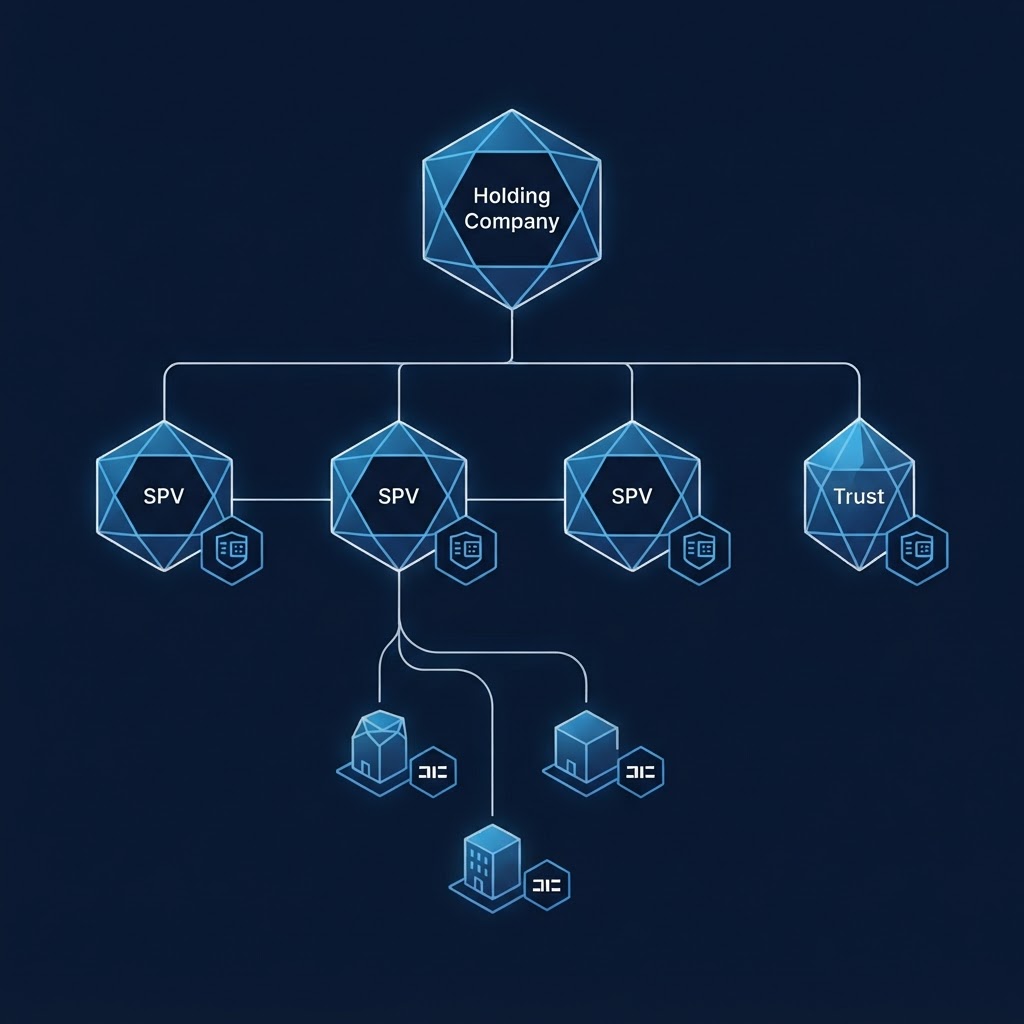
A family office rarely runs one company. It runs a holding company, a property SPV or three, a vehicle for private equity commitments, perhaps a trust, and an operating business that started it all. So the pitch for a virtual IBAN for family office use sounds perfect: one IBAN per vehicle, one dashboard, no new bank relationship every time the family buys a building.
Half of that pitch is true. The other half depends on a question most provider pages never ask: whose money sits behind the IBAN? Get that answer wrong and the neat structure on your org chart is a single commingled pot on the provider's books. This guide gives you the rule we use to decide, the regulation behind it, and the paperwork that keeps each entity clean.
What a virtual IBAN actually is, in family office terms
The European Banking Authority's report on virtual IBANs describes the common pattern. A virtual IBAN has the same format and functionality as a regular IBAN. It is linked to a master account that has its own, different IBAN. Incoming payments are credited to that master account, and to the payer the virtual IBAN is typically indistinguishable from any other.
That is the whole trick: a virtual IBAN is an identifier, not a separate pot of money. Our explainer on how a virtual IBAN works walks through the routing step by step.
The master account decides who owns the money
The detail that matters for a family office is in the same EBA report. The master account can be held in the end user's own name, or in the name of another entity that hands out the virtual IBANs. In the second case it may double as that institution's safeguarding account, and the EBA notes that end users who are not the master account holder may not have a payment account of their own at all.
Apply that to a family structure. If the holding company holds the master account and issues virtual IBANs labelled "Property SPV 1" and "Property SPV 2", the money that lands on those IBANs is, legally, the holding company's money with a label on it. The label helps your bookkeeper. It does not give SPV 1 an account.
European law has started to catch up. Tomberg & Partners points out that Article 2 of the EU Anti-Money Laundering Regulation, Regulation (EU) 2024/1624, now defines a virtual IBAN as an identifier routing payments to a master account with a different IBAN. Stibbe puts the date that regulation starts to apply at mid-2027. The direction of travel is clear: identifier and account are different things, and supervisors will treat them differently.
Where virtual IBANs genuinely help a family office
None of this makes virtual IBANs a bad tool. Among the benefits market participants reported to the EBA, PayTechLaw lists facilitating the centralisation of payments within a group and reducing the complexity and cost of opening and managing separate bank accounts. Both are real for a family office, as long as you use them inside the right boundary.
Sorting inflows inside one entity
The strong use case is many flows, one owner. Inside a single property SPV, give each building or each tenant its own virtual IBAN, so rent arrives already tagged. Inside a co-investment vehicle, give each co-investor a virtual IBAN for capital calls, so you can see who has paid without chasing references. Inside the holding company, separate dividend receipts from loan repayments.
Bank-grade virtual account systems are built for exactly this. BNP Paribas describes its virtual account management as a way to segregate transactions by entity, business line or counterparty, produce statements per virtual account, and rationalise the number of physical accounts.
Reconciliation at the point of receipt
The payoff is time. Clear Junction describes attribution happening at the point of receipt rather than after an investigation, provided the operator keeps its house in order: clean creation and closure of identifiers so none are orphaned, consistent mapping, and balances that agree across the internal ledger, bank statements and safeguarding reports. For a lean family office team that closes the books for six entities every quarter, that is the difference between a morning and a week.
Where they do not: one SPV, one account in its own name
The boundary is the legal entity. A family office banking guide from Global Investments sets out the standard: in a well-structured family office, each trust, company or personal holding has its own account or accounts, because commingling assets between entities creates legal, tax and beneficiary problems.
The vehicles that own assets, sign contracts, borrow, and file their own accounts each need money in their own name. That means a dedicated account, or at minimum a named account where the entity, not the holding company, is the account holder. If you are weighing those two, our guide to the named virtual IBAN explains what the label "named" does and does not promise.
Commingling and the intercompany loan problem
Here is the consequence people discover at audit. The Association for Financial Professionals' guide to concentrating cash across borders is blunt: any physical transfer of funds between accounts held in the name of separate legal entities creates an intercompany loan. The same guide describes the clean alternative, a virtual account network under a header account that mirrors the group as an in-house bank, with intercompany positions settled as book entries and arm's length interest applied.
Read those two sentences together. Moving money between your SPVs is fine. Pretending it did not move, because the "accounts" were only labels on one pot, is not. Treat every entity-to-entity flow as a documented intercompany transaction, and if the volume grows, look at multilateral intercompany netting or a proper in-house banking structure rather than more labels.
Name checks: Confirmation of Payee and Verification of Payee
The second consequence shows up when someone pays you. In the UK, Confirmation of Payee checks the name the payer types against the name on the receiving account. In the euro area, the Instant Payments Regulation made Verification of Payee mandatory for payment service providers from 9 October 2025.
A tenant paying "Property SPV 1 Ltd" into an IBAN registered to the holding company may get a warning. The Euro Banking Association's paper on Verification of Payee matching lists virtual IBANs among the set-ups that make matching hard, and Tomberg notes that a pooled virtual IBAN cannot pass a name-match check at all. A warning on every rent payment is not a compliance breach, but it is friction, and it invites the payer to ask questions you would rather not answer by email.
A decision rule for structuring entity accounts
We reduce it to three layers.
| Layer | What it is | What it needs |
|---|---|---|
| Legal entity | Holding company, each SPV, each trust, the operating company | An account in its own name, onboarded on its own |
| Flow inside an entity | Rent per building, capital calls per investor, dividends versus loan repayments | A virtual IBAN on that entity's own account |
| Group view | Consolidated cash, approvals, reporting for the family | A dashboard or reporting layer across entities, not a shared account |
The test for the first row is simple: if the entity will appear on a contract, a land registry entry or a tax return, it gets its own account. Everything else is labelling, and labelling is where virtual IBANs shine.
Providers that serve family offices increasingly sell the group view on top of separate accounts. Oxen pitches a dedicated named IBAN for each investment vehicle with transfers between them on one platform, and Narvi describes one login across all companies with access granted company by company. Whatever platform you choose, ask the same question: is each entity the account holder, or is it a line on someone else's ledger?
Onboarding each entity: what compliance will ask for
Separate accounts mean separate onboarding, and that is where family offices lose weeks. A KYC checklist for holding companies and SPVs from ENTER lists what compliance teams want: a source of funds declaration, a source of wealth declaration for each ultimate beneficial owner, a written purpose for the entity and the account, expected counterparties and volumes, and the intercompany agreements that govern money moving through the structure. It names a vague source of funds declaration as the most common reason holding company applications are rejected.
The efficient move is to build the pack once. One current structure chart, one set of UBO source of wealth narratives, and signed intercompany loan and management fee agreements can be reused for every vehicle you onboard. The second SPV then takes a fraction of the effort of the first.
Safeguarding: what protects the money behind the IBAN
Whatever the identifier, ask where the money sleeps. Under Regulation 23 of the Payment Services Regulations 2017, a UK payment institution must segregate relevant funds and place them in a separate designated account with an authorised credit institution. The FCA reminds customers that money held with a payment or e-money institution is not covered by the FSCS. Safeguarding protects funds by keeping them apart from the provider's own money; it is not deposit insurance. Our guide to the safeguarding account explains how that works in practice.
How EX FI fits a family office structure
We would rather state our position exactly than let a badge imply one. EXFI is a trading name of EX Financial Solutions Ltd, which is not itself authorised or regulated by the FCA and acts as a distributor of payment services provided by Gemba Finance Limited, FCA FRN 804853. Regulated payment services are for UK customers only. EXFI accounts are payment accounts, not bank accounts. They are not covered by the FSCS, and funds are safeguarded in segregated accounts in accordance with the Payment Services Regulations 2017.
Within that, the set-up maps onto the three layers above. EX FI accounts are for business customers, and each entity applies in its own name with full online KYC, with standard applications reviewed within 24 to 48 hours. Balances can be held in GBP, EUR, USD, CHF and more than a dozen other currencies, each with its own dedicated IBAN where applicable, over SWIFT, SEPA, Faster Payments, BACS and CHAPS. Transfers between EX FI accounts are free, SEPA and UK Faster Payments cost 0.99 GBP, international SWIFT 26.40 GBP, and FX is 0.70 percent on major pairs and 0.90 percent on minors. UK-incorporated entities pay no monthly fee, no opening fee, and hold no minimum balance, so adding the next SPV does not add a standing cost.
None of this is tax or legal advice. How your entities lend to each other, and on what terms, is a question for your advisers; the accounts only make the answer visible.
FAQ
Can a trust in a family structure use a virtual IBAN?
Only as a label on an account. If the trust must hold its own money, which it usually must for beneficiaries and trustees to be protected, it needs an account where the trust or its trustees are the account holder. Whether a provider onboards trusts at all varies; EX FI accounts are for business customers only.
Do virtual IBANs show up in national account registers?
It depends on the country. Germany has led: PayTechLaw reports that since a 2020 BaFin administrative act, a credit institution issuing a virtual IBAN for a payment service provider must register it with the provider as account holder and the end user as beneficial owner. At EU level, the AMLR definition takes effect from mid-2027.
Can one director run every entity from a single login?
Yes, technically, on platforms that offer a multi-entity dashboard. Legally, each entity's mandate should still mirror its own board authority, so a director of the holding company is not automatically entitled to move money out of an SPV whose board they do not sit on.
Is a virtual IBAN cheaper than opening another account?
Inside an existing entity, yes: a new identifier needs no new KYC. For a new legal entity, no. The entity is onboarded on its own either way, so the saving a virtual IBAN offers is not available exactly where a family office most often wants it.