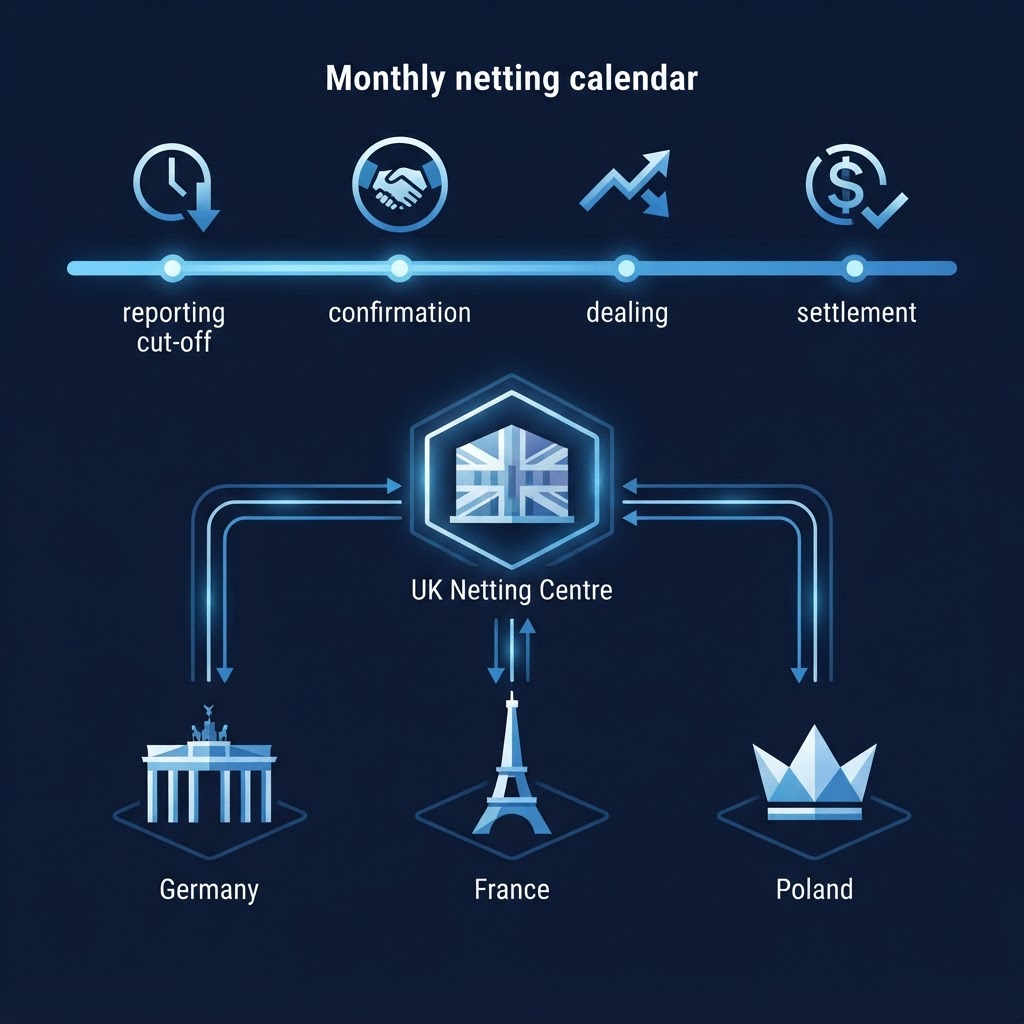
Multilateral intercompany netting is the moment a group stops paying itself invoice by invoice. Every entity reports what it owes and is owed to the others, a netting centre works out one net position per entity, and on a fixed date each company makes or receives a single payment. Nothing about the underlying invoices changes. Only the cash movement shrinks.
The concept is easy. Most of what is written about it stops there, or at a toy example with three subsidiaries called A, B and C. This guide is the part after the definition: how to tell whether your group is ready, the five decisions you make before the first cycle, what the month looks like, and how each entity books it. If you want the arithmetic first, our multilateral netting example works a four-entity GBP, EUR and PLN case end to end. If you are still choosing between approaches, read bilateral vs multilateral netting.
This is general information for finance teams, not accounting, tax or legal advice. Every jurisdiction in your group needs its own check.
What multilateral intercompany netting is, and is not
In a multilateral scheme the netting centre, usually group treasury or a treasury subsidiary, acts as the counterparty to every participant for the cycle. Subsidiaries stop paying each other directly. Net payers pay the centre, net receivers are paid by it. The flows are typically trade related: intercompany sales of goods, management fees, royalties and shared service recharges.
Why it matters more as a group grows: the number of possible payment relationships rises with every entity added. A five-entity group already has up to 20 bilateral intercompany pairs, and every one that settles over external rails pays a fee and, if currencies differ, an FX margin. Multilateral netting replaces all of them with at most one payment per entity.
What it is not: a liquidity tool. Netting reduces the number and value of settlements. It does not move surplus cash to where it earns more or fund a deficit; that is cash pooling, covered in the FAQ below.
Is your group ready for it?
Size alone is a weak signal. Research by Coprocess (now part of GTreasury) found that the number of subsidiaries is the least important factor in whether a company uses netting. Intercompany payment volume, the share of those payments that need FX and the number of currencies matter more. The same report offers a rough test:
| Factor | Netting unnecessary | Netting clearly needed |
|---|---|---|
| Entities | 1 to 3 | More than 10 |
| Intercompany payments | Under 5 million USD | Over 20 million USD |
| FX share of intercompany payments | Under 10 percent | Over 20 percent |
| Currencies | 1 or 2 | 5 or more |
Its rule of thumb: if three or more factors sit in the left column, netting is unnecessary; if two or more sit in the right column, it is clearly needed. Everything in between deserves a look. In the survey, 45 percent of companies used a centralised netting system, and groups with six or more currencies and at least 11 percent of payments involving FX adopted netting at a rate of 68 percent.
A UK parent with German, French and Polish subsidiaries invoicing each other monthly for services sits squarely in the middle band. Four entities, three currencies, most flows cross a currency. That is the profile where the decision is worth making deliberately rather than by habit.
Five decisions before the first cycle
Sign a netting agreement
Each subsidiary is a separate legal person. A right to set off what one owes against what another owes it is not automatic between entities that are separate legal persons, so groups document it in a written agreement among all participants. It should say which balances may be netted, how the centre settles them, the calendar, how disputes are handled and what happens when an entity leaves or fails to pay. The same source flags a quieter risk: the centre's own balances with each entity must be settled or reviewed on a cadence, not left to build up.
Choose the netting centre
Coprocess describes the centre as either an existing entity given the role or one set up for it, and it may be an entity that actively trades with the others or one used for internal financing and services. For a UK-led group the parent is the obvious candidate: it usually holds the treasury function, the bank relationships and the sterling base currency. Whichever you choose, it needs accounts in the currencies it will receive and pay, or it will convert money in only to convert it straight back out.
Receivable driven, payable driven or settle only matched
This choice decides who controls what settles. In a receivable driven scheme the payee loads its invoices, which Coprocess calls the most efficient model because the party that wants to be paid drives the data. In a payable driven scheme the payer loads what it agrees to pay, which leaves late or disputed invoices unresolved. Settle only matched pays only where both sides agree. In practice, a peer group reported by treasuryXL found that in most companies it is the paying entity that declares the invoices it will settle, with disputes moved to a separate forum.
Decide what is in scope
Start with clean, invoiced intercompany trade. The same treasuryXL peers reported problems when accruals for services received were pushed through the intercompany account. Customer receipts are usually kept out too: the ACT notes that redirecting them can require a bank indemnity, and delays in passing money on can look like interest-free intercompany loans.
Fix the rate process and currency accounts
Most schemes run two passes: a first run at indicative rates so every participant knows roughly what it will pay or receive, then a second run that fixes the rate before treasury executes the FX. The gap between the two should be short, because the group carries the rate movement in between. Some groups lock the rate with forwards.
The monthly cycle, day by day
Coprocess notes that monthly is the most common frequency. The calendar has four fixed points, which Eco lays out using a DBS sample spread over roughly a week:
| Day | What happens | Who acts |
|---|---|---|
| Reporting (input cut-off) | Entities submit the intercompany invoices due this cycle | Every subsidiary's AP or AR team |
| Confirmation | The centre matches payer and payee records and publishes indicative net positions; disputes are raised | Netting centre, then subsidiaries |
| Dealing (netting date) | Rates are fixed, FX is executed on the net currency positions, final statements and payment instructions go out | Group treasury |
| Settlement | Net payers pay the centre, the centre pays net receivers, accounts are reconciled | Treasury and each entity |
Publish the calendar well in advance and avoid national holidays in every participating country. Plan for the entity that does not pay on settlement day; the remedies come up in the FAQ. The window between reporting and settlement is where much of the value sits, because both sides of every invoice have to agree before cash moves, so mismatches surface inside the cycle instead of as month-end breaks.
Accounting for multilateral intercompany netting
The clearing account entries
A common pattern uses a netting clearing account in each entity. Oracle's NetSuite documentation shows it plainly: for each participant, one entry debits intercompany payables and credits the clearing account, another credits intercompany receivables and debits the clearing account, and the clearing account is brought back to zero after every netting. The net cash payment to or from the centre then clears what remains. If the netting rate differs from the rate an invoice was booked at, the entity recognises a realised FX gain or loss.
For a subsidiary that owes 120 and is owed 90 in a cycle, the payable of 120 and the receivable of 90 both clear through the clearing account, leaving a net 30 that is settled by one payment to the centre. Each underlying invoice is closed in full.
Keep the gross record
Cash moved once, but the history did not shrink. Auditors and transfer pricing reviewers expect gross invoice-level records to remain available, so the netting report should show the gross position each entity started with, the net amount settled and the clearing entries on both sides.
German subsidiaries have an extra reason. Under the Foreign Trade and Payments Ordinance, the Bundesbank states that in a netting procedure the gross amounts behind the netting are reported, not the netted balance. A DE GmbH that receives one net payment still reports the underlying gross flows above the threshold. Build that data into the cycle from the start.
Netting in the books is not offsetting on the balance sheet
Clearing settled invoices is bookkeeping. Presenting an unsettled receivable and payable as one net figure in an entity's own financial statements is a separate question. Under IAS 32 paragraph 42 and FRS 102 paragraph 11.38A, a financial asset and liability are offset only where the entity has a legally enforceable right to offset and intends to settle net or simultaneously, and PwC notes the right must hold in the normal course of business, on default and on insolvency. A netting agreement may support that analysis; it does not settle it on its own. That is a conversation for your auditors, not a default setting in the netting software.
From cash netting to an in-house bank
Many groups take the next step. Instead of settling net positions in cash, the treasuryXL peers book every intercompany transaction to an account with the parent: from the subsidiary's point of view the invoice is settled, and treasury decides when, and whether, the intercompany account is paid down. Netting becomes the base of an in-house banking structure, which can later extend to third-party payments made on behalf of subsidiaries.
That brings its own obligations. Outstanding intercompany balances usually need to carry interest, which can raise withholding tax issues or require prior approval for each loan, and the same peers note that many countries do not allow cross-border netting at all. Groups with entities in restricted markets often settle those entities gross or leave them out, which is why netting by region is common.
Once volume grows, spreadsheets stop being enough. The treasuryXL peers regarded more than 1,000 transactions a month as low volume and said some kind of system is usually needed. What those tools do, and when a group outgrows a spreadsheet, is the subject of our guide to currency netting software.
Where the account layer fits
Netting decides how much moves. The accounts it moves through decide what each movement costs. A netting centre that holds a balance in every currency it pays out can receive euros and pay euros without converting, and only the true net exposure needs FX.
EXFI is that account and payment layer, not a netting calculation engine. A multi-currency business account holds balances in 16 or more currencies, including GBP, EUR and PLN, each with a dedicated IBAN where applicable. Transfers between your own entities' EXFI accounts are free; SEPA and UK Faster Payments cost 0.99 GBP, international SWIFT 26.40 GBP, and FX is 0.70 percent on major pairs and 0.90 percent on minors. For the wider picture of money moving between your companies, read our guide to intercompany payments.
Regulated payment services provided by Gemba Finance Limited (FCA FRN 804853). UK customers only. EXFI is a trading name of EX Financial Solutions Ltd, which acts as a distributor of those services and is not itself authorised by the FCA. EXFI accounts are payment accounts, not bank accounts: funds are not covered by the FSCS and are safeguarded in segregated accounts under the Payment Services Regulations 2017.
FAQ
How often should a multilateral netting cycle run? Monthly is the most common frequency. It gives subsidiaries a predictable cut-off and settlement date, and it leaves time between reporting and settlement to resolve disputes. Groups with very high intercompany volume sometimes run shorter cycles, at the cost of more work per month.
Is intercompany netting the same as cash pooling? No. Cash pooling concentrates liquidity to optimise interest; netting reduces the number of settlements to cut transaction cost. Many groups use both: netting first to shrink the payments, then pooling to sweep the remaining balances into a central account.
Can entities in exchange control countries join the cycle? Sometimes, with conditions. Countries with exchange controls may require central bank approval, limit which flows can be offset or require gross settlement. Treasury teams usually handle restricted entities with gross-in, gross-out settlement or leave them out of the cycle.
What happens if a subsidiary does not pay on settlement day? Everyone else's net position assumed it would. Remedies reported by practitioners include taking the cash directly from the subsidiary's account under a prior mandate, or booking the amount to an in-house bank account so the cycle still closes. Settling quickly after the rate fix also limits FX risk.