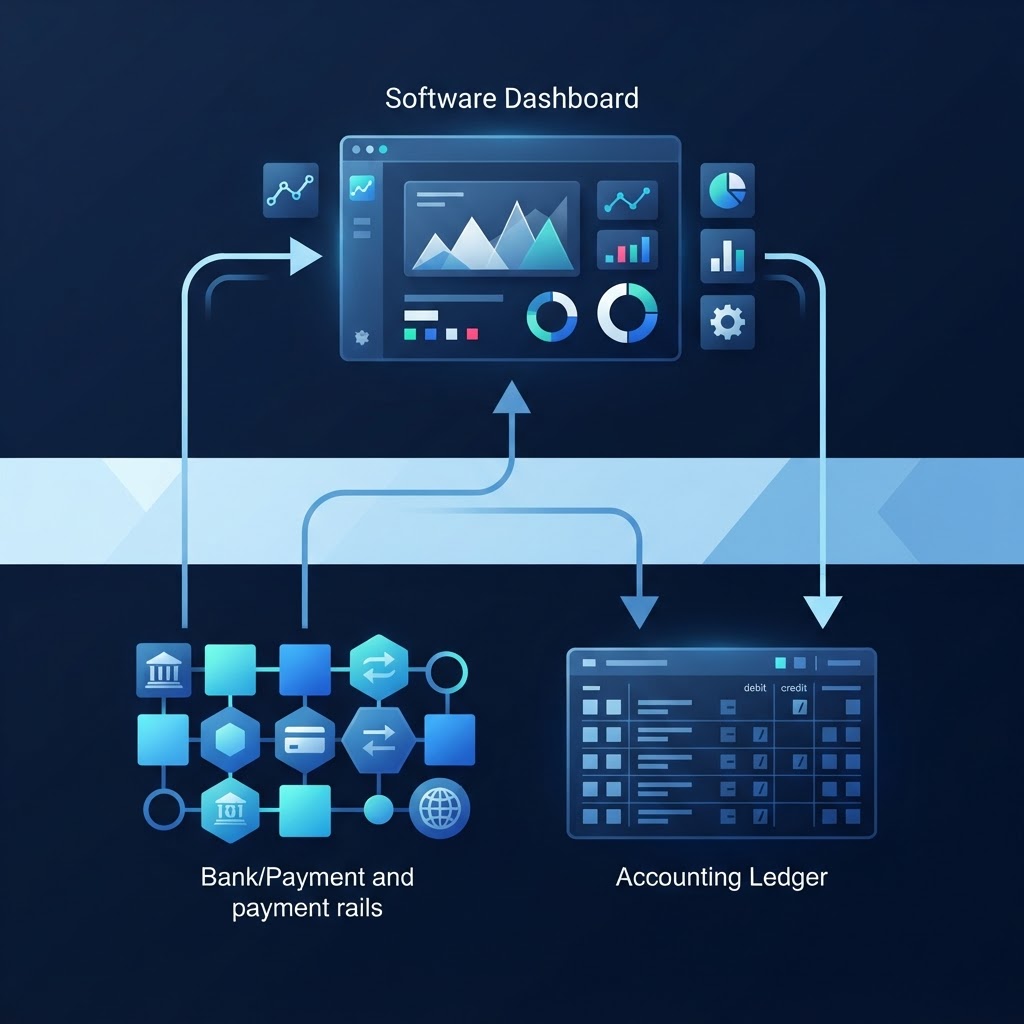
What is a treasury management system? It is software that sits above your banks and beside your accounting system, and tells you where your cash is, where it is going and what could hurt it. One vendor puts it neatly: a TMS connects what happened (the ERP), what is happening (the banks) and what is about to happen (forecasts) in one continuous view.
Almost every explanation you will find is written by a company that sells one. That is not a reason to distrust them, but it does explain why they all read like feature lists. This guide takes a different route. It starts with where a TMS sits, because once you see the stack, the features explain themselves. EX FI does not sell a treasury management system, so we have no shortlist to push you towards.
What is a treasury management system?
The Association for Financial Professionals defines a TMS as an enterprise-wide solution overseeing global liquidity, FX transactions, financial risk mitigation, derivatives and bank account access. Stripped of the jargon, it does four jobs, which Stripe groups as cash, liquidity and payments; debt and investments; risk; and reporting, forecasting and compliance.
Without one, treasury is a morning ritual: log into each bank portal, export the balances, paste them into a spreadsheet, and hope nobody moved money in the meantime. A TMS automates that ritual and adds controls around what happens next. If you want to see what that looks like inside real companies, our treasury management system examples walk through eight named deployments.
Where a TMS sits: the three-layer picture
The single most useful thing to understand about a TMS is what it is not. It is not where your money lives.
Layer 1: the accounts that hold the money
At the bottom are your bank accounts and payment accounts, in every entity and currency. This is where cash actually sits and where payments actually leave from. Every balance a TMS shows you is read from here.
Layer 2: the ERP that records it
Beside the accounts sits your ERP or accounting system. It is the system of record: it books invoices, closes the month and produces the statutory accounts. It knows what you owe and are owed, but it usually learns about bank movements after the fact.
Layer 3: the TMS that reads and instructs both
On top sits the TMS. It pulls balances and transactions from layer 1, pulls expected flows from layer 2, and combines them into a cash position and a forecast. When you pay, it does not move money itself. It originates payment instructions through its connections to multiple banks, and the bank or payment provider executes them.
That picture explains why the quality of layer 1 matters so much. A TMS can only show real-time cash visibility if the accounts underneath can deliver data in real time.
How a treasury management system works
The mechanics run in roughly six steps.
- •Connect. The TMS links to each bank, typically through host-to-host links, EBICS, SWIFT or APIs.
- •Collect. Balances and transactions arrive as statements in standard formats such as SWIFT messages, BAI2 or BTRS, and the system flags missing or incomplete files.
- •Standardise. Data from different banks, currencies and formats is mapped into one structure.
- •Position and forecast. Today's balances are combined with ERP data on receivables, payables and debt to project cash forward.
- •Act. Payments, FX deals and internal transfers are created, approved and sent to the banks.
- •Post. Treasury transactions are booked back to the general ledger automatically, closing the loop with layer 2.
Step one is where projects succeed or stall. One buyer guide puts it bluntly: treasury software is judged by its weakest bank connection. Some banks offer real-time APIs, others only file-based statements, others only a portal. Vendors compete on connection counts (Nomentia, for example, describes 10,000+ bank connections), but the number that matters is how many of your banks connect well.
The seven core functions
The AFP lists seven primary functions. Here they are with what each one means in practice and who genuinely needs it.
| Function | What it does | Who needs it |
|---|---|---|
| Cash management | Daily cash positions across all banks, accounts and entities, plus forecasting | Anyone with more than a handful of accounts |
| Payments | Creates, approves and sends payments to many banks; can act as a company-wide payment hub | Groups paying from several banks or entities |
| Foreign exchange | Spot and forward deals, exposure tracking, valuations and hedge accounting | Businesses with material non-home-currency flows |
| Debt and investments | Loans, facilities, letters of credit and short-term investments | Groups with borrowing or surplus cash to place |
| Accounting and G/L | Automatic journal entries and bank-to-book reconciliation | Everyone who uses the other modules |
| Bank account management | Central register of accounts and signatories, with approval workflows (eBAM) | Groups with many accounts and changing signatories |
| Reporting | Dashboards and reports on cash, risk, payments, debt and forecasts | Everyone, eventually |
Two capabilities sit across these rows and drive many purchases. Most TMSs support netting, which lets group companies offset what they owe each other before settling (see multilateral intercompany netting). Many also support an in-house bank, where the parent acts as banker to its subsidiaries; our in-house banking example shows how that works. On the FX row, a TMS records and values hedges, but the hedging decisions still come from policy; our guide to foreign exchange risk management techniques covers those.
One caution from the same AFP entry: base packages usually include only limited debt and investment functionality, with more added at extra cost. The seven functions are a menu, not a bundle.
Types of treasury management system
"TMS" sounds like one product category. It is closer to several. The Treasury Research Company describes treasury technology as eight overlapping functional markets, from cash visibility and payments to hedge accounting and supply-chain finance, and sorts the products into three types:
- •Enterprise treasury platform: one broad product covering several treasury activities.
- •Modular treasury suite: a family of modules from one provider, implemented a few at a time.
- •Specialist solution: a product focused on one area, such as forecasting or payments, that works alongside other tools.
There is also a fourth option most groups already own: the treasury module in their ERP. J.P. Morgan notes that many corporates buying an ERP bundle already have treasury capability they are not using, and the AFP observes a broader trend of treasury functions moving into ERP platforms.
Finally, deployment. Systems are either installed on your own servers or cloud-hosted, and cloud-hosted systems are generally more economical and quicker to deploy, while on-premise systems give maximum control over features and security.
What a TMS is often confused with
| Thing | What it is | How it differs from a TMS |
|---|---|---|
| ERP treasury module | Treasury features inside your accounting system | Tight ledger integration; check how many of your banks it connects to and how deep its FX tools go |
| Bank portal | One bank's online banking | Shows one bank only; a TMS sits across all of them |
| Bank "treasury management services" | A bank's suite of cash, payment and liquidity products | These are services from one provider, not software you control across many |
| Payment or multi-currency account | Where money is held and moved | Layer 1 of the stack; a TMS connects to it, it does not replace it |
The third row trips people up most often, because banks use the phrase "treasury management" for their own product suites. A TMS is bank-agnostic software. If you are evaluating vendors for a UK group, our guide to choosing a treasury management system in the UK covers the local specifics.
Does your business need one?
That is a separate question, and we answer it properly in our guide on whether you need treasury management software at all, including the entity and bank-count thresholds where the spend starts to make sense.
Two points belong here. First, pricing is built from the number of banks, accounts, entities, modules and users, with implementation and bank connectivity priced separately; our breakdown of treasury management software pricing puts numbers on those bands. Second, a TMS automates what you have. J.P. Morgan warns that it will not solve problems rooted in organisational structure, responsibilities, processes or controls. If cash is scattered across too many accounts, that is a layer 1 problem, and software on layer 3 will only display it more clearly.
Where EX FI fits, and where it does not
EX FI is not a treasury management system. It does not forecast, hedge or manage debt.
It sits in layer 1. EX FI offers business payment accounts in 16+ currencies including GBP, EUR and USD, with dedicated IBANs where applicable, access to Faster Payments, BACS, CHAPS, SEPA and SWIFT, free internal transfers between your own entities, and Xero reconciliation. Regulated payment services are provided by Gemba Finance Limited (FCA FRN 804853), for UK customers only. EX FI accounts are payment accounts, not bank accounts: funds are not covered by the FSCS but are safeguarded in segregated accounts under the Payment Services Regulations 2017, as set out in the EX FI legal notice.
Why that matters for a TMS: fewer accounts at fewer providers means fewer connections to build, price and maintain, and cleaner intercompany payments between your entities. Whether you then add a TMS on top is your decision.
FAQ
Does a treasury management system hold your money? No. Your cash stays in your bank and payment accounts. The TMS reads balances and transactions from those accounts and sends payment instructions to them, but the provider holding the account executes every payment.
What is the difference between a TMS and cash management software? Cash management or cash visibility tools cover one area: balances, positions and forecasts. A TMS usually spans several areas, adding payments, FX, debt, accounting and bank account management. A company with only a few banks may need nothing more than visibility and forecasting.
Is a treasury management system cloud based or on premise? Both exist. On-premise systems run on your own servers and give maximum control; cloud-hosted systems are generally more economical and faster to deploy.
What does a TMS need from your banks? A working connection to each bank, through host-to-host, EBICS, SWIFT or an API, that delivers statements in a standard format on a reliable schedule. Each connection takes time to set up and test, so the number of banks you hold drives both cost and timeline.