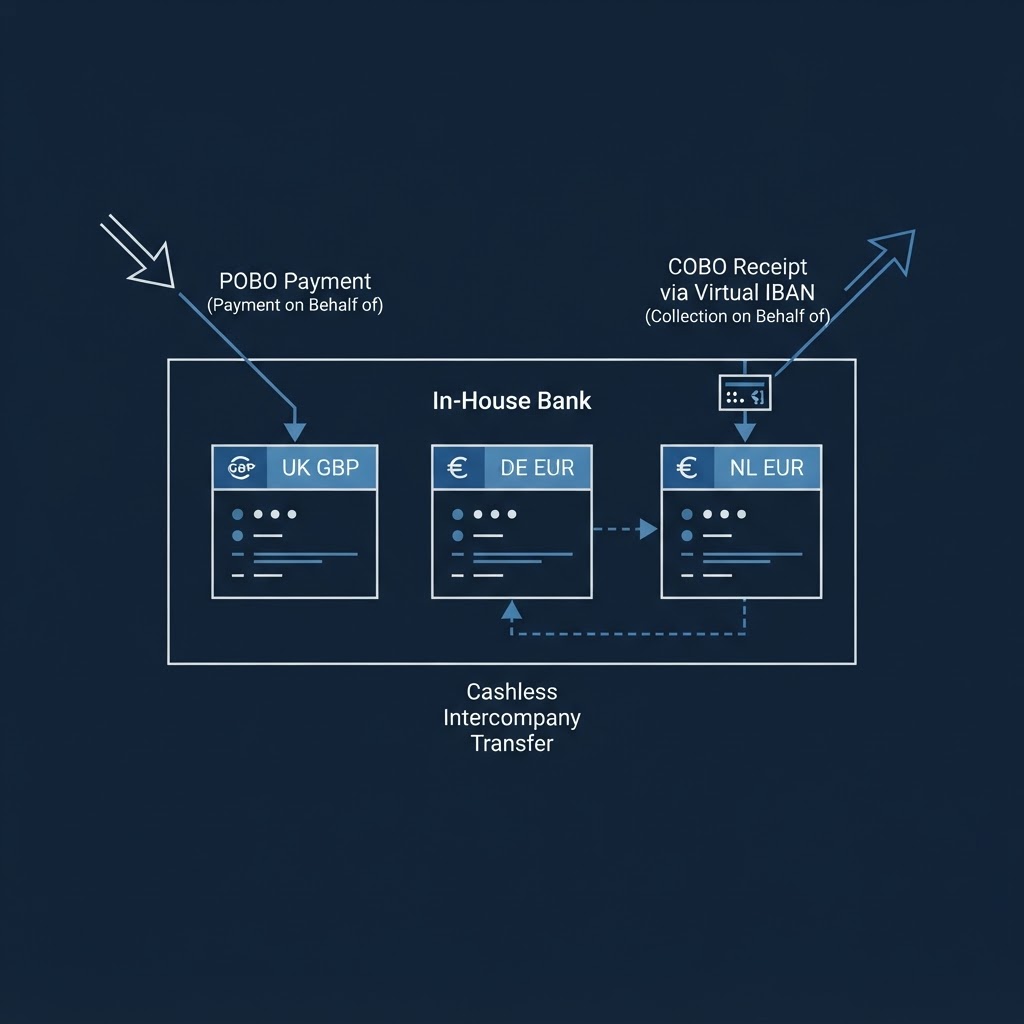
Search for an in-house banking example and you get two kinds of page. Bank case studies about Roche or ABB that report the outcome but never show the ledger, and definitions that never show a single transaction. This article does both. First a small, illustrative group runs one month through an in-house bank, entry by entry. Then six real corporate examples, with the numbers they published. Then the tax and regulatory traps, and what a smaller group can adopt first.
What an in-house bank is, in one paragraph
The Association of Corporate Treasurers describes an in-house bank as a structure where central treasury acts as an internal banking facility for the group, with all subsidiaries dealing with it. In practice, as DBS explains, the in-house bank (IHB) entity pays suppliers from its own bank account on behalf of operating companies and debits their intercompany current accounts; it receives collections on their behalf and credits those accounts; and payments between group companies become book transfers that never touch the banking system. The operating companies end up holding balances with the IHB instead of with banks.
A worked in-house banking example: one group, one month
All names and numbers below are illustrative. They exist to make the mechanics visible, not to suggest what any real group should do.
The group and its internal current accounts
Group Treasury Ltd, a UK company, is the in-house bank. It holds one external bank account per currency: one in GBP, one in EUR. Three operating companies participate, each with an internal current account (ICA) at the IHB in its own currency:
| Participant | Currency | Opening ICA balance |
|---|---|---|
| UK Trading Ltd | GBP | +200,000 (deposit with IHB) |
| DE GmbH | EUR | +400,000 (deposit with IHB) |
| NL BV | EUR | -150,000 (borrowing from IHB) |
Because the participants no longer hold their own operating accounts, the IHB's external balances simply mirror the ledger: GBP 200,000 and EUR 250,000 (400,000 minus 150,000).
Four transactions through the in-house bank
1. Payment on behalf of (POBO). NL BV owes a Dutch supplier EUR 80,000. The IHB pays it from its EUR account, with NL BV named in the remittance information so the supplier can reconcile, and debits NL BV's ICA by EUR 80,000. External EUR cash falls by 80,000.
2. Collection on behalf of (COBO). A German customer pays DE GmbH's invoice of EUR 250,000 to a virtual IBAN that routes into the IHB's EUR account. The IHB reads the virtual IBAN, identifies DE GmbH and credits its ICA by EUR 250,000. External EUR cash rises by 250,000.
3. Cashless intercompany settlement. DE GmbH invoices NL BV EUR 120,000 for goods. Without an IHB this is a SEPA payment between two bank accounts. With one, it is two ledger entries: DE GmbH +120,000, NL BV -120,000. Nothing leaves the group and external cash does not move.
4. Payroll on behalf of. UK Trading Ltd's GBP 90,000 payroll runs from the IHB's GBP account. Its ICA is debited by 90,000.
| Participant | Opening | Movements | Closing |
|---|---|---|---|
| UK Trading Ltd (GBP) | +200,000 | -90,000 payroll | +110,000 |
| DE GmbH (EUR) | +400,000 | +250,000 COBO, +120,000 intercompany | +770,000 |
| NL BV (EUR) | -150,000 | -80,000 POBO, -120,000 intercompany | -350,000 |
Four business events, three external rail movements, one intercompany flow settled at zero cost.
Internal interest
NL BV is now borrowing EUR 350,000 from the IHB, and DE GmbH is lending it EUR 770,000. Those balances carry interest. Whether they count as intercompany loans or as deposits depends, as Standard Chartered notes, on the regulatory environment and on whether the IHB is a non-financial company or a registered finance company. The rates must be arm's length and set with tax advisers.
The arithmetic itself is simple. If NL BV's average debit balance over a 30-day month were EUR 300,000 at an illustrative 4.0 percent a year:
300,000 x 0.04 x 30 / 365 = EUR 986.30 of interest charged to NL BV.
DE GmbH's credit balance earns interest the same way, at the IHB's deposit rate. The spread between the two rates, and the frequency of calculation (daily, monthly or quarterly), are design decisions written into the intercompany agreements.
The check: external cash equals the internal ledger
This is the control that makes an in-house bank auditable. For each currency, the IHB's external bank balance must equal the sum of the participants' ICAs, plus the IHB's own position:
- •GBP: bank 200,000 - 90,000 = 110,000. Ledger: UK Trading Ltd +110,000. Matches.
- •EUR: bank 250,000 - 80,000 + 250,000 = 420,000. Ledger: 770,000 - 350,000 = 420,000. Matches.
The intercompany sale appears in neither external balance, which is exactly the point. If the two sides ever disagree, something was booked on one side only.
Real in-house banking examples from large groups
The worked case is small on purpose. Here is what the same model looks like at scale, as each company or its bank reported it.
Two patterns stand out. Every one of these groups started with intercompany flows and only later pushed into third-party payments and collections. And the headline benefit is almost always fewer banks and fewer accounts, not interest income.
Most in-house banks are also less complete than these. Citi's treasury diagnostics found that among companies with IHBs, 64 percent have some form of cashless intercompany netting, 33 percent have POBO and only 11 percent have ROBO.
Where in-house banks run into tax and regulation
The ledger is the easy part. The design work is in the rules, which vary country by country. Standard Chartered's list of typical restrictions includes:
- •Currency controls that limit offshore IHB structures in many markets.
- •Intercompany lending limits, sometimes outright bans on cross-border local currency loans.
- •Withholding tax on interest paid to an offshore IHB.
- •Thin capitalisation caps that put a ceiling on total intercompany borrowing.
- •Registration: in some markets the IHB may need to register as a financial institution, which the bank flags as common in parts of Western Europe such as Germany.
- •Payment masking: some clearing systems cannot carry information about the underlying payer, which can block POBO payments.
Some countries are harder than others. Treasury practitioner Laurent Geunens points to Japan as a market where legal and tax restrictions make POBO difficult. For a UK and German group, the German registration question deserves early attention. None of this is advice for your structure; it is the list of questions to take to your tax and legal advisers before go-live.
A smaller group's version
A three-entity group does not need Roche's architecture, but the honest warning from Tan Gravam applies: a full in-house bank needs a treasury system, an arm's-length intercompany framework and tax and legal design, and is not a spreadsheet exercise.
What a smaller group can adopt first, in roughly the order the large groups did:
- •One account per currency at group level, so balances are visible in one place. That is the foundation of real time cash visibility.
- •A monthly intercompany netting cycle, so only net amounts move. Our multilateral netting example works one through with real fees.
- •A documented intercompany ledger with agreed interest terms, before any third-party payments run on behalf of others.
- •POBO and COBO last, country by country, once the tax review is done.
The broader concept, including when a full IHB is worth building, is covered in our guide to in-house banking.
Where an account layer fits
Every example above rests on the same base: a small number of external accounts per currency, under group control, with internal transfers that cost nothing. That part we provide. EXFI offers multi-currency business payment accounts with dedicated IBANs across 16 or more currencies, reaching SWIFT, SEPA, FPS, BACS and CHAPS, with internal transfers free and intercompany payments that generate compliant invoices automatically. It is the same reasoning behind a multi-currency business account for any group with more than one operating currency. It is not an in-house bank system: the intercompany ledger, interest and tax design remain yours.
The compliance position, stated exactly. Regulated payment services are provided by Gemba Finance Limited, FCA FRN 804853, UK customers only. EXFI is a trading name of EX Financial Solutions Ltd, which is not itself authorised or regulated by the FCA and acts as a distributor of those services. These are payment accounts, not bank accounts; funds are not covered by the FSCS but are safeguarded in segregated accounts in accordance with the Payment Services Regulations 2017.
FAQ
Is an in-house bank a real bank?
No. It is a group company acting as banker to its affiliates, usually without a banking licence. In some markets, such as parts of Western Europe including Germany, it may still need to register as a financial institution and meet capital and reporting requirements.
What is the difference between POBO and COBO?
POBO (payments on behalf of) means the in-house bank pays third parties for an affiliate from the IHB's own account. COBO (collections on behalf of) means it receives payments for the affiliate. ROBO and LOBO are other names for COBO.
Does an in-house bank create intercompany loans?
Usually, yes. An affiliate with a debit balance on its internal current account is borrowing from the IHB, and one with a credit balance is lending to it. That brings arm's-length interest, withholding tax and thin capitalisation into scope.
What software runs an in-house bank?
Typically a treasury management system or an ERP module. Novartis and Estee Lauder both built theirs on SAP, and ABB moved its in-house bank onto SAP S/4HANA.