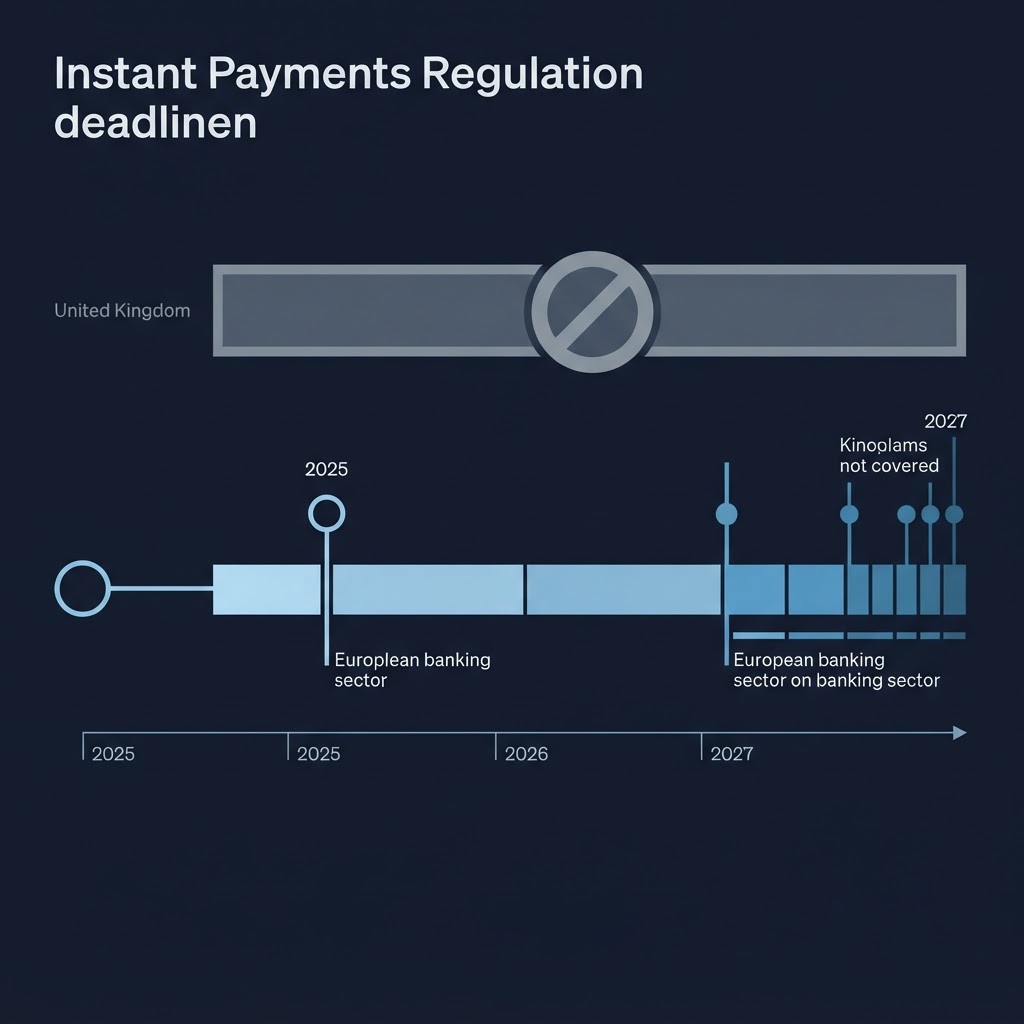
SEPA Instant payments can reach a UK account, and a UK business can send them. That is the easy half of the answer. The hard half is that nothing in EU law obliges your UK provider to offer either, so whether a given euro payment lands in nine seconds or next business day depends on who holds your account and who holds your counterparty's. This guide separates the three questions that get mixed together under "SEPA Instant payments UK": what the scheme reaches, what the Instant Payments Regulation forces, and what your provider actually does. ## The short answer The UK is a SEPA country. The European Payments Council's current country list records that, by decision of its board on 7 March 2019, the United Kingdom remains part of the SEPA geographical scope as of 1 February 2020, one of eleven non-EEA countries alongside Switzerland, Andorra and, since 2025, Albania, Montenegro, North Macedonia and Moldova. The SEPA Instant Credit Transfer scheme, SCT Inst, applies in every country on that list. The Instant Payments Regulation is a different thing. It is EU law that amends the SEPA Regulation and obliges payment service providers located in EU Member States to offer instant euro transfers by fixed dates. The UK is not a Member State. The EPC's own rulebook page draws the line: reachability is mandatory for EEA participants under the Article 5a deadlines, and for non-EEA participants in accordance with applicable law. UK applicable law contains no such deadline. So: reachable, yes. Obliged, no. A UK provider that has adhered to SCT Inst can send and receive instant euros today. One that has not will route your euro payment as a standard SEPA credit transfer, or over SWIFT, and nobody in Brussels will make it do otherwise. ## Inside the scheme, outside the mandate: why the UK position is different ### What the scheme says SCT Inst went live in November 2017 and the EPC describes it as aiming to progressively reach all 41 SEPA countries and territories. The 2025 rulebook, in effect since 5 October 2025, gives the payer's provider, the payee's provider and the clearing system a total of nine seconds to make funds available, runs 24 hours a day on every calendar day, and no longer sets a scheme-level maximum amount. Providers set their own limits. The UK community was in the scheme before Brexit. When the EPC Board approved UK Finance's application for continued participation on 7 March 2019, it counted 84 UK providers in the SEPA Credit Transfer scheme and 5 in SCT Inst. The current figure sits in the EPC's public register of participants, which is the only authoritative place to check a specific provider. ### What the regulation says Regulation (EU) 2024/886 was adopted on 13 March 2024 and, per the European Central Bank, covers credit transfers denominated in euro within the European Union. Its core rule is that a provider offering ordinary euro credit transfers must also offer instant ones, at no higher price, with a verification of payee check before every transfer. Every obligation in the text is addressed to providers "located in a Member State whose currency is the euro" or "located in a Member State whose currency is not the euro". A UK provider is neither. The EPC country list makes the same point for the SEPA Regulation as a whole: legislation adopted for the EEA is assumed to apply fully and directly only to transactions between institutions located within the EU and the EEA. ### What UK law says The UK kept the original SEPA Regulation. The FCA explains that Regulation 260/2012 was onshored through the EU (Withdrawal) Act 2018 and that it is the competent authority overseeing SEPA compliance in the UK. That onshored text predates the Instant Payments Regulation, and the FCA page says nothing about instant transfers. UK providers must participate in an EU-wide SEPA scheme to be reachable for euro payments; they are not required to pick the instant one. This is not a loophole and not a grievance. It is simply where the regulatory perimeter sits, and it is why competitor pages that copy the EU deadlines into a UK explainer are misleading you. ## The IPR deadlines and what they mean for a UK business The deadlines still matter to you, because they bind the banks your EU customers and suppliers use. The staggered timetable in Article 5a of the regulation: | Provider type and location | Receive instant by | Send instant by | |---|---|---| | Banks in euro area Member States | 9 January 2025 | 9 October 2025 | | Banks in non-euro Member States (Poland, Sweden, Denmark, Czechia and others) | 9 January 2027 | 9 July 2027 | | E-money and payment institutions in the euro area | 9 April 2027 | 9 April 2027 | | E-money and payment institutions outside the euro area | 9 April 2027 | 9 July 2027 | | UK providers | Not covered | Not covered | Two consequences follow for a UK business. First, since 9 October 2025 every bank in the euro area must offer its customers the option of sending instant. A German or Dutch customer who pays your euro invoice from a bank account is now choosing between standard and instant on the same screen, at the same price. If your UK provider can receive SCT Inst, those payments arrive in seconds. If it cannot, the payer's bank either falls back to a standard credit transfer or rejects the instant attempt, and the payer sees an error with your IBAN on it. Second, the scheme is no longer a minority rail. The ECB's June 2026 status update records 2,821 SCT Inst participants as of May 2026, close to 80 percent of all 3,540 SEPA credit transfer adherents, and puts instant at 35.6 percent of all euro credit transfer volume in the first quarter of 2026. The next adherence wave is expected in April and July 2027 when the e-money, payment institution and non-euro deadlines bite. Within the EU, instant is becoming the default. A UK provider that stays on standard SEPA is choosing to be the slow end of every euro relationship its customers have. ## Receiving SEPA Instant payments in the UK Four things decide whether an incoming instant payment lands. ### Is your provider in the SCT Inst register? The EPC register of participants lists every adhering provider and whether it participates as a beneficiary provider only or as both originator and beneficiary. A provider that is in the standard SCT scheme but not the SCT Inst scheme can accept standard SEPA credit transfers, covered in which UK banks accept SEPA payments, but no instant ones. ### Is your account enabled? Participation is at provider level; enablement is at account level. Revolut's help page spells out the trap: even if a bank supports SEPA Instant, your account may not be enabled to receive instant transfers, and you should confirm with the bank. The EPC's clarification paper on the SCT and SCT Inst rulebooks strongly encourages participants to make sure that any euro or national-currency account already open to standard SEPA transfers is also open to incoming SCT Inst, precisely because the alternative is unnecessary rejects. Encouraged is not obliged. ### Euros into a sterling account within ten seconds The scheme allows the payee's account to be in any currency; the conversion is done by the receiving provider and sits outside the rulebook. The hard part is the clock. The Euro Banking Association's guidance note on FX for instant payments explains that a eurozone provider which rejects an incoming instant transfer because it cannot convert the currency within the 10 seconds is in breach of its receiving obligation, so eurozone providers have had to build automated conversion that runs inside the window, around the clock, including when the FX market is closed. A UK provider has no such obligation, so for a sterling account the question is capability, and you should ask it directly. The cleaner route is to receive euros into a dedicated euro IBAN and convert when you choose, which also removes the weekend FX problem entirely. ### The originator address requirement Because the UK is a non-EEA SEPA country, the EU Funds Transfer Regulation requires the full address of the payer on every transfer where either provider is outside the EEA. The clarification paper confirms this applies to SCT Inst as it does to standard transfers. Missing address data is the most common cause of a rejected payment to a GB IBAN, as we set out in can SEPA payments be made to the UK. One deadline has moved. The EPC had set 15 November 2026 as the date after which unstructured addresses would be rejected. In September 2026 it reversed that: version 1.2 of the 2025 SCT Inst rulebook, effective 30 September 2026, maintains support for unstructured addresses beyond the previously announced 15 November 2026 deadline, with a new end date to be determined. Structured addresses remain the format to ask your payers for; the cliff edge is simply no longer this November. ## Sending SEPA Instant payments from the UK ### Which UK providers send instant Grey's help centre puts it bluntly: SEPA Instant from UK banks is not universally supported, as not all UK banks are enrolled in SCT Inst. The providers that do tend to be the ones built for euro flows. LHV Bank's UK API documentation shows the pattern: a euro payment is processed as SCT Inst via RT1 or TIPS if the beneficiary bank supports instant payments, as standard SCT if it does not, and over SWIFT if neither applies, with instant processed 24/7 including weekends. Monzo's help page shows the consumer version: a SEPA credit transfer must be submitted before 16:45 GMT to go out the same day, while a SEPA Instant payment has no cut-off and the app tells you before you confirm which one you are getting. The test for any UK provider is the same: does it appear in the register as an originator provider, not only a beneficiary one, and does its product documentation say which scheme a euro payment is routed on. If the answer is a vague "SEPA", assume standard. ### Limits Since the 2025 rulebook there is no maximum amount at scheme level; each provider sets its own. In practice many still apply the old ceiling. Xe states that SEPA Instant is available to its UK and European customers for transfers up to 100,000 EUR, provided both banks are part of the scheme. Inside the EEA, Article 5a(6) of the regulation also gives the customer the right to set their own per-day or per-transaction cap and to change it at any time. A UK provider may offer the same control, but it is a feature, not a right. ### Timing and the restore rule The nine second scheme target is backed by a hard rule in the regulation: if the payer's provider has not received confirmation that funds were made available within 10 seconds of the time of receipt, it must immediately restore the payer's account to the state it would have been in had the transaction not taken place. The 2025 rulebook builds that into the scheme itself, so it protects a UK originator too: an instant payment either completes in seconds or is unwound. There is no limbo. ## What it costs Article 5b of the regulation says charges for instant transfers may not exceed those for ordinary credit transfers of the same type. It binds euro area providers from 9 January 2025 and non-euro Member State providers from 9 January 2027. It does not bind UK providers. Revolut, for its part, lists SEPA Instant as free of fees from its side. For everyone else, read your tariff for two separate lines, SEPA and SEPA Instant, and check the FX rate applied if you send from sterling, which is where the real cost usually sits rather than in the transfer fee. For the outbound mechanics in detail, see SEPA transfer from the UK to Germany. ## Checklist before you promise a supplier instant euros 1. Check the register. Confirm your provider is listed as an SCT Inst participant in the EPC register, and in which role. 2. Confirm account enablement. Ask in writing whether your specific EUR or GBP account is enabled for incoming and outgoing SCT Inst. 3. Ask about in-flight FX. If you receive into sterling, ask whether conversion runs automatically inside the 10 second window at weekends. 4. Get the per-transaction limit. Many providers still apply 100,000 EUR or lower. 5. Give EU payers complete details. IBAN, BIC, exact registered name for verification of payee, and your full address in separate town and country fields. 6. Keep standard SEPA as the fallback. An instant attempt to a non-reachable account is rejected, not downgraded, unless the provider's own routing does the fallback for you. 7. Price the delay. Standard SCT at T+1 is often fine for supplier payments; instant earns its keep on collections, refunds and weekend cash. ## Where EXFI fits, and what it is not Straight answer first: EXFI is not a bank. EXFI accounts are payment accounts, not bank accounts. Funds are not covered by the FSCS; they are safeguarded in segregated accounts under the Payment Services Regulations 2017. Regulated payment services are provided by Gemba Finance Limited (FCA FRN 804853), UK customers only. EX Financial Solutions Ltd, trading as EXFI, acts as a distributor of those services and is not itself authorised by the FCA. For how that model works, see what is a payment institution. What EXFI gives a UK business handling euro flows, per the published features and pricing: - a dedicated EUR IBAN alongside GBP and other currencies, so euros arrive as euros and you decide when to convert
- •SEPA, FPS, BACS, CHAPS and SWIFT rails from one account
- •SEPA payments listed at 0.99 GBP
- •FX at 0.70 percent on major pairs when you do convert
- •no monthly fee for UK-incorporated entities, no opening fee and no minimum balance Whether a particular euro payment is routed over the instant scheme or the standard one is a question to put to the provider before you rely on it, and that applies to EXFI as to anyone else. Business customers only, and none of this is financial advice. Operational detail on the inbound side is in receiving SEPA payments in the UK. ## FAQ ### Does the EU Instant Payments Regulation apply to UK banks? No. Article 5a addresses providers located in EU Member States, the EPC rulebook states that non-EEA participants follow their own applicable law, and the SEPA Regulation the UK onshored predates the instant payments amendments. A UK provider chooses whether to adhere to SCT Inst. ### Is there a maximum amount for a SEPA Instant payment? Not at scheme level since the 2025 rulebook; each provider sets its own limit. Xe applies 100,000 EUR for UK and European customers. Within the EEA, customers also have a legal right to set their own per-day or per-transaction cap. ### Can SEPA Instant pay into a UK sterling account? The scheme allows accounts in any currency and leaves conversion to the receiving provider. Eurozone providers must complete that conversion inside the 10 seconds; a UK provider has no such duty, so ask whether your sterling account is enabled and how weekend conversion is handled. ### What happens if a SEPA Instant payment is not confirmed within ten seconds? The payer's provider must immediately restore the payer's account as if the transaction had never taken place. The payment is either completed in seconds or unwound; it does not sit pending. ### Do I still need to give my EU payer a structured address for a SEPA Instant payment? The payer's full address is required on any transfer where one provider is in a non-EEA SEPA country such as the UK. The 15 November 2026 cut-off for unstructured addresses was dropped by the EPC in September 2026 and no new date has been set, but separate town and country fields remain the format least likely to be rejected.