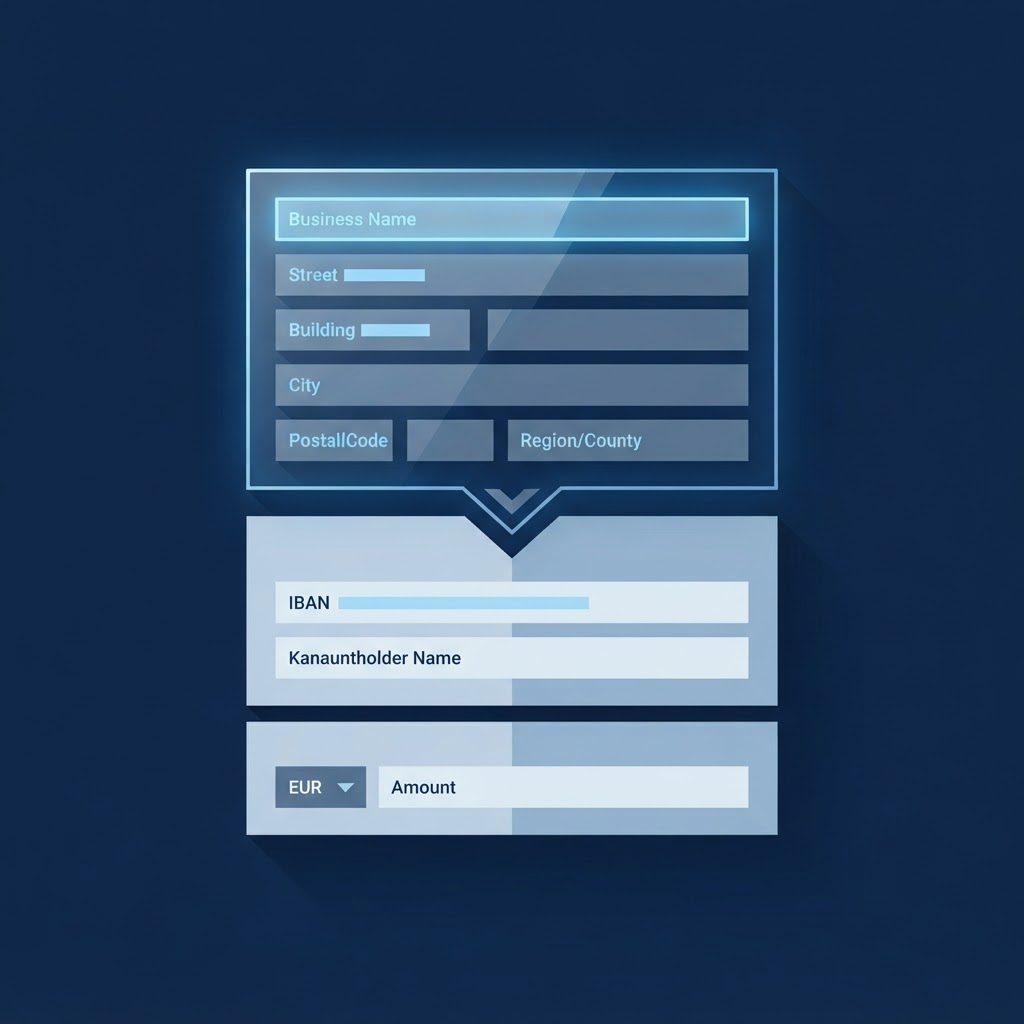
A SEPA transfer from the UK to Germany is supposed to be the easy payment. Euros, a German IBAN, next business day. Most of the time it is. But a UK business paying a German supplier is not sending a domestic eurozone payment, and the differences decide whether the money lands in full, lands on time, or bounces back with a rejection code.
This guide covers the part the comparison sites skip: what the scheme rules require from a UK payer, what changes on 15 November 2026, how long the payment takes, where the cost actually sits, and what your German counterparty has to do once the money arrives.
The short answer
Yes, you can pay a German IBAN by SEPA credit transfer from a UK account. The UK kept its place in the SEPA geographic scope after Brexit, but the European Payments Council is explicit that it did so as a non-EEA country, which brings extra data requirements. Since 1 January 2021, SEPA credit transfers and SEPA Instant payments involving a UK scheme participant must carry:
- •the full address of the payer (you)
- •the BIC of the German bank, when your own bank or payment provider asks for it
The EPC warns that missing these details may lead to the payment being rejected by the receiving side. So the three things that make UK to Germany different are the address, possibly the BIC, and the currency conversion if you start in sterling.
What you need before you send
Gather these before you open the payment screen:
- •The German IBAN. German IBANs start with DE and are 22 characters long. Check it against something your supplier sent in writing.
- •The payee name, exactly as the account is held. German banks have run Verification of Payee since October 2025, so a name that does not match the account can trigger a warning to the payer.
- •The German bank's BIC. Inside the EEA the BIC is optional, but a UK originated payment is not an intra-EEA payment. If your provider's form asks for it, fill it in.
- •A payment reference. Germans call it the Verwendungszweck. Put the invoice number in it so the supplier's accounts team can match the payment.
- •Your own full business address, held correctly by your provider.
If you are unsure which code goes in which box, our guide to IBAN, SWIFT and BIC explained walks through it.
The payer address rule for UK payments
This is the rule most UK businesses never hear about until a payment fails. Under the EU Funds Transfer Regulation, the EPC's guidance on addresses in SEPA payments states that the full address of the payer must be provided whenever either payment provider sits in a SEPA country outside the EEA. The UK is one of those countries. Within the address, the Country and Town Name fields are mandatory.
In practice your bank or payment provider usually fills this in from the address it holds on file. That is exactly why it matters that the registered address on your business account is complete and current. An old office address, or one squeezed into a single free text line, is the weak point.
The 15 November 2026 structured address deadline
The same EPC guidance sets a hard date. For SEPA credit transfers and SEPA Instant payments executed from 15 November 2026, any address in the payment must be structured or hybrid. Unstructured addresses will be rejected, by your provider before sending or by the banks in between.
What that means:
- •Structured: separate fields for street, building number, postcode, town and country.
- •Hybrid: town and country in their own fields, the rest in address lines.
- •Unstructured: the whole address typed into free text lines. This stops working.
If you pay German suppliers from accounting software or by uploading pain.001 payment files, ask your provider now whether your originator address and any stored beneficiary addresses are held in structured form. If you only pay through a banking app, confirm that your business address on file is complete. Six weeks is not long for a finance team to fix master data.
How long a UK to Germany SEPA transfer takes
There are two SEPA rails, and which one you get depends on your provider.
SEPA Credit Transfer. Payments submitted before the cut off on a business day settle by the end of the next business day. Send on Friday afternoon and your supplier sees it Monday. Weekends and bank holidays on either side do not count.
SEPA Instant. Under EU Regulation 2024/886, German banks have had to accept incoming instant payments since 9 January 2025, and to be able to send them since 9 October 2025, at no higher price than a standard transfer. Funds arrive in under 10 seconds, every day of the year.
The catch for a UK payer: that regulation binds EU payment providers. Every German bank can now receive an instant payment, but whether you can send one from the UK depends on whether your own provider offers SEPA Instant. We cover this in SEPA Instant payments in the UK.
Two other things slow payments down. Large transfers can pause for source of funds checks, and a missing address or wrong IBAN turns a one day payment into a week of returns and resubmissions.
What it really costs
The SEPA leg is usually cheap. What makes a UK to Germany payment expensive is the conversion before it.
SEPA moves euros only. If your money sits in a sterling account, your bank converts it to euros first, at its own rate, at the moment you pay. Barclays, for example, caps its conversion charge at 2% for business customers. On a €20,000 supplier invoice, simple arithmetic on that cap is up to €400 lost to the rate, which can dwarf the transfer fee itself.
Two ways to reduce it:
- •Hold euros. A euro balance with its own IBAN lets you convert when the rate suits you, or not at all if you also receive euros from EU customers. Paying German suppliers out of euros you were paid in removes the conversion twice over. Our guide to a euro business account in the UK goes deeper.
- •Use SEPA, not SWIFT, for euros. Santander UK notes that SWIFT payments to EEA beneficiaries may arrive with deductions taken by correspondent banks, while deductions cannot be taken from SEPA payments. Your supplier receives the invoice amount.
If you are also on the receiving end of euro payments, see which UK banks accept SEPA payments and what they do to the euros when they land.
Bundesbank reporting on the German side
One detail worth passing on to your German counterparty. German residents, companies included, must report payments of more than 50,000 euros to or from non-residents to the Deutsche Bundesbank under the Foreign Trade and Payments Ordinance (AWV). The report is due by the seventh working day after the end of the month.
The duty sits with the German resident, not with you as the UK payer. It is a statistical report, not an approval, and it does not block the payment. But a German supplier receiving a large payment from a UK customer for the first time may ask you for the purpose of the payment, and a clear reference makes their report easier. Transfers between a company's own accounts are not reportable.
Where EXFI fits, and what it is not
Straight answer first: EXFI is not a bank. EXFI accounts are payment accounts, not bank accounts. Funds are not covered by the FSCS; they are safeguarded in segregated accounts under the Payment Services Regulations 2017. Regulated payment services are provided by Gemba Finance Limited (FCA FRN 804853), UK customers only. EX Financial Solutions Ltd, trading as EXFI, acts as a distributor of those services and is not itself authorised by the FCA.
For a UK business paying Germany, the published EXFI pricing and features are:
- •a dedicated EUR IBAN alongside GBP, so euros can stay euros
- •SEPA, FPS, BACS, CHAPS and SWIFT from one account
- •SEPA payments listed at £0.99
- •FX at 0.70% on major pairs when you do choose to convert
- •no monthly fee for UK incorporated entities, no opening fee and no minimum balance
Business customers only. None of this is financial advice; compare the full cost for your own volumes, currencies and payment timing.
FAQ
Can I send a SEPA transfer from a sterling account?
Not directly. SEPA only carries euros, so a sterling account has to convert first, usually at the bank's rate at the moment of payment. Holding a euro balance with its own IBAN lets you pay German suppliers without converting on the spot.
Why was my SEPA payment to Germany rejected?
For UK payers the usual causes are an incomplete payer address, a missing BIC that the provider asked for, an IBAN typo, or a payee name that does not match the account. From 15 November 2026 an unstructured address becomes another reason for rejection.
Is there a limit on a SEPA transfer to Germany?
The standard SEPA credit transfer scheme has no upper limit, although your provider may set its own. Payments over 50,000 euros trigger a Bundesbank report for the German resident, which is a statistical duty, not a block on the payment.
Do I need to tell my German supplier anything?
Send the invoice number as the payment reference, and for large payments tell them what the payment is for. That helps them reconcile it and, above 50,000 euros, complete their Bundesbank report.