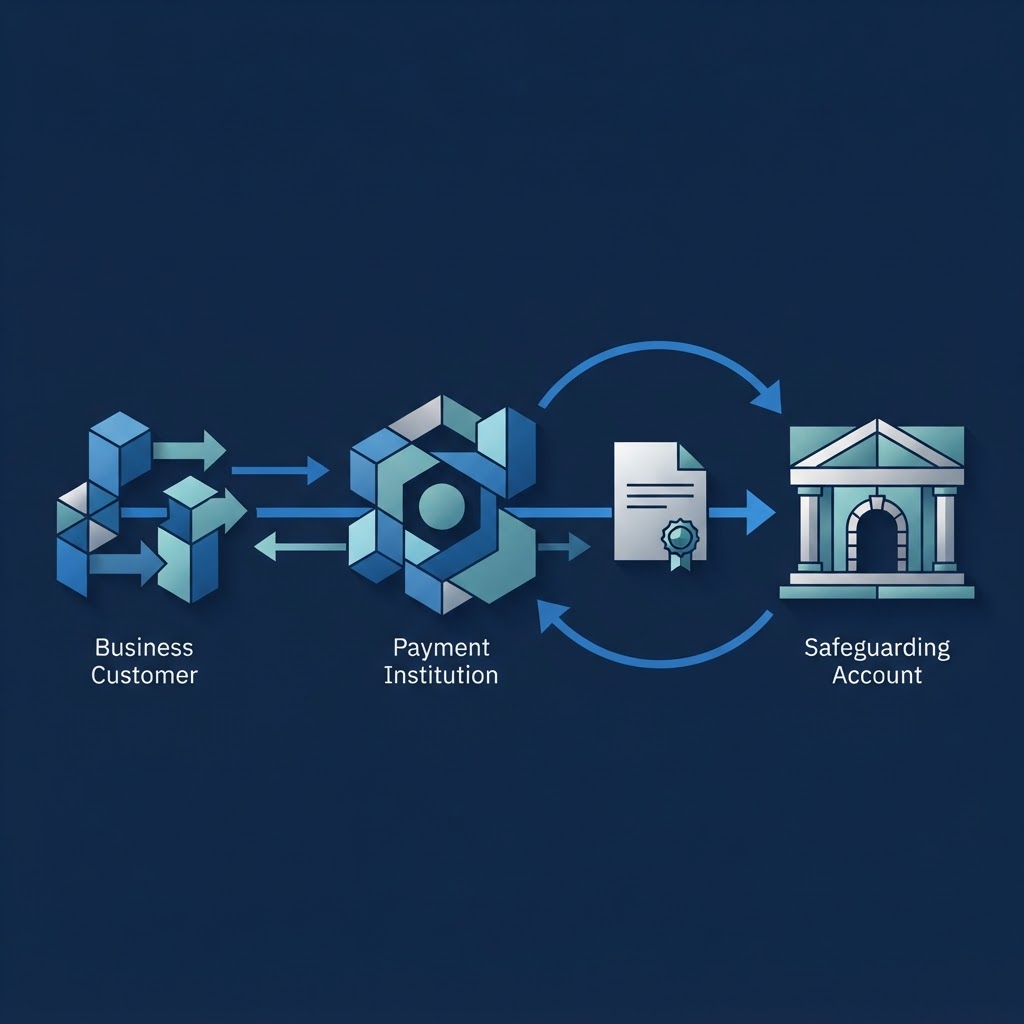
A safeguarding bank account in the UK is the account a payment or e-money firm opens at a bank to hold its customers' money apart from its own. The firm is regulated, but the money physically sits with a bank, and that bank has to be the right kind of institution, sign the right paperwork and pass the firm's own checks. If your business balance sits with a payment institution, the safeguarding bank is the last link in the chain between you and your money. Most pages ranking for this phrase are sales pages from the banks that offer the account. This one is the neutral view: which institutions are allowed to hold it, which kinds of UK banks offer it, what the bank promises in writing, why firms find it hard to get one, and what to ask your own provider. For the basics, start with what a safeguarding account is. ## What a safeguarding bank account is The rule comes from regulation 23 of the Payment Services Regulations 2017. An authorised payment institution must keep customer funds segregated from its own. If it still holds them at the end of the business day after it received them, it must place them in a separate account with an authorised credit institution or the Bank of England, or invest them in approved secure, liquid assets held with a custodian. The account has to meet three conditions: - It is designated to show it holds funds for safeguarding.
- •It is used only for those funds.
- •Nobody other than the payment institution has any interest in or right over the money, except as the regulation allows. If the firm becomes insolvent, customers' claims are paid from that pool before other creditors. There is a second route, insurance or a comparable guarantee, but it is the minority choice. ClearBank, citing the Electronic Money Association, puts it at around 95% of firms using segregated safeguarding accounts. So for almost every UK payment firm, "safeguarding" means a bank account. ## Which UK banks offer safeguarding accounts No public list ranks safeguarding banks, and we do not recommend one. What can be said is what kinds of bank offer the account and what each says about itself. ### Specialist B2B and clearing banks These banks are built to serve other financial firms. ClearBank says it holds safeguarded sterling funds at the Bank of England and can allocate up to 6 million virtual IBANs from a single parent account. Bank of London lists its eligible clients as payment institutions, small payment institutions and some e-money and payment initiation firms, with digital onboarding. ### Digital banks with a payments arm Starling offers safeguarding, segregated, operational, CASS and virtual accounts to regulated payment service providers, but notes that its safeguarding and segregated accounts are available only to clients using its Payment Services. In other words, the safeguarding account comes with the payments relationship rather than as a standalone product. Griffin, a newer UK bank, offers dedicated or pooled safeguarding accounts for FCA-regulated e-money and payment institutions. ### High street and corporate banks The large banks offer the account too, though they publish less about it. In a 2019 directory compiled by The Payments Association, Barclays, NatWest, LHV and BFC Bank, alongside ClearBank and Starling, all said they offered safeguarding accounts to e-money institutions. NatWest described its version as a specific, non-interest-bearing current account with no virtual accounts. That directory is several years old, so treat it as a map of who has played in this market, not a current price list. ## What the bank signs: the acknowledgement letter A designated account is not enough on its own. The bank has to sign a letter. The FCA publishes the wording as a template in CASS 15 Annex 1. In plain English, the bank agrees to four things: - No set-off. It has no claim on the money for anything owed on any other account, including the firm's own. The exceptions are its fees for running the account, or once every client claim has been paid.
- •A distinct title. The account's name differs from any account holding the firm's own money. The FCA's guidance expects that name to include the word safeguarding where the bank's systems allow it.
- •Release on demand. It pays the money out on proper instruction from the firm or from a liquidator or administrator appointed if the firm fails.
- •No compliance duty. It is not responsible for the firm's own safeguarding compliance. That stays with the firm. Under the rules in force since May 2026, the firm generally needs that prescribed letter, countersigned by the bank, for each account, and must review it at least annually. The day-to-day side of running the account is covered in our guide to the EMI safeguarding account. ## Pooled, dedicated or virtual: how the account is structured Banks offer three broad shapes: - Pooled. One safeguarding account holds every customer's money. It is the simplest to open, but the firm's own ledger carries the whole job of knowing who owns what.
- •Dedicated. A separate account, with its own sort code and account number, for each customer. Griffin offers both pooled and dedicated models.
- •Virtual. Virtual account numbers sit on top of one real safeguarding account, so each incoming payment can be matched to the right customer while the money stays in one place. Starling describes virtual accounts linked to a single balance in the same way. Whatever the shape, a pooled balance does not remove the duty to know each customer's share. The FCA requires records that show the amount owed to each customer at any time. Virtual account numbers are the same mechanism behind virtual IBANs, and they make that reconciliation easier, not optional. ## Why getting a safeguarding account is hard Founders often hit this wall first. Griffin calls it the chicken-and-egg problem: to get authorised as a payment or e-money institution you need to show safeguarding arrangements, but most banks will not open a safeguarding account until you are authorised. The same article says opening one with a traditional bank can take up to six months or more, because the bank reviews the firm's financial crime controls by hand. Some banks have found a way through. Bank of London says a full acknowledgement letter can only be issued once a firm is authorised, but before that it can give proof of the account or a signed statement of intent to provide safeguarding once the firm is regulated. In the 2019 directory, Starling put its onboarding at up to 8 weeks. ## One bank or several: the 2026 diversification rule Picking a bank is now a regulated decision in its own right. The FCA expects enhanced due diligence when a firm appoints or reviews any third party that holds customer funds. ClearBank's summary of CASS 15 quotes the duty to "exercise all due skill, care and diligence in the selection, appointment, and periodic review of third parties". Since May 2026, firms must also consider diversification: they have to assess from time to time whether to spread funds across more banks, and change providers or balances if the answer is yes. The reason is the track record. Payment firms that failed between Q1 2018 and Q2 2023 had average shortfalls of 65% of customer funds. The full rulebook behind these duties is covered in our guide to the FCA safeguarding account rules. ## Is a safeguarding bank account covered by the FSCS? There are two cases, and they have different answers. - If the safeguarding bank fails: the FSCS may look through the account to the customers whose money is in it. The FCA confirms this in its policy statement PS25/12. ClearBank, for example, says its safeguarding accounts are eligible for FSCS protection up to £120,000 per eligible person.
- •If the payment firm fails: the FSCS does not step in. Your protection is the safeguarded pool itself, minus the costs of distributing it. The second case is the one that usually matters to a business customer, and it is why the quality of the safeguarding arrangement counts. The full comparison is in safeguarding vs FSCS. ## What to ask if your business balance sits with a payment firm You cannot see the safeguarding account yourself, but you can ask about it. Four questions are reasonable for any provider: 1. Which legal entity holds the FCA authorisation? The brand you deal with may be a distributor. Check the firm reference number on the FCA register.
- •Which bank or banks hold the safeguarding account? A firm that has done its due diligence knows the answer.
- •One bank or several? Since May 2026 the firm must have considered diversification, so it should be able to say why it chose its current setup.
- •Segregation or insurance? If insurance, ask who the insurer is and when the policy renews. A provider may not share internal documents, but every question maps to a duty it already has. If you are still deciding whether a payment account is right for you at all, our guide to payment institution vs bank sets out the trade-off. ## How this applies to EX FI Our position, stated exactly. EXFI is a trading name of EX Financial Solutions Ltd, which is not itself authorised or regulated by the FCA. It acts as a distributor of payment services provided by Gemba Finance Ltd, which is authorised and regulated by the FCA as a payment institution, firm reference number 804853. The safeguarding duty, including the choice and review of the safeguarding bank, sits with Gemba Finance Ltd as the authorised firm. EXFI accounts are payment accounts, not bank accounts. They are not covered by the FSCS; funds are safeguarded in segregated accounts in accordance with the Payment Services Regulations 2017. As the exfi.app footer says: UK customers only. The questions above are fair to ask us too. ## FAQ ### Can a payment firm keep its safeguarding account at any bank? No. Customer funds still held at the end of the next business day must go to an authorised credit institution or the Bank of England, in an account designated for safeguarding and used for nothing else. The firm can also invest them in approved secure, liquid assets held with an authorised custodian. ### Can a firm open a safeguarding account before FCA authorisation? Partly. Some banks will provide proof of an account or a signed statement of intent during the application. The full acknowledgement letter, which the rules require for a live safeguarding account, is only issued once the firm is authorised. ### Does a safeguarding account earn interest? It depends on the bank. Some advertise interest on safeguarding balances, and others offer non-interest-bearing accounts. Any interest is a matter between the payment firm and its bank; it does not change what the firm owes its customers. ### Is a safeguarding account the same as a client money account? No. Safeguarding accounts are for e-money and payment institutions under the payment and e-money regulations. Client money accounts are for investment and wealth firms under CASS 7. Both keep customer money apart from the firm's own, under different rulebooks.