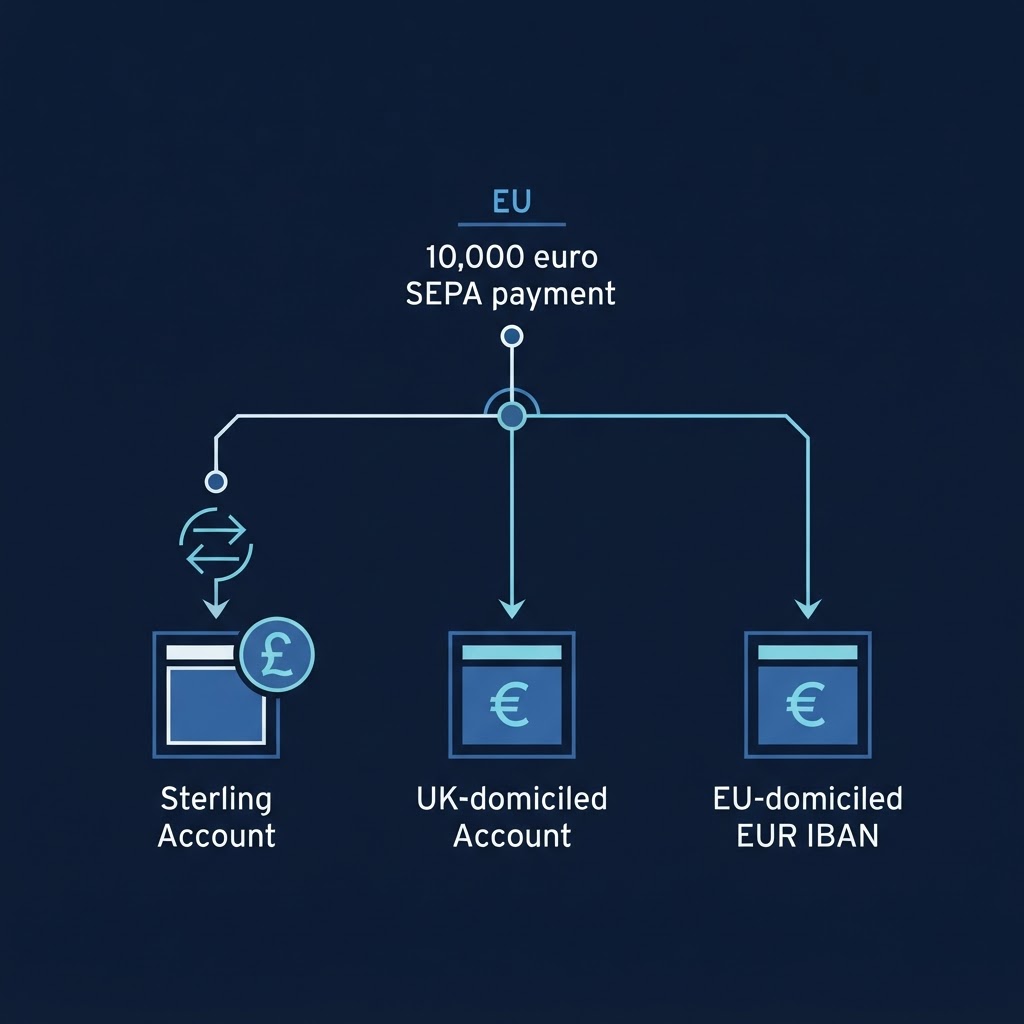
Receiving SEPA payments in the UK is not a question of eligibility. Every mainstream UK bank will take an incoming SEPA credit transfer, and so will the fintech payment accounts. The question that actually costs money is where the euros land. Point an EU customer at a sterling account and the bank converts on arrival at its own rate. Point them at a euro IBAN and you keep the euros and choose when to convert. This guide walks through the three setups a UK business can use, what each one does to a 10,000 euro invoice, the exact details to print on the invoice, and the checks to run when the money arrives. ## The short answer You can receive a SEPA payment into any of three places: a GB IBAN on your sterling account, a euro currency account at a UK bank, or an EU-domiciled EUR IBAN issued by a payment institution. All three are reachable by the same SEPA credit transfer. They differ on three things: whether receiving is free, whether the euros are converted automatically, and whether an EU payer's bank will accept the IBAN without complaint. The rest of this article is those three differences, with the numbers taken from the providers' own tariffs. ## What the scheme guarantees the receiver ### Full original amount, shared charges The SEPA Credit Transfer rulebook lists among its benefits that payments are made for the full Original Amount and that the Originator and Beneficiary are responsible for their own charges. Its charging principle is the shared one: each side is charged separately by its own provider, and the level of that charge is a matter for each participant and its customers. In practice this means the amount that leaves your customer's account is the amount that reaches your provider. Anything that comes off after that is your provider's charge, and it has to be published. ### Credited by the next banking business day The same rulebook obliges the originator's provider to credit the beneficiary's provider within one Banking Business Day of receiving the instruction. The cycle counts business days, not calendar days, and cut-off times are set by the sending bank, outside the rulebook. The version in force is the 2025 rulebook v1.2, which the EPC says replaced v1.1 on 30 September 2026. That same release delayed the date after which unstructured payer addresses are no longer permitted, with a new end date still to be set. For the UK receiver the address rule matters because an EU payer paying a UK IBAN already has to supply one; we cover what changed for payments to the UK after Brexit separately. The instant variant has its own clock. Under the amended SEPA Regulation an SCT Inst must be made available on the payee's account within ten seconds, the rulebook sets a nine second internal target, and the EPC has removed the scheme-level maximum amount, leaving limits to individual providers. The obligation to offer instant payments comes from an EU regulation whose deadlines run from 9 January 2025 for euro area banks to 9 April 2027 for payment and e-money institutions. None of those dates bind a UK provider. Whether your incoming SEPA payment can arrive in ten seconds depends on whether your UK provider has chosen to join the instant scheme, which we examine in SEPA Instant payments and the UK. ## Three ways to receive SEPA payments in the UK ### Setup 1: a GB IBAN on your sterling account This is what most UK businesses already have. Your sterling business account carries a GB IBAN and a BIC, and both can go on a euro invoice. The bank receives the euros and converts them to pounds before crediting your account. Barclays' business tariff puts receiving a SEPA credit transfer, or a euro payment from the EEA, at 0 pounds, and states that its currency conversion charge will be no more than 2 percent for business customers, reducing above 25,000 pounds. TSB charges 2 pounds to receive an electronic payment from abroad up to 100 pounds and 7 pounds above that, waived for euros from qualifying EEA countries, and tells you that a foreign currency credited to a sterling account is calculated at the exchange rate on the day the payment is credited. Royal Bank of Scotland's Bankline tariff lists SEPA credit transfer receipts at 0 pounds, while non-euro receipts cost 1 pound below 101 pounds and 7 pounds from 101 pounds, with the fee deducted from the principal before it credits your account. Starling publishes the clearest arithmetic. Its inbound exchange rate includes a 2 percent margin, so 1,000 euros arriving when the mid-market point is 0.8446 is credited as 827.70 pounds rather than 844.60. Starling also says it cannot tell you the rate in advance; you see it in the transaction feed afterwards. So setup 1 is free to receive and expensive to hold. On a 10,000 euro invoice, a 2 percent margin is 200 euros of value gone on the day the money lands, at a rate you did not pick. The list of banks and what their pages say is in which UK banks accept SEPA payments. ### Setup 2: a euro currency account at a UK bank The same banks will open a euro-denominated account alongside your sterling one. Barclays' tariff is explicit that incoming funds are converted at the day's rate unless you hold a currency account. With a euro account the SEPA payment is credited in euros, and you convert when you choose, or never, if you pay EU suppliers from the same balance. Two things to check before you rely on this. First, the account still carries a GB IBAN, so the payer-side friction some EU banks apply to non-EU IBANs does not go away. Second, a currency account at a high street bank is a separate product with its own fee schedule and eligibility, and that schedule is rarely on the public tariff page. Ask for it in writing. ### Setup 3: an EU-domiciled EUR IBAN from a payment institution Fintech payment accounts issue euro account details through an EU entity. Wise's EUR details, for example, use a Belgian BIC and a Belgian address, carry no fee for domestic EUR receipts, arrive usually within minutes and at most one working day, and hold the money as euros. Wise does not issue localised French or German IBANs, which occasionally matters when a payer's system insists on a domestic one. For UK business customers, account details sit behind a one-time 50 pound setup fee with no monthly subscription. Tide sits between setups 1 and 3. It gives you separate EUR SEPA details, but converts every euro receipt to pounds automatically, charging 1 pound per payment on its Standard plan and a 1.5 percent FX markup that falls to 0.5 percent on its top plan. Read the plan terms before assuming a EUR IBAN means a EUR balance. Setup 3 solves the IBAN acceptance problem and the forced conversion problem at once. What it changes is who holds your money and under which protections, which is the subject of the EXFI section below. ### The three setups side by side | Setup | Fee to receive | Euros converted on arrival? | IBAN country | Published conversion cost | |---|---|---|---|---| | Sterling account at a UK bank | 0 pounds at Barclays and RBS; TSB waives for EEA euros | Yes, at the bank's rate | GB | Up to 2 percent at Barclays and Starling | | Euro account at a UK bank | Per the currency account tariff | No | GB | Only when you convert | | EU-domiciled EUR IBAN (payment institution) | None at Wise for domestic EUR | No at Wise; yes at Tide | BE for Wise | Wise at conversion; Tide 0.5 to 1.5 percent | ## What to put on the invoice A SEPA payment that is rejected or repaired is usually the receiver's fault, because the receiver wrote the invoice. Print these, exactly: 1. Beneficiary name as it appears on the account, not a trading name the provider does not know. 2. IBAN, with spaces every four characters so it survives being typed. 3. BIC. Barclays' tariff notes the SWIFTBIC is optional for SEPA except when the payment is to or from a non-EEA SEPA country, and that banks receiving payments without it are entitled to charge a repair fee. The UK is a non-EEA SEPA country, so include it. 4. Your registered address, because the payer's bank may need it to complete the message. 5. Invoice number in the remittance line, and nothing else, so it reconciles automatically. 6. Charges: SHA. TSB's tariff states that to comply with the Payment Services Regulations 2017 the shared option must be selected for all EEA payments. Put the word on the invoice so your customer's finance team does not pick OUR and pay extra, or BEN and short you. ## Timing: when the euros actually land Count from the moment your customer's bank accepts the instruction, not from the moment the customer presses pay. If the instruction lands after the sending bank's cut-off, the clock starts the next business day. From acceptance, the rulebook gives the sending provider one banking business day to credit yours, and Barclays' own table promises euro payments into a UK or EEA account no later than the end of the next working day. Payment institutions tend to beat that. Wise's observed range for domestic EUR receipts is usually minutes, sometimes up to one working day. If both your provider and your customer's bank are in the SCT Inst register, the payment can arrive in ten seconds on any calendar day, including weekends, which standard SCT never does. ## Five checks when a SEPA payment arrives 1. Amount. It must equal the invoice. SEPA pays the full original amount, so a short credit means either conversion happened or the payment did not travel as SEPA at all, and a SWIFT receiving fee was deducted from the principal. 2. Currency of the credit. Euros on a euro balance, or pounds on a sterling account. If you expected euros and got pounds, your customer used the wrong details. 3. Rate applied. Starling and Tide both show the rate and margin in the transaction detail after the event. Record it; a 2 percent margin on every receipt is a cost line, not noise. 4. Value date. It drives interest, FX booking and the day your accountant recognises the receipt. 5. Remittance reference. If the invoice number arrived intact, the payment reconciles itself. If it did not, fix the invoice template before the next one goes out. ## Where EXFI fits, and what it is not EXFI distributes regulated payment services provided by Gemba Finance Limited (FCA FRN 804853), for UK customers only. The accounts hold balances in GBP, EUR, USD and other currencies, each with its own dedicated IBAN where applicable, so a UK-incorporated business can give an EU customer euro details and keep the receipt as euros. SEPA and UK Faster Payments cost 0.99 pounds, FX is 0.70 percent on major pairs and 0.90 percent on minors, there is no monthly fee for UK-incorporated entities, and accounts are for business customers only. What it is not: EXFI is not a bank. The regulated firm is Gemba Finance Limited; EX Financial Solutions Ltd, company number 17105188, acts only as a distributor of its services. The accounts are payment accounts, not bank accounts, so funds are not covered by the FSCS but are safeguarded in segregated accounts under the Payment Services Regulations 2017. If that distinction is new to you, read safeguarding versus FSCS cover before choosing any setup 3 provider, and see our guide to opening a euro business account in the UK for the comparison of bank and non-bank options. This article is general information about payment schemes and published tariffs, not financial advice. ## FAQ ### Do I need a euro account to receive SEPA payments in the UK? No. Barclays, TSB and RBS all accept SEPA credit transfers into a sterling business account and convert the euros on arrival. A euro account changes what happens to the money, not whether it can arrive. ### Can an EU customer refuse to pay a GB IBAN? Some try. The UK sits outside the EU rule that stops banks discriminating between Union IBANs, so a GB IBAN can be refused by a supplier portal or questioned by a payer's bank. An EU-domiciled EUR IBAN, such as the Belgian one Wise issues, removes the argument. ### Why did my SEPA payment arrive short? Because it was not treated as a SEPA credit transfer on arrival. RBS, for example, deducts its receiving fee from the principal on non-euro international credits. If the payer sent euros through SWIFT instead of SEPA, or sent a non-euro currency, a fee comes off before the credit. True SEPA receipts arrive in full. ### Is there a maximum amount I can receive by SEPA? The SCT scheme sets no cap, and the EPC has removed the scheme-level maximum for SCT Inst too. Any ceiling comes from your provider or your customer's bank, which can set its own transaction limits. ### Can I receive SEPA payments at the weekend? Not by standard SEPA credit transfer, which runs on banking business days only. SCT Inst runs every calendar day, but only if both your provider and the payer's bank participate in the instant scheme.
Back to News
Insights 11 min read15 October 2026
Receiving SEPA Payments in the UK: EUR IBANs, Fees, Timing
Receiving SEPA payments in the UK: three account setups, what to put on the invoice, what banks charge, when euros land and how to keep the full amount.
E
EX FI