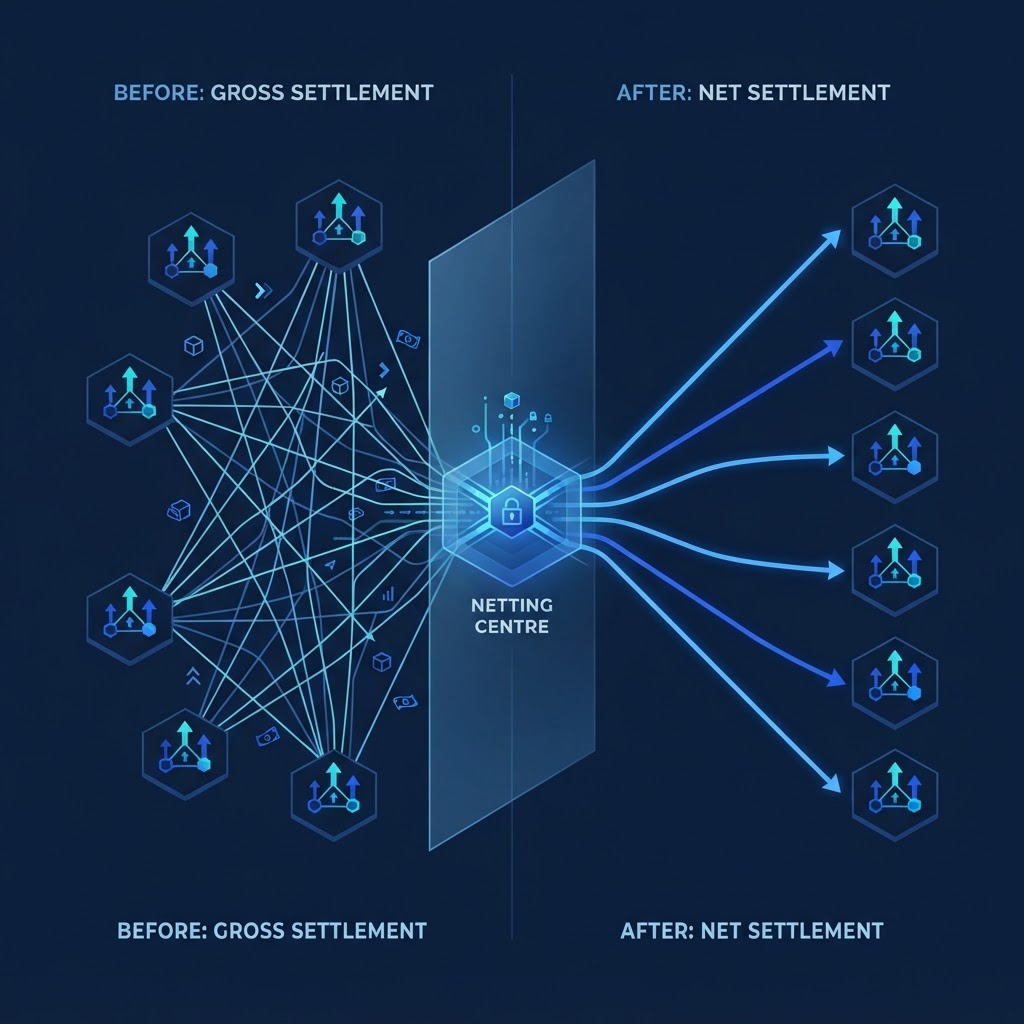
Currency netting software takes every invoice your group's entities owe each other in a month, in every currency, and turns it into one payment in or out per entity, with one FX trade per currency for the whole group. Search for it and you get a page of vendors and banks, each describing its own module. This guide steps back from them: what the software does, whether you need it yet, the five ways it is sold, the features worth paying for, and what it costs.
It assumes you know what netting is. If not, start with our multilateral netting example for the arithmetic and bilateral vs multilateral netting for the two models. For the setup itself (netting agreement, netting centre, monthly calendar, journal entries), see our guide to multilateral intercompany netting.
What currency netting software actually does
Strip the branding away and every product runs the same cycle. Nomentia's description is typical: the system collects intercompany obligations from ERP and manual inputs, runs bilateral and multilateral netting calculations, and distributes statements for entity confirmation and dispute handling. PNC breaks its bank-hosted version into four steps: organise, compile data, net payments, reconcile, after which each entity pays or receives one net amount in its functional currency.
In practice that means:
- •Collect. Entities load intercompany payables and receivables for the cycle, by ERP interface or file.
- •Match. The system pairs each payable with the counterparty's receivable and flags differences before the cut-off.
- •Convert. Agreed items are converted at the cycle's rate so positions in different currencies can be added up.
- •Net. Each entity ends with a single position. The positions sum to zero.
- •Deal FX once. The netting centre aggregates by currency and trades only the residual.
- •Settle and book. Net payers pay, net receivers are paid, and the entries that clear the intercompany balances go back to the ledgers.
The currency part is where the money is. Ripple Treasury, built on GTreasury, describes the effect plainly: by matching FX exposures and aggregating non-matched exposures, your netting center can trade larger volumes at better rates. Instead of each subsidiary buying euros for each invoice, the group buys the net amount once.
Do you need software yet?
Not every group does. A spreadsheet can net five entities in two currencies perfectly well. The question is when it stops being enough.
PaymentsJournal summarises the thresholds Coprocess published from its survey of treasurers. Netting is clearly advantageous if two or more of these apply, and offers little if the group sits at the low end on most of them:
| Factor | Netting offers little | Netting clearly pays |
|---|---|---|
| Entities | Three or fewer | Double digits |
| Intercompany payments a year | Under 5 million USD | Over 20 million USD |
| Share of those payments needing FX | Under 10 percent | Over 20 percent |
| Currencies | One or two | Three or more |
The adoption data points the same way. In the underlying Coprocess survey, 45 percent of companies used a centralised netting system, and groups with six or more currencies and at least 11 percent of payments involving FX adopted one at a rate of 68 percent. Volume matters as much as structure: a peer group of corporate treasurers reported by treasuryXL treated more than 1,000 transactions a month as low volume and said some kind of system is usually needed beyond that.
Why do groups stay on spreadsheets? In the AFP/gtnews treasury technology survey, organisations without a treasury system most often cited the cost versus benefit of a system (36 percent) and the flexibility of Excel (25 percent). Both are fair reasons at low volume. The signs that the spreadsheet has become the bottleneck are practical ones: the cut-off slips every month because entities argue over mismatched invoices by email, nobody can show auditors which version of the file was settled, and FX is still bought entity by entity because the group never sees its net position in time.
Five ways netting software is delivered
"Netting software" covers very different products. The first decision is the delivery model, not the vendor. The names below are examples of each model, not a ranking.
A module inside a treasury management system
Most treasury management systems offer netting as one module among cash positioning, forecasting and payments. Datalog's TMS module, for example, centralises all flows between subsidiaries, calculates the net balance for each and makes a single consolidated payment. Nomentia sells netting inside its treasury suite and routes settlement to its payment module or in-house bank. This model suits groups already buying a TMS: the netting data, FX exposures and payments sit in one place. Our guide to the best treasury management software covers that wider purchase.
A specialist netting platform
Some products are built around netting first. Ripple Treasury's netting, powered by GTreasury, offers receivable driven, payable driven and settle only matched runs and can pull third-party vendor payments into the cycle. Corpay pitches its Netting Manager as a way to reap the benefits of intercompany netting while avoiding the expense of an outsourced solution, run as self-service. Specialist platforms tend to be deepest on matching, disputes and run options, and can sit beside whatever ERP and banks you already use.
A bank-hosted netting service
Several banks run netting for corporate clients. PNC offers configurable full, gross, currency or hybrid calculations with dual approval. ING, through Bank Mendes Gans, offers a fully outsourced process and says clients achieved reductions in payments and FX costs of between 55 and 80 percent on average, settling in up to 37 currencies and over 70 countries over the client's existing accounts. That figure is the bank's own claim about its clients, not a benchmark for yours. The trade-off with a bank service is that the FX usually goes to that bank, so compare its rates against what the group could get elsewhere.
Netting inside an intercompany accounting suite
Close and reconciliation platforms have moved into settlement. BlackLine's Intercompany Net & Settle keeps intercompany activity in a virtual subledger, applies country-specific multilateral netting rules and factors in withholding taxes, then issues payment instructions in SWIFT, PAIN or ACH formats. This model suits groups whose real pain is intercompany reconciliation at month end, with settlement as the second problem.
Virtual accounts instead of a netting cycle
The newest option removes the cycle altogether. J.P. Morgan describes virtual netting: each entity settles intercompany invoices one by one against a virtual account held with the group's in-house bank, using normal ERP payment runs, without touching the banking system. It suits large groups with an in-house bank already in place, and the same article lists the right questions for any purchase: time to return on investment, ongoing operating cost, integration effort and professional services.
How integrated is netting in practice? Not very. Citi's treasury diagnostics found that almost one in three companies (32 percent) operate a netting centre without an integrated TMS or ERP module to manage the net obligations, and almost one in three have fewer than half of their eligible entities taking part.
The feature checklist
The vendor pages above describe much the same functions. Read across them and this is the list to test against:
| Feature | Why it matters |
|---|---|
| Receivable driven, payable driven and settle only matched runs | Decides who controls what settles; Coprocess calls receivable driven the most efficient model |
| Automatic matching with mismatch drill-down | Matching, not calculation, is where the monthly work is |
| Online dispute discussion with notifications | Replaces the email chains that delay the cut-off |
| Entity confirmation of statements | Each entity approves its position before settlement |
| Rate source control and residual FX export | Lets treasury hedge only the net exposure |
| Configurable calendar and cycle frequency | Monthly is common; some groups need more often |
| ERP import and export | Feeds data in and posts clearing entries back |
| Dual approval and role-based access | Basic payment control |
| Payment file output (SWIFT MT, ISO 20022 PAIN) | Net settlements go to your bank or account provider |
| Country rules and withholding tax handling | Some jurisdictions restrict netting or require gross reporting |
| Gross vs net savings reporting and audit trail | Proves the case to the CFO and the auditor |
Do not judge a system only on its calculation engine. A treasury practitioner writing in The Global Treasurer estimated that around 40 percent of the costs saved by netting come from fewer transaction fees and 60 percent from better payment discipline and adjacent processes such as reconciliation and dispute handling. The matching and dispute tools are where that 60 percent is won.
Scope is the other test. PNC lets clients include risk management hedges, royalties, foreign earnings repatriations and intercompany loan payments alongside trade invoices, and several platforms can fold third-party vendor payments into the run. The more flows a system can take, the more value one cycle captures.
What it costs, and what pays for it
Vendors rarely publish netting prices, and we will not guess. The most specific public figure is old: a 2004 Global Treasurer article put a netting licence at 30,000 to 70,000 USD as a module of a larger system, with standalone systems rented annually for about the same. Treat it as history, not a quote. Pricing today is usually subscription based and tied to entities, modules and implementation work; our guide to treasury management software pricing covers how those quotes are built.
The benefit side is easier to list than to promise. Coprocess suggests looking for direct savings in value dating, FX costs, bank transfer fees and lifting fees, then adding the administrative cost of chasing missing payments, resolving problems and reconciling invoices. Datalog reports one industrial group with more than 100 subsidiaries achieving a 30 percent reduction in processing costs after deploying its module. Your own case comes from your own numbers: count last year's intercompany payments, their fees and the FX margin paid on each, then compare that with one payment per entity and one trade per currency.
Questions to ask on a demo
- •Which run model does it support: receivable driven, payable driven, settle only matched, or all three?
- •How are mismatches shown, and can entities dispute an item and push it to the next cycle?
- •Where do the FX rates come from, and can we deal the net trades with any provider?
- •What does it post back to our ERP, and in what format?
- •How does it handle a jurisdiction that restricts netting or requires gross reporting?
- •What share of our entities can realistically join in year one, and what blocks the rest?
- •What is the full cost over three years, including implementation and internal staff time?
Where the account layer fits
Netting software calculates. It does not hold money. Every model above still ends with real payments: net payers pay the netting centre and net receivers are paid by it, each in its own currency. That means the netting centre needs accounts in every currency it receives and pays, or it converts money in only to convert it straight back out.
EXFI is that account and payment layer, not a netting engine. A multi-currency business account holds balances in 16 or more currencies, including GBP, EUR, USD, CHF and PLN, each with its own dedicated IBAN where applicable. Transfers between your own entities' EXFI accounts are free; SEPA and UK Faster Payments cost 0.99 GBP, international SWIFT 26.40 GBP, and FX is 0.70 percent on major pairs and 0.90 percent on minors. Whichever netting tool calculates the positions, the settlements it produces can run over those accounts. For the broader picture of moving money between your companies, read our guide to intercompany payments.
Regulated payment services provided by Gemba Finance Limited (FCA FRN 804853). UK customers only. EXFI is a trading name of EX Financial Solutions Ltd, which acts as a distributor of those services and is not itself authorised by the FCA. EXFI accounts are payment accounts, not bank accounts: funds are not covered by the FSCS and are safeguarded in segregated accounts under the Payment Services Regulations 2017. This article is general information, not financial, tax or legal advice.
FAQ
Is currency netting software the same as a treasury management system?
Not always. Netting is often sold as a module of a treasury management system, but it is also available as a specialist platform, as a service hosted by a bank, or inside an intercompany accounting suite. A group can buy netting without buying a full TMS.
Can a small group run netting in Excel?
Yes, at low volume. With three or fewer entities, one or two currencies and little FX, a well-controlled spreadsheet is usually enough. The case for software grows with entity count, currencies, the FX share of intercompany payments and the number of monthly transactions.
Does netting software execute the FX trades?
Usually not by itself. It calculates the net position in each currency and exports it, or routes it to a dealing or payment module. The trade is then executed with a bank or payment provider, which is why rate source and provider choice matter.
What can be included in a netting run besides invoices?
Depending on the system, intercompany loans and interest, royalties, management fees, hedge settlements, dividends and even third-party vendor payments. Check each flow against local rules before including it.