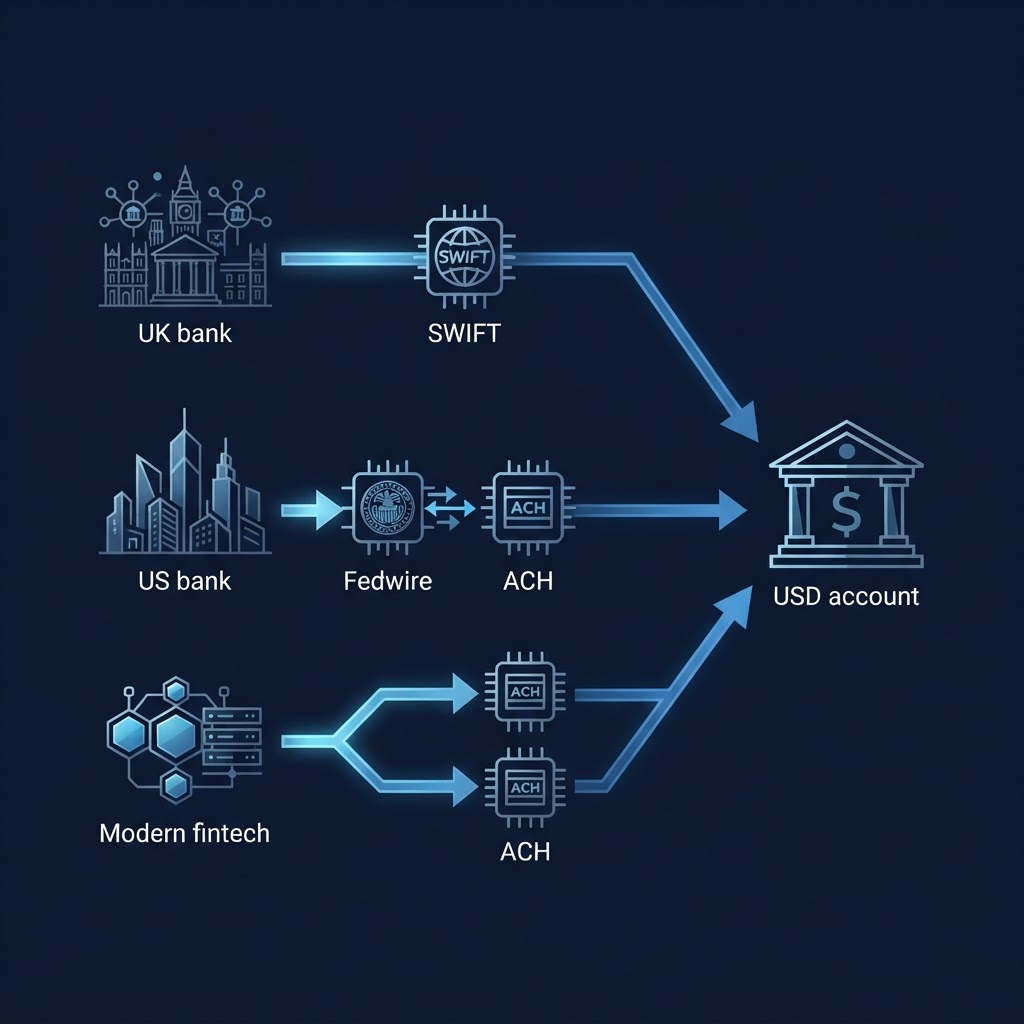
If you want to open a USD business account as a UK company, the application is the easy part. The hard part is choosing between three products that all call themselves a "dollar account" but behave very differently once a US customer tries to pay you. Some give you a US routing number and nothing else. Some reach only SWIFT. Some are bank deposits, others are safeguarded payment accounts. This guide sorts the three routes, shows the two checks that decide which one fits, and then walks through the opening process.
First decide which USD account you actually need
There are three routes, and most UK businesses only need one of them.
Route 1: a US bank account. This is a real American bank account, opened with an American bank. It is the hardest route. Airwallex's guide to opening a US business bank account from the UK explains why: Patriot Act identity rules mean US banks typically want a Social Security Number or ITIN, a verified physical US address that is not a P.O. box, and often a branch visit in person. US-focused fintechs are not much looser on structure: Mercury and Relay require a US-registered entity with an EIN. If you have not formed a US LLC or corporation, this route is effectively closed.
Route 2: a USD account at a UK bank. Your high-street bank may offer a currency account next to your sterling one, but with conditions. WorldFirst reports that Barclays asks for 12 months of trading and HSBC requires an existing business account, and it puts the conversion margin at roughly 2.6 percent at Lloyds and 3 to 5 percent at many high-street banks. Some challenger banks sit here too. Starling's USD business account costs 5 GBP a month, is open to limited companies only, and at the time of writing its page said it was not accepting new applications.
Route 3: USD account details from a fintech or payment institution. This is where most UK exporters end up. You stay a UK company, apply online, and receive USD details in your company's name. Wise lists a US routing (ABA) number and account number with no local address needed. WorldFirst says approval typically takes 48 hours and that it accepts sole traders as well as limited companies.
| If you... | You probably need |
|---|---|
| Already have a US LLC or corporation with an EIN | Route 1, or a US fintech |
| Are a UK Ltd billing US clients or paid by US platforms | Route 3 |
| Want USD next to an existing bank relationship and FSCS cover | Route 2, if you meet the bank's conditions |
The table is the start, not the answer. Two checks decide whether a specific account works for you.
The detail that decides everything: which US rail your account reaches
"Receive USD" can mean three different payment rails. Before you apply anywhere, ask which ones the account details actually reach.
ACH routing number: local, batched, cheap
ACH is the US domestic network for batched electronic debits and credits. The Federal Reserve's FedACH service settles these between US financial institutions, including a same-day option. US marketplaces, payroll tools and most American customers paying an invoice default to ACH, and they need a US routing number and account number to do it. Starling's USD account is built on this rail: an ACH routing number, same-day ACH up to 25,000 USD, and no per-payment charge.
Fedwire: the same-day US wire
Fedwire is the US real-time gross settlement system. The Fedwire Funds Service gives same-day transfers with finality, because payments settle in Federal Reserve master accounts. A US client paying a large invoice by "wire" usually means this. Not every USD account can receive it: Starling's page states plainly that its USD account cannot send or receive wire transfers or SWIFT payments, while Airwallex says its USD Global Account comes with both ACH and Fedwire routing numbers.
SWIFT: the international fallback
SWIFT is how USD moves between banks in different countries, through correspondent banks. It works almost everywhere but is slower and fee-bearing; our explainer on cross border payments over SWIFT covers who pays which fee. If an account reaches USD only by SWIFT, a US customer sends you an international wire rather than a domestic payment.
The practical test: ask the provider which of the three your company's USD details accept, inbound and outbound. A freelancer paid by a US platform needs ACH. A firm paid by US corporates may also need Fedwire. A firm buying from suppliers in Asia that invoice in dollars may only need SWIFT.
Who holds your dollars: deposit or safeguarded payment account
The second check is the one almost no dollar-account page puts on the table.
At a bank, your USD balance is a deposit. Starling says eligible deposits are covered up to 120,000 GBP by the Financial Services Compensation Scheme. At a fintech, your balance usually sits with an e-money institution or a payment institution. The FCA's guidance on payment service providers is direct: if a non-bank provider fails, your money is not protected by the FSCS. EMIs and authorised payment institutions safeguard it instead, in a separate account at a bank or with an insurance policy or guarantee, so you should get most of it back, but it may take time and may not be the full amount.
The FCA also warns that brand names are often not the name on its register. Look for the firm behind the brand, usually in the website footer or the terms, and check that firm on the Financial Services Register. Neither model is "safe" or "unsafe" by default; they protect you differently. We break down the mechanics in safeguarding vs FSCS.
How to open a USD business account from the UK, step by step
For Route 3, the most common path, the process looks like this.
- •Check your Companies House record first. Hollis and Co advise that the company name on the application must match Companies House exactly, including "Ltd" or "Limited", and that mismatches are a common cause of delay. Confirm directors and Persons with Significant Control are current.
- •Prepare ID for every individual. Expect photo ID and recent proof of residential address for each director and each Person with Significant Control.
- •Describe your dollar flows. Who pays you in USD, who you pay, rough monthly volumes and which countries. Vague answers here are what trigger follow-up questions.
- •Ask the rail and protection questions above before you submit, not after you are approved.
- •Apply online and answer any requests for information quickly. Then send a small test payment before you hand the details to clients.
If you are taking Route 1 with a US entity, the document set is bigger: EIN confirmation letter, Articles of Organization and Operating Agreement for an LLC, and proof of business activity, which GlobalSolo notes has mattered more since 2025. For the full document pack by entity type and what stalls reviews, see how to open a multi currency account.
Where EX FI fits, stated exactly
EX FI sits in Route 3. Its accounts hold balances in GBP, EUR, USD and 13 or more other currencies and reach SWIFT, SEPA, FPS, BACS and CHAPS. Published pricing: no monthly fee for UK-incorporated entities, no opening fee, no minimum balance, international SWIFT payments at 26.40 GBP, internal transfers free, and FX at 0.70 percent on major pairs. Applications are reviewed within 24 to 48 hours with online KYC.
Two things we will say plainly. First, on headline conversion margin EX FI is not the cheapest name in this article; WorldFirst quotes 0.3 percent for new customers rising to 0.50 percent. Second, EX FI's published materials list SWIFT as the rail for international payments and do not advertise a US ACH routing number. If your main need is getting paid by US platforms over ACH, ask before you apply. If you pay and get paid in dollars across borders, alongside euros and sterling, it is built for that.
On the regulatory side: regulated payment services are provided by Gemba Finance Limited (FCA FRN 804853), and EX FI serves UK customers only. EXFI is a trading name of EX Financial Solutions Ltd, which is not itself authorised by the FCA and acts as a distributor of Gemba's payment services. EX FI accounts are payment accounts, not bank accounts: funds are not covered by the FSCS and are safeguarded in segregated accounts under the Payment Services Regulations 2017. If you are weighing this against your existing bank, our look at foreign currency business accounts at UK banks covers what those pages leave out.
FAQ
Can a UK limited company open a USD account without a US entity?
Yes. UK bank currency accounts and fintech USD details are both open to UK companies with no US entity. Wise, for example, accepts UK Ltd companies. A US entity with an EIN is only needed for US banks and US-focused fintechs such as Mercury and Relay.
Can sole traders open a USD business account in the UK?
It depends on the provider. Starling's USD business account is for limited companies only. WorldFirst says it accepts sole traders and freelancers, subject to its compliance checks.
Will USD account details work for Amazon or Shopify payouts?
US platforms generally pay out over local US rails, so you want details with an ACH routing number. Airwallex names Amazon and Shopify as platforms its USD Global Account can receive from. An account that reaches USD only by SWIFT may not be accepted as a payout destination.
Do I have to convert dollars to pounds when they arrive?
Not if the account holds a USD balance. WorldFirst notes that some banks convert incoming dollars automatically at a rate you do not see in advance; with a held balance, you convert when you choose.