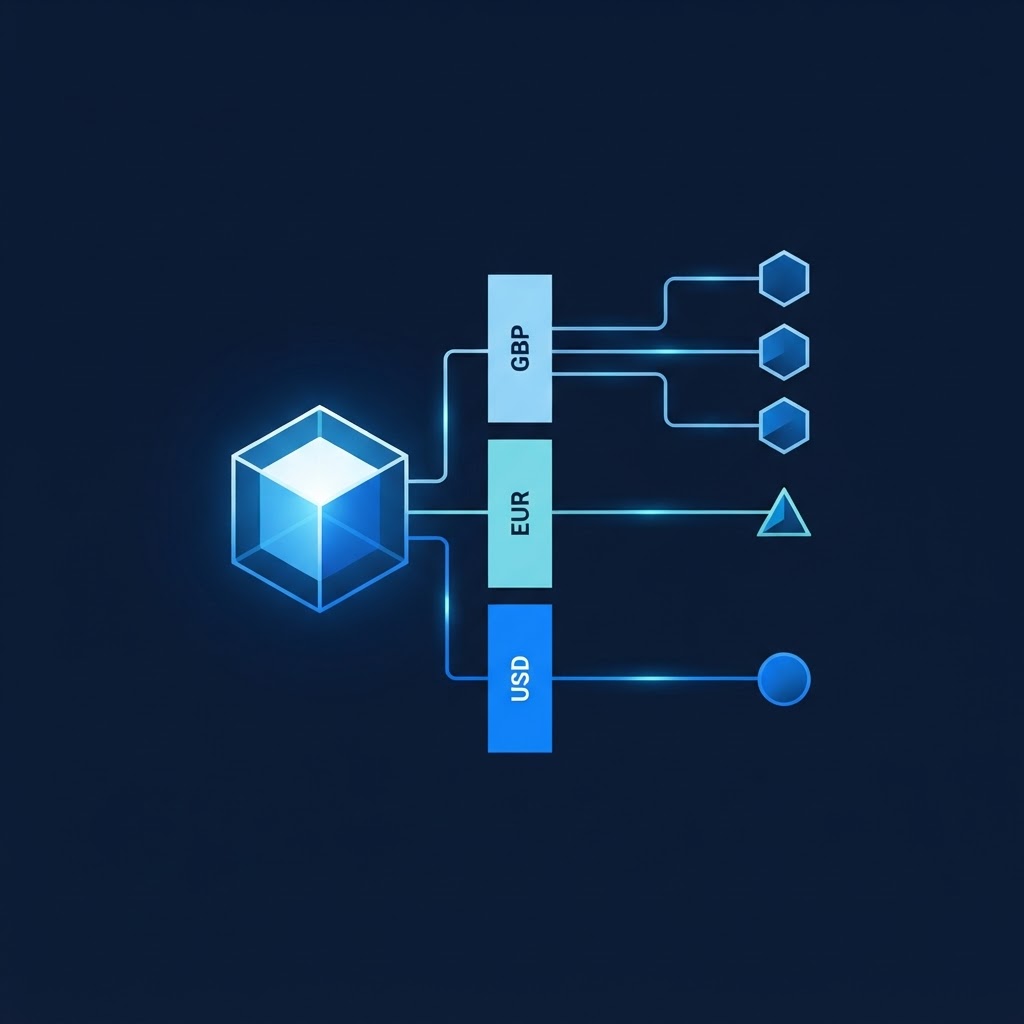
A multi currency business account in the UK is sold on a list of features: forty currencies, local details, instant transfers. The list tells you very little. What decides whether the account saves you money is plumbing. Which payment rail each currency actually rides. What kind of account details sit behind each balance. And where the cost is taken, which is rarely the line marked "fee".
This guide walks through that plumbing for a UK incorporated business, rail by rail, with primary sources wherever they exist. If you want the shortlist and the scoring method instead, read how to compare UK providers. This page is the part underneath it.
What the account actually is
One account, several balances, one per currency. You receive in a currency, hold it without converting, and convert only when you decide to. Where the provider offers it, each balance comes with its own receiving details, so a payer in that currency pays you the way they would pay a local supplier. Wise Business, for example, lists a UK sort code and account number, a euro IBAN, a US routing number and an Australian BSB code as separate sets of details.
Two things follow from that definition. First, the value is in the details and the rails behind them, not in the number of currencies you can hold. Second, most providers in this market are payment or e-money institutions rather than banks, which changes how your balance is protected. That distinction is covered in safeguarding versus FSCS, and the general definition in what a multi currency business account is.
Sterling: three rails, three jobs
Your GBP balance should come with a UK sort code and account number. Those details connect to three domestic systems, and each one does a different job.
Faster Payments
Faster Payments is the default for day to day sterling. Pay.UK describes it as available day and night, 365 days a year, supporting real time payments of up to £1m, and reports 5.55 billion transactions worth £4.84 trillion in 2025. The £1m is the scheme ceiling. Your provider will set its own limit, often much lower, so check it before you rely on it for a supplier run.
Bacs
Bacs is the batch rail, and it is how Direct Debits and Direct Credits move. Pay.UK's Bacs figures show 6.86 billion payments worth £6.05 trillion in 2025, including 5.0 billion Direct Debits. If you collect subscriptions, pay suppliers who want Direct Debit, or run payroll through a bureau, Bacs access matters more than any headline currency count.
CHAPS
CHAPS is for high value, time critical sterling. The Bank of England calls it a same day system, usually open 6am to 6pm Monday to Friday, and describes CHAPS payments as irrevocable: once sent, they cannot be recalled. It also notes that thousands of institutions reach CHAPS indirectly through a small group of direct participants. That is normal, but it is worth asking your provider how it connects and what the cut off time is.
A useful test: if a provider's page says "UK payments" without naming Faster Payments, Bacs and CHAPS separately, ask which ones you actually get.
Euros: the IBAN question
This is where UK accounts most often surprise people. Kaeltripton points out that UK banks stopped being direct SEPA participants when the UK left the EU, so euro payments from a traditional UK bank usually travel through correspondent banks rather than as a simple SEPA transfer. Its figures put a SWIFT euro transfer from a UK bank at around £15 to £30 plus the FX margin, against pence for a SEPA credit transfer inside the eurozone.
Specialist providers fix that with a euro balance that can send and receive over SEPA directly. The detail to check is the IBAN itself. A financeb2b review of one UK payment institution's stack lists a GB format IBAN that receives SEPA Credit Transfers and SEPA Instant, and then flags the catch: some SEPA payers still reject IBANs that are not from their own country. That practice is known as IBAN discrimination and is technically prohibited, but the review says it still occurs.
So the practical questions for your euro balance are:
- •Is the IBAN in your company's own name, or a pooled account with a reference?
- •Which country code does it start with?
- •Does it receive SEPA Instant, or standard SEPA only?
If your euro customers are large corporates with rigid supplier onboarding, question 2 can matter more than the fee table. For the difference between the codes themselves, see IBAN vs SWIFT vs BIC, and for what a dedicated IBAN in your own name involves, business IBAN account.
Everything else: SWIFT and who pays the fee
Currencies without a local rail on your account move over SWIFT. The same financeb2b review lists SWIFT transfers at 1 to 4 days with three charge options:
- •OUR: you pay all fees.
- •SHA: fees are split, you pay yours and the recipient pays theirs.
- •BEN: the recipient pays everything.
The review also notes that even under OUR, banks in the correspondent chain can take their own deductions, so the beneficiary sometimes receives slightly less than you sent. That is an industry wide feature of SWIFT, not a quirk of one provider. If an invoice has to be settled to the penny, agree the charge option with your supplier up front.
On price, Kaeltripton puts SWIFT fees at the large UK banks at £15 to £40 per transfer. That is the number most people remember, and it is usually not the biggest one.
Where the cost actually sits
WorldFirst's UK guide breaks the cost of an international account into five parts: the monthly fee, the FX markup on each conversion, foreign transaction fees on card spend, ATM charges, and deductions taken by banks in the middle of a transfer. Its own illustration makes the point cleanly: a "£0 transfer" at a 2.5% spread costs far more than a £10 transfer at 0.4%.
Kaeltripton's range for the big UK banks is a 2 to 3 percent FX margin on top of the flat SWIFT fee. At that level, the margin on a single mid sized conversion outweighs a year of monthly fees.
That gives you a simple way to read any UK provider:
- •Take last quarter's statements. List every conversion and every outgoing international payment.
- •Apply the provider's published FX rate for each currency pair to the converted amounts.
- •Add the per payment fee for each rail you used, SWIFT separately from SEPA and Faster Payments.
- •Add the monthly fee and any card charges.
The number at the bottom is the one to compare. The full comparison method, with worked arithmetic, is in how to compare UK providers. If you currently bank with a high street lender, what the UK banks do not show you covers why their FX margin is often hard to find at all.
Where EX FI fits, stated exactly
EX FI is a provider in this market, so read this section as a provider describing itself.
According to exfi.app, EX FI accounts hold balances in GBP, EUR, USD, CAD, CHF, DKK, NOK, SEK, PLN, HKD, SGD, ZAR, CNY and more, each with a dedicated IBAN where applicable, and reach SWIFT, SEPA, Faster Payments, Bacs and CHAPS. Published FX conversion is 0.70% on major pairs and 0.90% on minors. Regulated payment services are provided by Gemba Finance Limited (FCA FRN 804853), UK customers only.
The EX FI Impressum sets out the structure. EXFI is a trading name of EX Financial Solutions Ltd, which is not itself authorised by the FCA and acts as a distributor of payment services provided by Gemba Finance Ltd. EX FI accounts are payment accounts, not bank accounts. Funds are not covered by the FSCS; they are safeguarded in segregated accounts under the Payment Services Regulations 2017.
Apply the same questions to us as to anyone else: which country code your euro IBAN carries, what your Faster Payments limit is, and what last quarter would have cost at our published rates. Ask before you open, not after.
FAQ
Can a UK multi currency business account receive SEPA Instant payments?
Some can. It depends on how the provider connects to SEPA. The financeb2b review above lists SEPA Instant receipt on a GB format IBAN, with near instant arrival only where the payer's bank also supports it. Ask your provider directly rather than assuming.
Is there a limit on Faster Payments from a business account?
The scheme itself supports payments up to £1m, per Pay.UK. Each provider sets its own limit within that, often lower and sometimes different for new accounts, so check yours before scheduling a large supplier payment.
Do I need a multi currency account if my bank already gives me an IBAN?
Not necessarily, but they are different things. The GB IBAN on a sterling account identifies that account internationally. It does not give you local euro or dollar receiving details, so foreign currency payments into it are usually converted on arrival or routed over SWIFT.
Do foreign currency balances affect my UK tax return?
They can. Kaeltripton notes that UK companies holding foreign currency balances must account for exchange gains and losses in their corporation tax return. This is not tax advice; speak to your accountant about how it applies to your company.